Tags
#Self Preservation
Quotes: 22
Quotes tagged #Self Preservation

Protecting Peace as an Essential Form of Survival
Ultimately, the force of the quote lies in its realism. Survival is not only about dramatic crises; often it is about the daily choices that keep a person emotionally intact. A worker who refuses after-hours messages, a caregiver who asks for respite, or a student who takes distance from harmful friendships is not acting selfishly. Each is making a decision that prevents depletion from becoming damage. For that reason, Chödrön’s message is both comforting and corrective. It gives moral permission to step back without shame, while also naming a truth many learn too late: when peace is repeatedly sacrificed, the self begins to disappear. Protecting it, then, is not a retreat from responsibility, but the foundation that makes any responsible life possible. [...]
Created on: 3/17/2026

Boundaries as Self-Preservation, Not Exclusion
Building on that reframing, boundaries aren’t necessarily about creating more distance; they’re often about defining the terms of connection. A boundary can sound like, “I can talk, but not late at night,” or “I want to help, but I can’t take this on alone.” In that sense, it is less a barrier than a blueprint for sustainable relationship. Paradoxically, clear boundaries can make intimacy safer. When expectations are named, people don’t have to guess where the edge is—and you don’t have to rely on resentment to signal that you’ve been pushed too far. [...]
Created on: 3/15/2026

Self-Care as Resistance and Self-Preservation
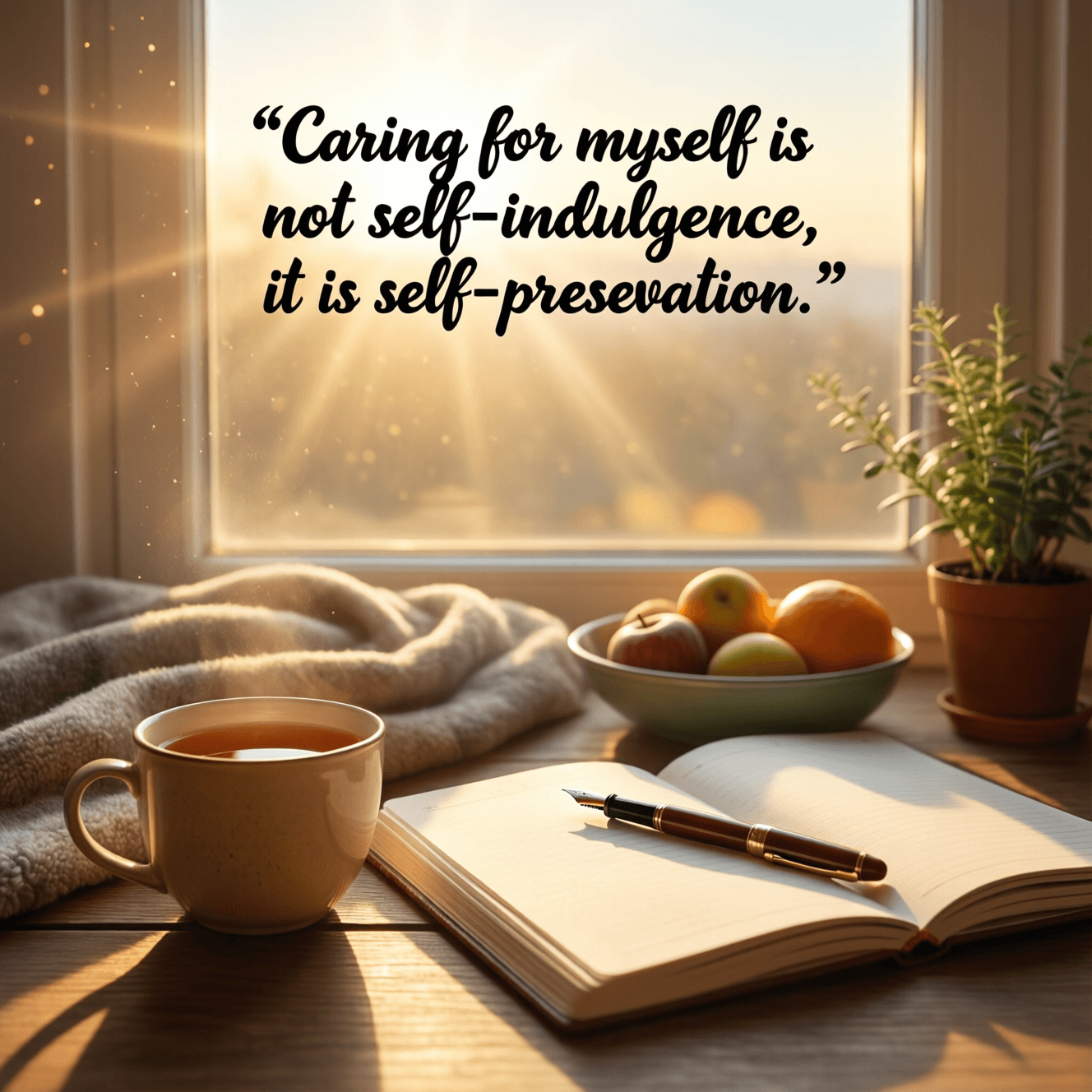
Moving from principle to practice, Lorde’s idea naturally extends to boundaries. Self-preservation often looks less like pampering and more like saying no, leaving harmful spaces, limiting contact, or insisting on respect. These actions can feel “indulgent” only because many people are trained to equate goodness with compliance, especially those expected to carry others’ emotional labor. Yet boundaries are one of the clearest ways to preserve a life. They reduce chronic stress, prevent resentment, and make relationships more honest. In this light, Lorde’s quote validates the quiet, difficult choices—ending a draining obligation, turning off the phone, declining an unpaid task—that protect health and dignity even when they disappoint others. [...]
Created on: 2/3/2026

Self-Care as Survival, Not Indulgence
Finally, Lorde’s sentence offers an ethic that scales from the intimate to the lifelong: treat yourself as someone worth sustaining. This does not deny pleasure or joy; it simply refuses to let care be dismissed as vanity when it is actually maintenance. In that way, “self-preservation” becomes both a personal practice and a moral stance. Taken together, her words invite a lasting shift—from earning rest to needing it, from proving toughness to honoring limits. The goal is not indulgence, but continuity: the ability to keep living, loving, and contributing without losing oneself in the process. [...]
Created on: 2/3/2026

Self-Care as Survival, Not Indulgence
Building on that shift in meaning, Lorde’s words also carry a political charge. In “A Burst of Light” (1988), she describes self-care as “an act of political warfare,” linking personal maintenance to resisting systems that profit from exhaustion and silence. Seen this way, self-preservation is not merely a private preference but a strategic stance: if you are worn down, you are easier to control, exploit, or ignore. By staying well enough to think, speak, and act, the individual keeps access to agency—especially when society subtly rewards self-neglect in the name of duty or toughness. [...]
Created on: 2/2/2026

Self-Care as Survival, Not Selfishness
From there, the quote implicitly disputes the idea that caring for yourself and caring for others are opposing duties. The accusation of “self-indulgence” often assumes a zero-sum moral economy: any attention paid inward is attention stolen from family, community, or work. Lorde rejects that premise by tying self-care to continued capacity. In everyday life, this looks less like grand self-focus and more like sustainable limits—sleeping enough to think clearly, taking a break before resentment hardens, seeking support before crisis hits. Rather than shrinking responsibility, such practices can expand what a person is able to give over time, replacing heroic exhaustion with steadier, more honest contribution. [...]
Created on: 2/1/2026

Self-Care as Survival, Not Selfishness
Finally, Lorde’s statement asks for discernment: not every pleasant act is preservation, and not every hard act is neglect. Preservation can be humble—drinking water, taking a walk, turning off the phone, eating real food, asking a friend for help, or leaving a space where you are routinely diminished. The point, in the end, is not to curate a perfect routine but to protect the conditions that make a life possible. By naming self-care as self-preservation, Lorde gives moral permission to survive—and suggests that survival, especially under strain, is not a private luxury but a serious and often courageous commitment. [...]
Created on: 1/30/2026