
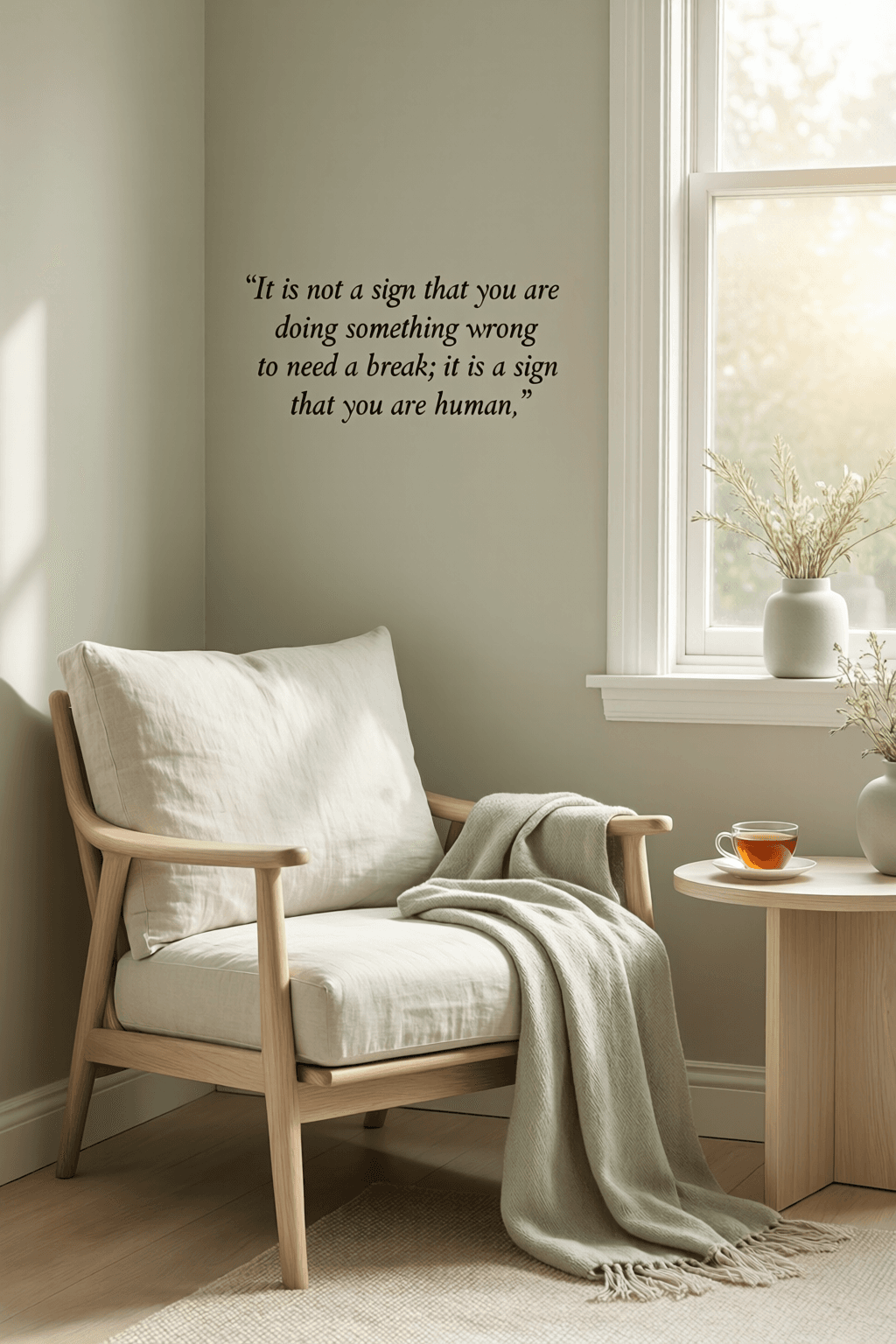
It is not a sign that you are doing something wrong to need a break; it is a sign that you are human. — Nedra Glover Tawwab
—What lingers after this line?
Rest as a Human Reality
At its core, Nedra Glover Tawwab’s quote rejects the harsh belief that constant productivity is the measure of worth. Instead, it reframes the need for a break as evidence of our basic humanity: bodies tire, minds overload, and emotions require space to settle. What feels like failure is often simply fatigue speaking in a language we have been taught to ignore. In this way, the statement offers immediate relief. Rather than treating exhaustion as a moral flaw, it invites us to see it as a natural limit built into human life. That shift matters, because once rest is understood as normal, guilt begins to loosen its grip.
Challenging the Culture of Overwork
From there, the quote also speaks to a broader cultural problem: many societies reward endurance while quietly shaming pause. The modern ideal of being endlessly available can make even a short break feel selfish, yet historians of labor have long shown the cost of this mindset. For instance, Bertrand Russell’s essay “In Praise of Idleness” (1932) argues that a life organized entirely around work impoverishes both joy and thought. Seen in that light, Tawwab’s words become gently rebellious. They push back against the idea that burnout is proof of commitment, suggesting instead that overextension is not noble when it erodes the person doing the work.
The Psychology of Permission
Moreover, the quote functions like a form of emotional permission. Many people do not merely need rest; they need reassurance that rest is allowed. This is especially true for those shaped by perfectionism, caretaking roles, or anxiety, where slowing down can trigger shame rather than relief. Psychological research supports this need for self-compassion. Kristin Neff’s work on self-compassion, including Self-Compassion (2011), emphasizes that recognizing one’s struggles as part of the shared human experience reduces harsh self-judgment. Tawwab’s phrasing does exactly that: it normalizes the break by placing it within the common condition of being human.
Breaks as a Form of Wisdom
Once that permission is granted, a break no longer looks like avoidance; it begins to look like wisdom. Rest can interrupt spirals of irritability, careless mistakes, and emotional depletion before they deepen into something harder to repair. In other words, stepping back is often what allows a person to return with steadier attention and better judgment. This practical truth appears in both science and ordinary life. Studies on cognitive fatigue consistently show that sustained effort without recovery reduces performance and decision quality. Thus, Tawwab’s insight is not merely comforting language; it is a realistic reminder that pauses protect our capacity to function well.
Compassion in Everyday Life
Finally, the quote carries an ethical dimension: if needing a break is human, then extending grace to ourselves and others should also be human. A tired parent, an overwhelmed student, or an exhausted colleague may not be failing at life; they may simply be reaching a limit that deserves acknowledgment rather than criticism. By ending on humanity rather than achievement, Tawwab restores dignity to ordinary vulnerability. Her message encourages a gentler rhythm of living, one in which breaks are not signs of weakness but small acts of respect for the mind and body that carry us through the world.
Recommended Reading
As an Amazon Associate, we earn from qualifying purchases.
One-minute reflection
Where does this idea show up in your life right now?
Related Quotes
6 selectedRest is not the opposite of productivity. It is a vital part of it. Sustainable well-being requires cycles of effort and restoration. — Michelle Pearce
Michelle Pearce
At first glance, Michelle Pearce’s statement challenges a deeply ingrained modern assumption: that productivity and rest are enemies competing for the same limited time. Instead, she reframes rest as a functional partner...
Read full interpretation →Rest is revolutionary—it defies the pressure to always be 'on' and reminds us that we're human, not machines. — Ken Breniman
Ken Breniman
At its core, Ken Breniman’s quote reframes rest as more than a personal luxury: it becomes a form of resistance. In a culture that rewards relentless productivity, being constantly ‘on’ is often treated as a virtue, as i...
Read full interpretation →Rest and self-care are so important. When you take time to replenish your spirit, it allows you to serve others from the overflow. You cannot serve from an empty vessel. — Eleanor Brownn
Eleanor Brownn
Eleanor Brownn’s quotation begins with a simple but powerful claim: rest is not a luxury but a condition for meaningful giving. By linking self-care with service, she reframes replenishment as something outward-looking r...
Read full interpretation →Needing rest doesn't make you ungrateful. It makes you human. — Tessa Geurts-Meulendijks
Meulendijks
At its core, Tessa Geurts-Meulendijks’s quote gently challenges a common guilt: the fear that needing pause means failing to appreciate life’s blessings. Instead, it reframes rest as evidence of our humanity, not our mor...
Read full interpretation →Rest is not a passive indulgence; it is the essential rhythm that allows the heart to beat again. — Pema Chödrön
Pema Chödrön
At first glance, Pema Chödrön’s line challenges a common assumption: that rest is mere inactivity or a reward for productivity. Instead, she frames it as an essential rhythm, something woven into life itself rather than...
Read full interpretation →To rest is not self-indulgent; to rest is to prepare to give the best of ourselves. — Annie Wright
Annie Wright
At first glance, Annie Wright’s line challenges a familiar modern suspicion: that rest is laziness dressed up as virtue. Instead, she recasts it as a form of responsibility, arguing that restoration is what enables meani...
Read full interpretation →More From Author
More from Nedra Glover Tawwab →The most powerful relationship you will ever have is the relationship with yourself. — Nedra Glover Tawwab
Nedra Glover Tawwab’s quote places self-relationship at the center of human life, suggesting that every other bond is filtered through the one we have with ourselves. In other words, the way we speak to ourselves, interp...
Read full interpretation →Boundaries are not walls to keep others out, but gates to protect your own nervous system. — Nedra Glover Tawwab
At first glance, boundaries are often mistaken for rejection, distance, or emotional coldness. Yet Nedra Glover Tawwab’s image of gates rather than walls shifts the entire meaning: boundaries are not built to punish othe...
Read full interpretation →You do not have to fix everything today, this week, or alone. You can rebuild—gently, slowly, and sustainably. — Nedra Glover Tawwab
Nedra Glover Tawwab’s words begin by challenging a familiar pressure: the belief that healing must happen immediately and completely. By saying, “You do not have to fix everything today, this week, or alone,” she interru...
Read full interpretation →The greatest gift you can give an anxious mind is a home that serves as a sanctuary, where you can be heard without being judged. — Nedra Glover Tawwab
At its core, Nedra Glover Tawwab’s quote redefines home as more than a physical shelter. She presents it as an emotional refuge, a place where an anxious mind can finally lower its guard.
Read full interpretation →