
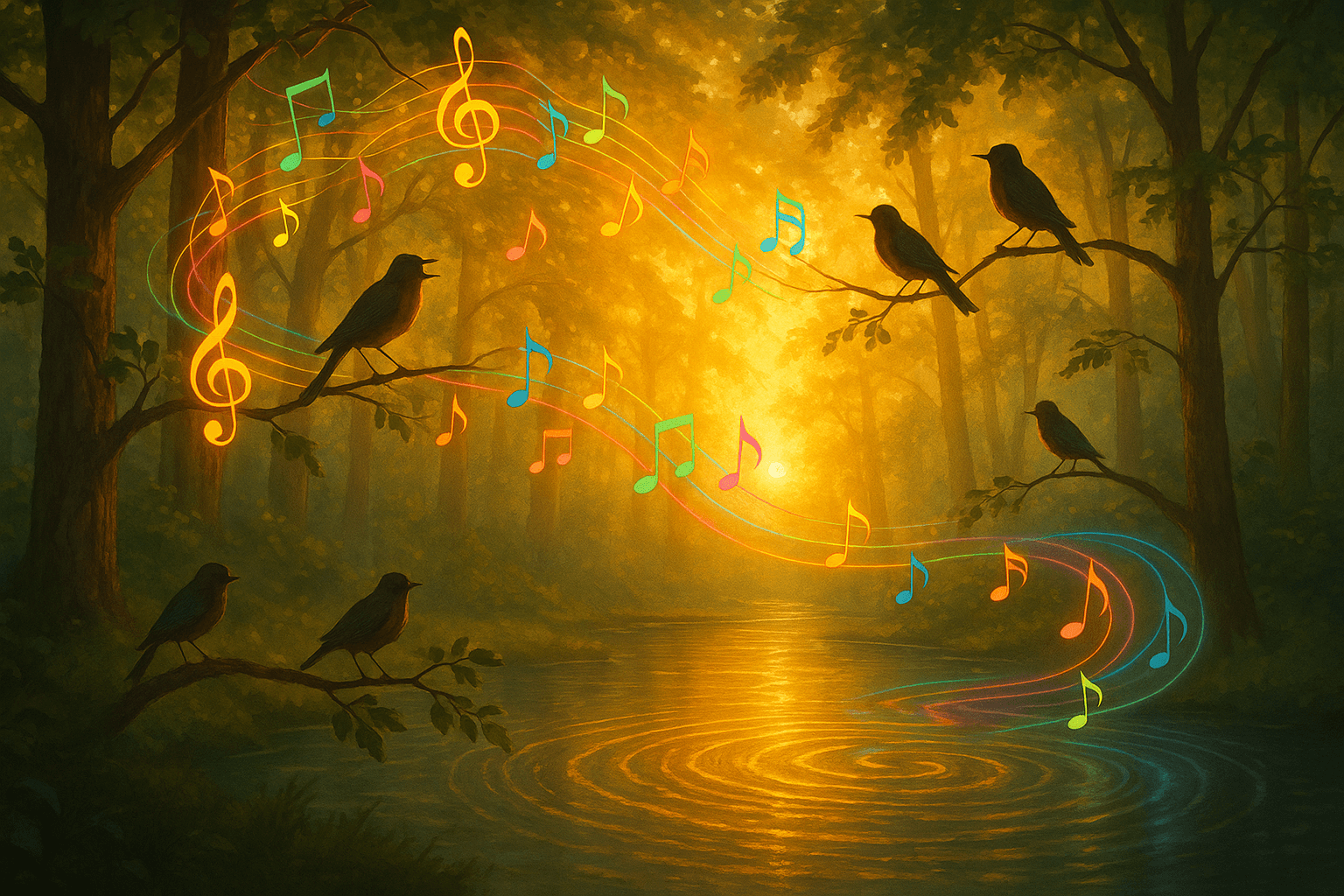
When words fail, music speaks. — Hans Christian Andersen
—What lingers after this line?
The Boundaries of Verbal Expression
Hans Christian Andersen’s statement starts by confronting a fundamental aspect of human existence: the limits of language. There are moments—grief, awe, overwhelming love—when words seem inadequate to capture the depth of feeling. Language, while versatile, cannot always convey the full complexity or paradox of inner emotional states, leaving gaps that ordinary conversation cannot bridge.
Music’s Unique Emotional Resonance
Into this void steps music, a universal language that transcends cultural and linguistic barriers. As Beethoven, who continued to compose intensely after losing his hearing, demonstrated—music has the power to evoke and articulate emotion with a precision words may lack. Through melody, harmony, and rhythm, music gives shape to what otherwise remains unspoken.
Illustrative Scenes from Literature and Life
In literature, scenes abound where music assumes the role of speech—such as Tolstoy’s *War and Peace* (1869), where Natasha’s dancing expresses joys she cannot articulate. Similarly, in everyday life, we turn to music during rituals—weddings, funerals, celebrations—when words fail us, relying on shared songs to articulate collective emotion.
Psychological Insights into Music’s Impact
Delving deeper, research in neuroscience confirms this phenomenon. Studies show music activates brain regions linked with emotion and memory, sometimes more profoundly than spoken language. Dr. Oliver Sacks, in *Musicophilia* (2007), observed patients unlocking memories or feelings through music after speech had been lost to illness—demonstrating music’s expressive advantage.
Embracing Music as Emotional Communication
Thus, Andersen’s phrase invites us to embrace music’s role as an essential means of human communication. When conventional dialogue falters, a song or melody often steps in to comfort, to unite, or to give voice to the ineffable. In this way, music stands not merely as entertainment, but as a vital extension of our capacity to connect and to be understood.
One-minute reflection
What does this quote ask you to notice today?
Related Quotes
6 selectedMusic is the universal language of mankind, translating dreams into reality. — Henry Wadsworth Longfellow
Henry Wadsworth Longfellow
Henry Wadsworth Longfellow’s insight captures music’s singular power to resonate across cultures and eras. Unlike spoken language, which relies on words and grammar, music expresses emotion and meaning through melody, rh...
Read full interpretation →Music is the universal language of mankind, translating dreams into reality. — Henry Wadsworth Longfellow
Henry Wadsworth Longfellow
Longfellow’s statement asserts that, unlike spoken tongues, music traverses the boundaries of culture, nationality, and time. Throughout history, melodies and rhythms have connected people with vastly different backgroun...
Read full interpretation →Sing to the quiet corners of your life; music awakens possibility. — Hildegard of Bingen
Hildegard of Bingen
Hildegard of Bingen’s line begins with an intimate directive: “Sing to the quiet corners of your life.” Those corners suggest the unvisited rooms of the self—habits done on autopilot, feelings we postpone, hopes we keep...
Read full interpretation →In a kiss, you will know everything I have kept silent.
Unknown
This quote highlights the ability of a kiss to convey emotions and feelings that words cannot express. It suggests that a kiss can communicate deep and hidden emotions effectively.
Read full interpretation →Music drives hatred away from those who would be filled with hate without it. - Pablo Casals
Pablo Casals
This quote highlights the transformative power of music. It suggests that music has the capacity to change one's emotions and alleviate negative feelings such as hate.
Read full interpretation →A smile is the shortest distance between two people. — Victor Borge
Victor Borge
This quote highlights how a simple smile can bridge the gap between two individuals. It suggests that smiling is a universal gesture that can cut through barriers and foster connection effortlessly.
Read full interpretation →More From Author
More from Hans Christian Andersen →Life itself is the most wonderful fairy tale. — Hans Christian Andersen
This quote suggests that the experiences and moments of life hold their own magic and wonder, much like a fairy tale that captures our imagination and delight.
Read full interpretation →Everything you need is already within you. — Hans Christian Andersen
This quote emphasizes the idea that individuals possess the inner strength, wisdom, and resources necessary to overcome challenges and achieve their goals without relying excessively on external factors.
Read full interpretation →