
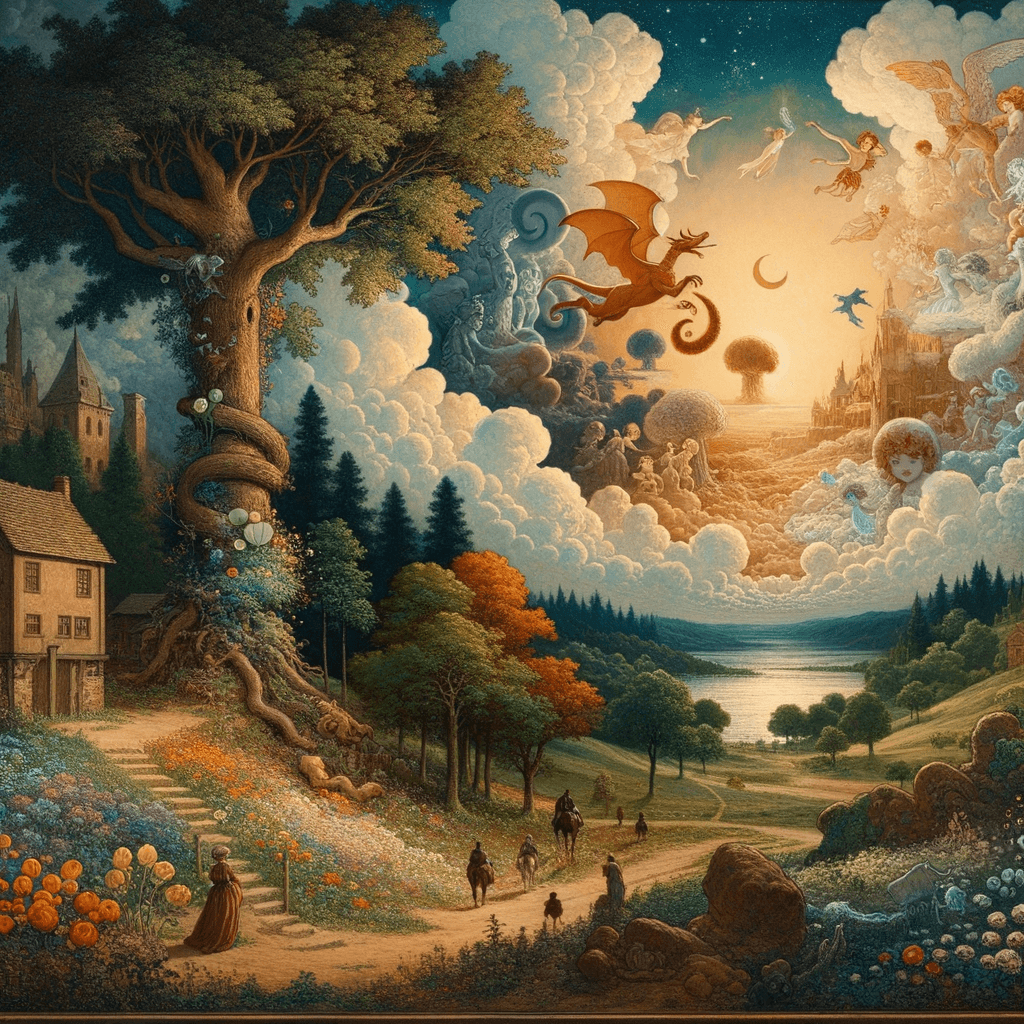
Life itself is the most wonderful fairy tale. — Hans Christian Andersen
—What lingers after this line?
Life's Intrinsic Magic
This quote suggests that the experiences and moments of life hold their own magic and wonder, much like a fairy tale that captures our imagination and delight.
Appreciation of Life
It encourages an appreciative view of life, suggesting that everyday experiences, adventures, and challenges are just as enchanting as the stories we read as children.
Perspective on Reality
By comparing life to a fairy tale, the quote implies that our perspective can transform our reality, enabling us to see the extraordinary in the ordinary.
Literary Context
Hans Christian Andersen, a 19th-century Danish author, is renowned for his fairy tales. His comparison of life to a fairy tale reflects his life's work and belief in the power of storytelling to reflect human experiences.
Optimism and Hope
The quote conveys a sense of optimism and hope, highlighting that life, despite its ups and downs, holds a myriad of magical and beautiful moments worth cherishing.
One-minute reflection
What feeling does this quote bring up for you?
Related Quotes
6 selectedAnxiety is just the imagination working overtime, and most of that overtime is completely unpaid. — Alain de Botton
Alain de Botton
At first glance, Alain de Botton’s remark frames anxiety with disarming humor: the mind behaves like an overworked employee, generating scenarios, rehearsing disasters, and collecting no reward for the effort. By calling...
Read full interpretation →Creativity is not the finding of a thing, but the making something out of it after it is found. — James Russell Lowell
James Lowell
James Russell Lowell’s line shifts attention away from the romantic myth of the sudden genius who invents from nothing. Instead, he argues that creativity truly begins after the initial encounter—after an idea, object, p...
Read full interpretation →In art, the hand can never execute anything higher than the heart can imagine. — Ralph Waldo Emerson
Ralph Waldo Emerson
Emerson’s line shifts attention from technique to inner vision. At first glance, he seems to be speaking about painting or sculpture, yet his deeper claim is that craftsmanship cannot surpass the emotional and imaginativ...
Read full interpretation →It is the main earthly business of a human being to make his home, and the immediate surroundings of his home, as symbolic and significant to his own imagination as he can. — G. K. Chesterton
G. K. Chesterton
Chesterton begins with a striking claim: making a home is not a secondary chore but one of our central earthly tasks. By calling it our “main earthly business,” he elevates domestic life into something almost moral and a...
Read full interpretation →A rock pile ceases to be a rock pile the moment a single man contemplates it, bearing within him the image of a cathedral. — Antoine de Saint-Exupéry
Exupéry
At first glance, Saint-Exupéry’s line seems to describe an ordinary heap of stones. Yet the moment someone looks at it while carrying the image of a cathedral within, the pile is transformed in meaning.
Read full interpretation →The function of art is to do more than tell it like it is—it's to imagine what is possible. — bell hooks
bell hooks
bell hooks argues that art should not stop at documenting reality, however honestly. Instead, it must move one step further and open a window onto possibility, suggesting that creativity is not only reflective but transf...
Read full interpretation →More From Author
More from Hans Christian Andersen →Everything you need is already within you. — Hans Christian Andersen
This quote emphasizes the idea that individuals possess the inner strength, wisdom, and resources necessary to overcome challenges and achieve their goals without relying excessively on external factors.
Read full interpretation →When words fail, music speaks. — Hans Christian Andersen
Hans Christian Andersen’s statement starts by confronting a fundamental aspect of human existence: the limits of language. There are moments—grief, awe, overwhelming love—when words seem inadequate to capture the depth o...
Read full interpretation →