
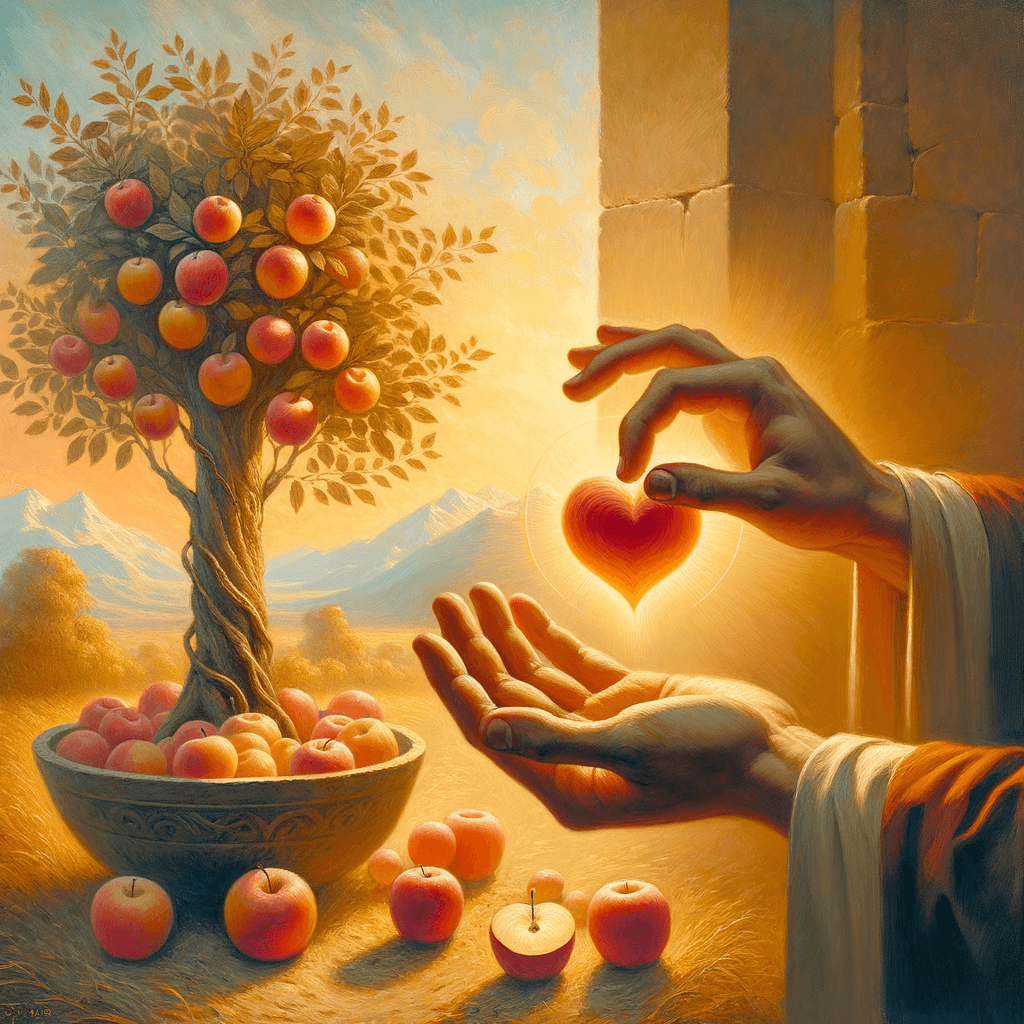
Where there is no love, put love, and you will draw out love. - Saint John of the Cross
—What lingers after this line?
Cycle of Love
This quote emphasizes the reciprocative nature of love. By giving love selflessly, even in places where it might be lacking, one can inspire others to respond with love in return.
Transformative Power of Love
It highlights the transformative power of love. When one introduces love into a loveless situation, it has the potential to change the environment and the people within it positively.
Self-Initiated Change
The statement encourages taking the initiative to be the source of love rather than waiting for it to emerge naturally. It promotes proactive love, suggesting that changes in relationships and environments start with one's own actions.
Spiritual Teaching
Saint John of the Cross, a Spanish mystic and friar, often wrote about the profound impact of divine love. This quote reflects his belief in the spiritual duty to spread love as a path to experiencing God's presence and grace.
Unconditional Love
The quote suggests the practice of unconditional love—offering love without expecting anything in return. This kind of love has the potential to inspire and heal even the coldest hearts.
Interpersonal Relationships
It also speaks to the dynamics of interpersonal relationships, where expressing love can break through barriers of indifference or hostility, fostering a more compassionate and understanding community.
One-minute reflection
Where does this idea show up in your life right now?
Related Quotes
6 selectedYou must love in such a way that the person you love feels free. — Thich Nhat Hanh
Thich Nhat Hanh
At its core, Thich Nhat Hanh’s statement redefines love as an act of care that does not confine. To love someone so that they feel free means offering affection without turning it into control, guilt, or dependence.
Read full interpretation →The sort of fearless openness required to turn toward our suffering is only possible within the spacious receptivity of love. — Frank Ostaseski
Frank Ostaseski
Frank Ostaseski’s statement begins with a striking claim: real courage is not simply toughness or willpower. Instead, the bravery required to face suffering honestly arises from love’s presence.
Read full interpretation →Healing is an art. It takes time, it takes practice, it takes love. — Maza Dohta
Maza Dohta
Maza Dohta’s quote begins by reframing healing as an art rather than a mechanical repair. That distinction matters, because art is rarely instant: it involves sensitivity, patience, revision, and care.
Read full interpretation →The only way to exist in a world that feels increasingly cold is to be the warmth you wish to receive from others. — Maya Angelou
Maya Angelou
At its core, Maya Angelou’s line reframes loneliness as a call to action rather than a verdict on the world. If life feels impersonal, distant, or harsh, she suggests that waiting passively for kindness may only deepen t...
Read full interpretation →We are called to be strong companions and clear mirrors to one another, to seek those who reflect with compassion how we are doing. — Wayne Muller
Wayne Muller
Wayne Muller’s quote begins with a call to companionship that is more than simple friendship. To be a strong companion is to stand beside another person with steadiness, honesty, and care, especially when life becomes co...
Read full interpretation →I have found that if you love life, life will love you back. — Arthur Rubinstein
Arthur Rubinstein
At its heart, Arthur Rubinstein’s remark suggests that life answers the attitude we bring to it. To love life is not to deny pain or difficulty; rather, it is to meet experience with receptivity, gratitude, and enthusias...
Read full interpretation →More From Author
More from Saint John of the Cross →