
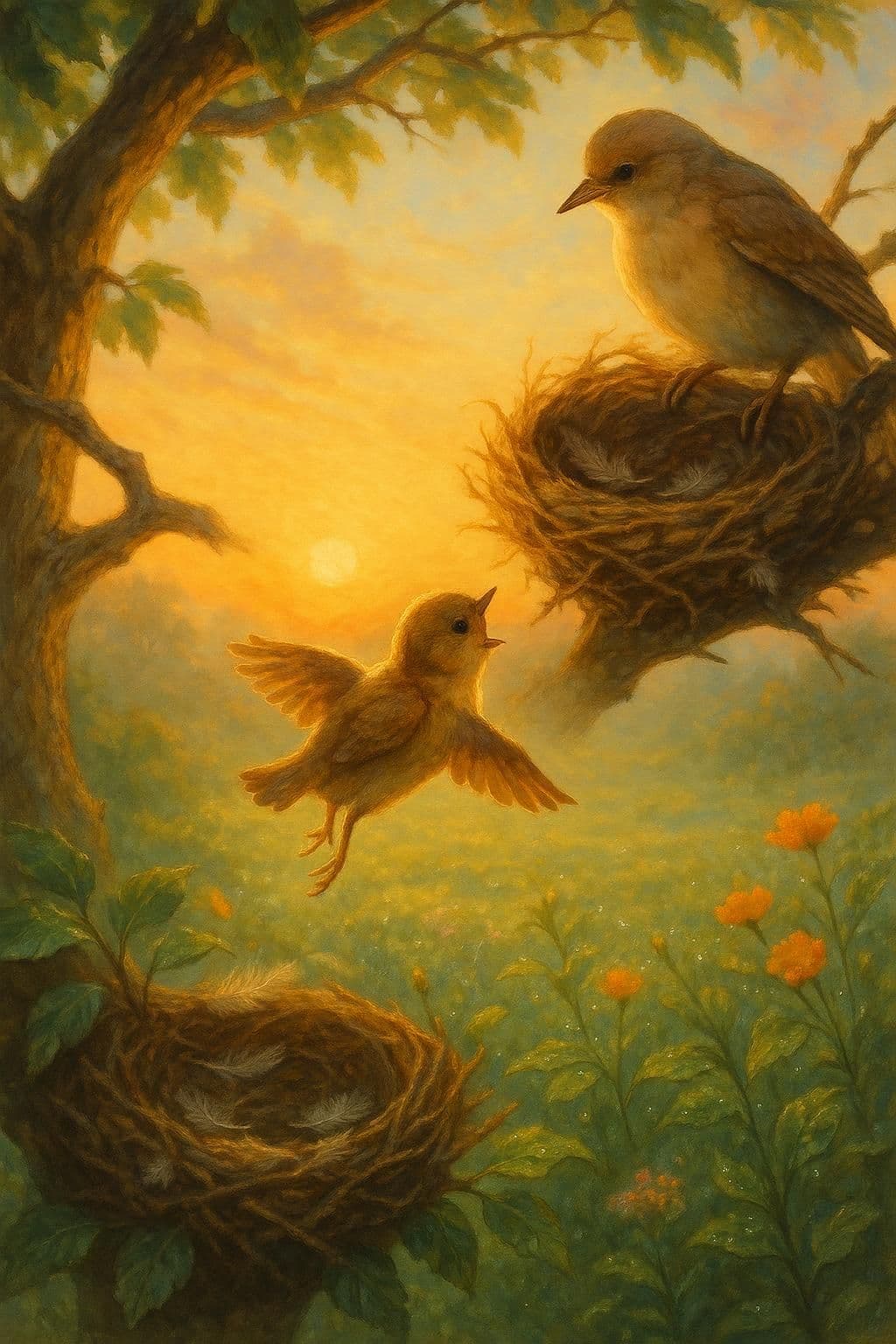
To be fully alive, fully human, and completely awake is to be continually thrown out of the nest. — Pema Chödrön
—What lingers after this line?
Embracing Discomfort for Growth
Pema Chödrön's metaphor of being 'thrown out of the nest' suggests that true vitality comes from repeatedly leaving comfort zones. Like a fledgling bird forced to fly for the first time, humans often discover their capabilities only when faced with unexpected challenges. In Viktor Frankl's *Man’s Search for Meaning* (1946), the author recounts how his greatest insights emerged during his harshest trials, underscoring that discomfort can catalyze profound personal development.
Awakening to the Present Moment
Being 'completely awake' signifies mindfulness—living in the present and accepting the unpredictability of life. Chödrön, a Buddhist nun, shares in *When Things Fall Apart* (1997) that awareness arises precisely when we relinquish control and dwell in uncertainty. The Buddhist tradition teaches that clinging to the familiar hinders enlightenment, and the journey truly begins at the moment of letting go.
The Human Experience of Vulnerability
To be 'fully human' involves confronting vulnerability. Brené Brown, in *Daring Greatly* (2012), argues that embracing vulnerability is essential for wholehearted living. Similarly, being pushed from the nest represents exposure and uncertainty, yet it is in these moments that one's resilience and authenticity are tested and revealed.
Cycles of Reinvention
The phrase implies that life’s challenges are ongoing; once comfort is re-established, new upheavals arise. Joseph Campbell’s 'Hero’s Journey,' outlined in *The Hero with a Thousand Faces* (1949), illustrates that every adventure begins with departure from the ordinary; upon return, further departures inevitably await. This cyclical deepening is vital to remaining alive and awake to one's potential.
Compassion for Self and Others
Chödrön teaches that repeated 'expulsions from the nest' build empathy. Each personal struggle increases our capacity to understand and support others in theirs. This idea echoes in Tolstoy’s *Resurrection* (1899), where suffering leads the protagonist to a compassionate awakening, seeing his experience reflected in others.
One-minute reflection
What's one small action this suggests?
Related Quotes
6 selectedIf you're always trying to maintain a certain image of yourself, you're always going to be afraid of being exposed. — Pema Chödrön
Pema Chödrön
Pema Chödrön’s line points to a quiet tradeoff many people make: the more energy we spend curating a particular version of ourselves, the more we bind our sense of safety to that performance. At first, “maintaining an im...
Read full interpretation →Only to the extent that we expose ourselves over and over to annihilation can that which is indestructible in us be found. — Pema Chödrön
Pema Chödrön
Pema Chödrön’s line hinges on an unsettling premise: what lasts in us is not discovered by protecting ourselves, but by repeatedly meeting what feels like our end. “Annihilation” here is less a literal destruction than t...
Read full interpretation →Home is the place where one finally allows the armor to drop and the spirit to breathe. — Maya Angelou
Maya Angelou
At its core, Maya Angelou’s reflection defines home not merely as a structure but as a sanctuary of emotional safety. The image of letting “the armor drop” suggests that daily life often requires protection—composure, re...
Read full interpretation →What shames us, what we most fear to tell, does not set us apart from others; it binds us together if only we can take the risk to speak it. — Brené Brown
Brené Brown
At first glance, Brené Brown’s insight appears paradoxical: the very experiences we hide for fear of rejection are often the ones that make us most recognizable to others. Shame convinces people that their pain, failures...
Read full interpretation →The hardest thing about loving someone deeply is letting them see your vulnerabilities. — Catherine Gilbert Murdock
Catherine Gilbert Murdock
At first glance, Murdock’s insight seems to define love as an act of devotion toward another person. Yet the quote quickly turns inward: the hardest part is not simply feeling deeply, but allowing that feeling to expose...
Read full interpretation →To love at all is to be vulnerable. Love anything and your heart will be wrung and possibly broken. If you want to make sure of keeping it intact, you must give it to no one. — C.S. Lewis
C.S. Lewis
C.S. Lewis begins with a stark truth: to love anything at all is to accept vulnerability.
Read full interpretation →More From Author
More from Pema Chödrön →The only way to move forward is to stop pretending that the past is still happening. — Pema Chödrön
Pema Chödrön’s line begins with a gentle but piercing insight: suffering often persists not only because something painful happened, but because part of us keeps reliving it as if it were still unfolding. In that sense,...
Read full interpretation →The best parts of your life are the ones that happen when absolutely no one is looking. — Pema Chödrön
Pema Chödrön’s quote turns attention away from applause and toward the private texture of living. At first glance, it suggests that life’s richest moments are not always the dramatic ones shared with an audience, but the...
Read full interpretation →Learning is not a sprint toward an end goal; it is a life-long rhythm of shedding what no longer serves you to make room for what does. — Pema Chödrön
At first glance, Pema Chödrön’s reflection challenges one of the most common assumptions about education: that learning is a race with a clear endpoint. Degrees, promotions, and certifications often tempt us to think of...
Read full interpretation →The truth is rarely comfortable, but it is the only thing that will actually set you free. Stop hiding from your reality and start owning your choices. — Pema Chödrön
At its core, Pema Chödrön’s statement argues that freedom does not come from denial, distraction, or carefully managed appearances. Instead, it begins with the willingness to confront what is real, even when that reality...
Read full interpretation →