
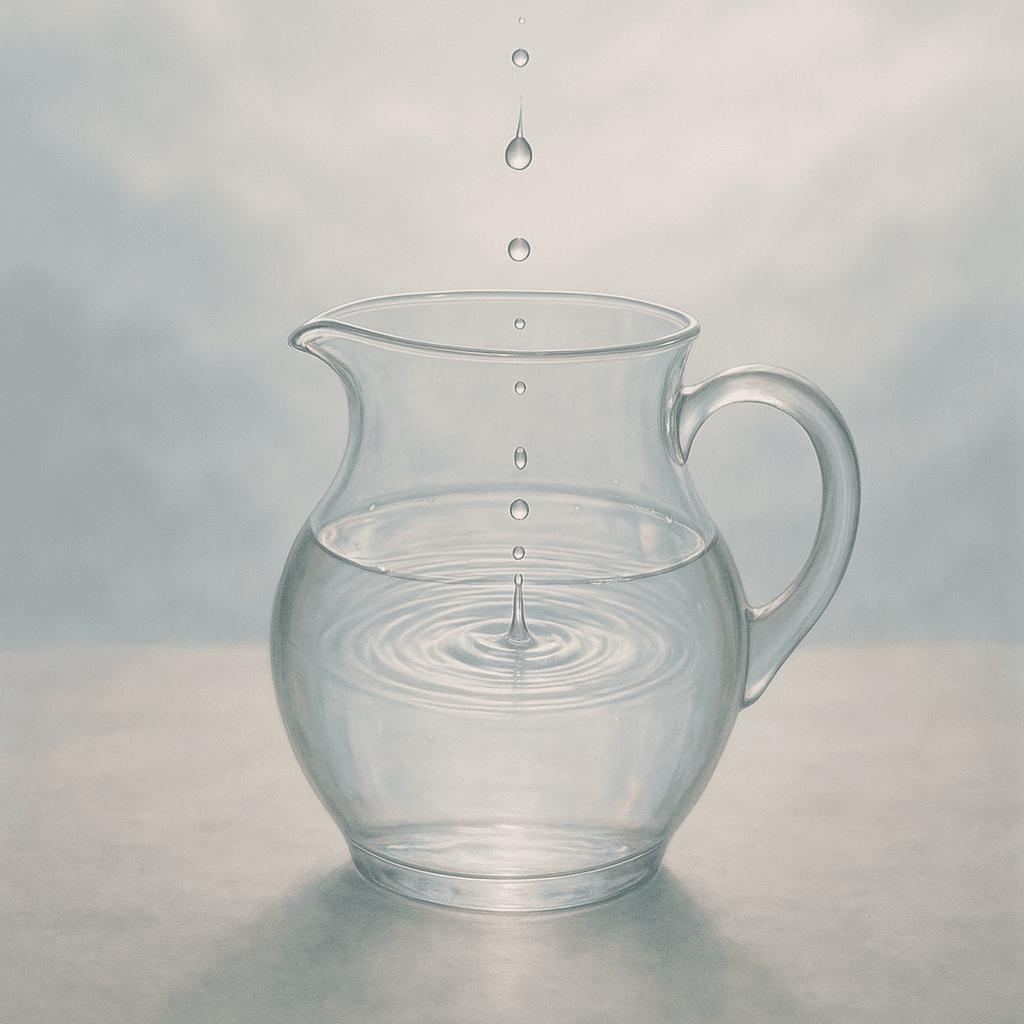
A jug fills drop by drop. — Buddha
—What lingers after this line?
Aphorisms of Accumulation
Buddha’s deceptively simple metaphor—‘A jug fills drop by drop’—distills the essence of gradual progress. This vivid imagery illustrates how seemingly minor, consistent actions coalesce into significant results over time. Whether forming a habit or acquiring wisdom, such aphorisms remind us that cumulative effort, rather than grand gestures, shapes lasting transformation.
Patience as a Virtue in Buddhist Thought
This teaching aligns closely with the Buddhist emphasis on patience and persistent mindfulness. In the Dhammapada, similar verses reinforce that enlightenment and virtue are not achieved overnight but through steady, daily practice. As each drop of water is essential to filling the jug, every moment spent in mindful living accrues merit, demonstrating that incremental growth lies at the heart of Buddhist philosophy.
The Ripple Effect Across Life’s Domains
Extending beyond spiritual growth, the drop-by-drop metaphor applies broadly to many areas of life. Successful artists, like Leonardo da Vinci, painstakingly refined their skills with countless sketches; scientists such as Marie Curie labored over thousands of experiments. Their achievements exemplify how steady input in any field, over time, creates outcomes that can seem miraculous in retrospect.
Modern Implications: Building Habits and Success
Transitioning to modern behavior science, James Clear’s ‘atomic habits’ concept echoes this principle. He argues that small, repeatable actions, compounded consistently, lead to profound change—much like drops adding up in a jug. Studies in psychology confirm that breaking large goals into manageable tasks increases motivation and actual achievement, validating Buddha’s ancient wisdom in today’s self-improvement literature.
Enduring Wisdom for Everyday Life
Ultimately, the drop-by-drop lesson encourages perseverance amid impatience or discouragement. Instead of seeking immediate results, embracing gradual accumulation can reduce anxiety and foster resilience. Whether nurturing relationships, learning a language, or saving for the future, recognizing the value in each small ‘drop’ empowers us to trust the process and realize the profound effects of persistence.
One-minute reflection
Where does this idea show up in your life right now?
Related Quotes
6 selectedBut patience can't be acquired overnight. It's just like building up a muscle. Every day you need to work on it, to push its limits. — Eknath Easwaran
Eknath Easwaran
Eknath Easwaran frames patience not as a fixed personality trait but as a capacity that develops over time. From the outset, his comparison to building muscle changes the way we think about self-control: instead of waiti...
Read full interpretation →Roses do not bloom hurriedly; for beauty, like any masterpiece, takes time to blossom. — Matshona Dhliwayo
Matshona Dhliwayo
At its heart, Matshona Dhliwayo’s quote reminds us that true beauty cannot be forced. A rose does not rush toward bloom, nor does it apologize for the time required to unfold.
Read full interpretation →There is no road too long to the man who advances deliberately and without undue haste; there are no honors too distant to the man who prepares himself for them with patience. — Jean de La Bruyère
Jean de La Bruyère
At its core, La Bruyère’s line praises steady movement over restless speed. A long road feels intimidating only when seen all at once; once it is broken into deliberate steps, distance loses much of its power.
Read full interpretation →The ultimate mysteries are opened only to those who have immense patience. — Osho
Osho
Osho’s statement begins with a simple but demanding premise: the deepest truths do not yield to force. In this view, mystery is not a puzzle to be solved quickly but a reality that unfolds on its own terms.
Read full interpretation →Do you have the patience to wait until your mud settles and the water is clear? — Lao Tzu
Lao Tzu
Lao Tzu’s question frames patience not as passive delay but as an active kind of wisdom. The image of muddy water settling on its own suggests that confusion often clears not through force, but through restraint.
Read full interpretation →The wise do things slowly, because they love it. — David Fell
David Fell
At first glance, David Fell’s line seems to praise caution, yet it reaches further than mere hesitation. To do something slowly, in this view, is not to be indecisive but to be fully present.
Read full interpretation →More From Author
More from Buddha →To keep the body in good health is a duty, otherwise we shall not be able to keep our mind strong and clear. — Buddha
At its core, this saying presents physical care not as vanity or indulgence, but as a duty. The body is treated as the necessary ground on which mental clarity stands, so neglecting it becomes more than a personal lapse—...
Read full interpretation →However many holy words you read, however many you speak, what good will they do you if you do not act upon them? — Buddha
Buddha’s question cuts through spiritual comfort by shifting attention from what we consume—holy texts and pious speech—to what we embody. Reading and reciting can feel like progress because they are visible and repeatab...
Read full interpretation →Better than a thousand hollow words, is one word that brings peace. — Buddha
Buddha’s saying begins with a simple comparison: quantity versus consequence. A thousand words can impress, distract, or even manipulate, yet still remain “hollow” if they do not reduce suffering or clarify the mind.
Read full interpretation →The way is not in the sky. The way is in the heart. — Buddha
Buddha’s line redirects spiritual seeking away from distant, external places—“the sky”—and toward the intimate terrain of lived experience. Instead of imagining truth as something hidden in the heavens or guarded by spec...
Read full interpretation →