
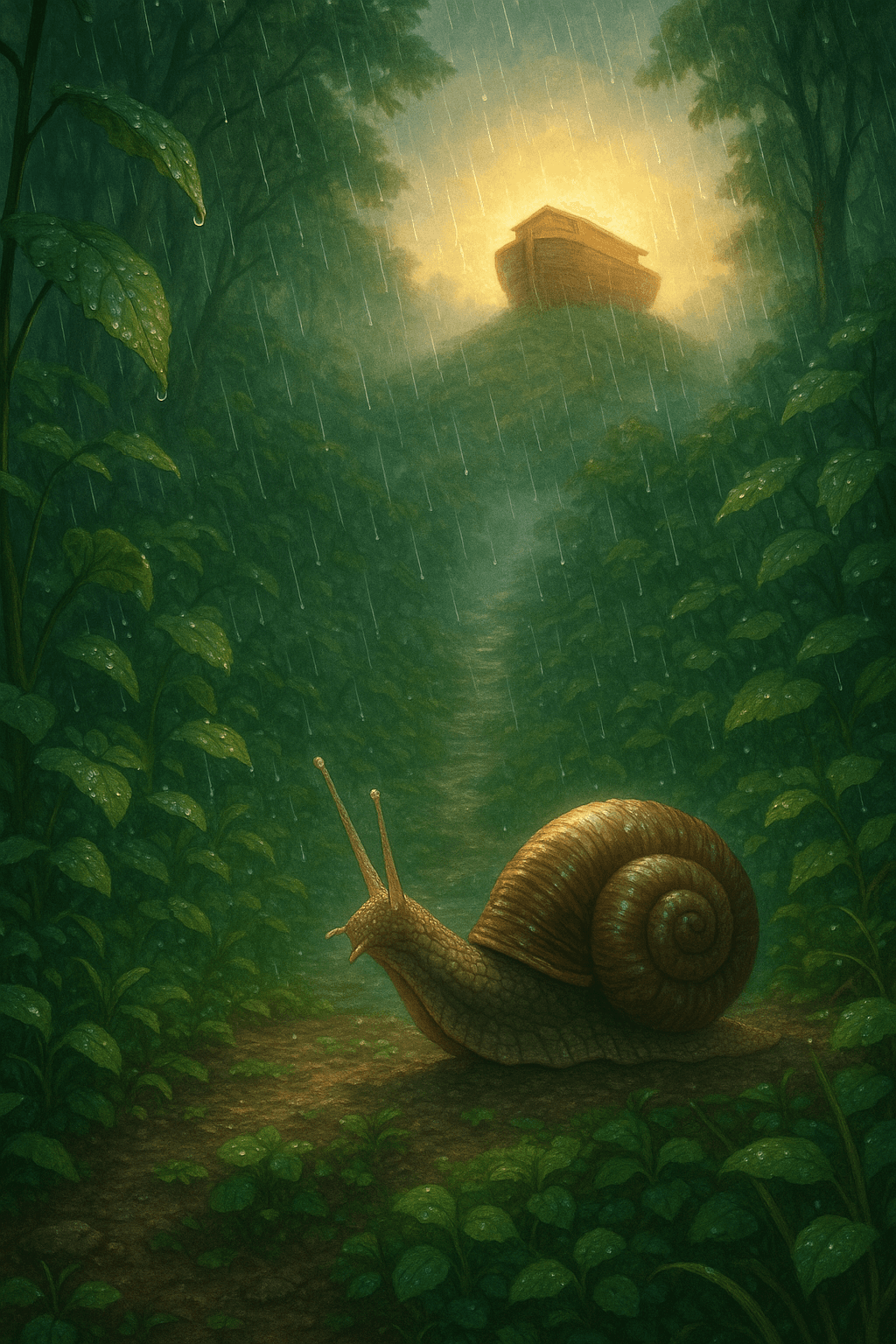
By persisting, the snail reached the ark. — Charles Spurgeon
—What lingers after this line?
The Humble Snail as Symbol
Charles Spurgeon's mention of the snail evokes a powerful image: a creature defined not by speed, but by unwavering determination. Historically, symbols like the snail have illustrated endurance, and in this context, it becomes an emblem for those who progress slowly but surely. The Ark, representing salvation and survival in the biblical narrative of Noah, sets the ultimate, seemingly unattainable goal. Through this pairing, Spurgeon highlights the possibility of success for even the most unlikely candidates, provided they persist.
Biblical Underpinnings of Endurance
Building on this imagery, Spurgeon’s reference subtly nods to the story of Noah’s Ark in Genesis, where creatures of every kind, regardless of their abilities, were given passage due to adherence to the call. The snail’s journey is a testament to the biblical value of perseverance, reminiscent of passages such as Hebrews 12:1—'let us run with perseverance the race marked out for us.' This scriptural backdrop reinforces the notion that persistence, not prowess, is what ultimately matters.
Lessons from Natural History
Transitioning from metaphor to nature, the snail’s methodical advance finds echoes in biological history. While fleet creatures like cheetahs or falcons grab attention, it is the slow and steady species that have often survived drastic environmental changes. Darwin’s observations in 'On the Origin of Species' (1859) note that adaptation is often about continued effort rather than dramatic leaps. Thus, the snail’s persistence mirrors broader natural processes, where resilience outweighs initial advantage.
Practical Applications in Human Life
From biblical and natural parallels, we can see striking relevance for human endeavor. Whether learning a new skill, overcoming setbacks, or striving toward personal transformation, individuals frequently underestimate the power of steady, incremental progress. Anecdotes abound—such as Thomas Edison’s many failed experiments before inventing the lightbulb—that celebrate perseverance. Spurgeon’s quote urges readers not to measure themselves against others’ speed, but to value the constancy of their own steps.
A Universal Principle for Success
Ultimately, the story of the snail on its journey to the ark bridges lessons of faith, science, and daily experience. Progress may be slow and the challenges formidable, but persistence carries us to our goals—regardless of how insurmountable they seem at the outset. By internalizing this truth, individuals of all backgrounds can confront obstacles not with haste, but with sustained effort, confident that steadfastness, above all, leads to lasting fulfillment.
Recommended Reading
As an Amazon Associate, we earn from qualifying purchases.
One-minute reflection
What feeling does this quote bring up for you?
Related Quotes
6 selectedOne doesn't get to be a master of one's own life by rushing. You have to learn the patience of a gardener who knows the harvest cannot be hurried. — Paulo Coelho
Paulo Coelho
At its core, Paulo Coelho’s reflection challenges a modern obsession with speed. He argues that mastery over one’s life does not come from frantic action or constant acceleration, but from learning when to wait, observe,...
Read full interpretation →Everything that is finished is a series of things that were started, and then carefully corrected. — M.C. Escher
M.C. Escher
At first glance, Escher’s remark seems simple, yet it quietly overturns the myth of effortless brilliance. He suggests that anything truly finished is not born whole; rather, it emerges from a chain of beginnings, each o...
Read full interpretation →A garden is a grand teacher. It teaches patience and careful watchfulness; it teaches industry and thrift; above all it teaches entire trust. — Gertrude Jekyll
Gertrude Jekyll
Gertrude Jekyll presents the garden not merely as a decorative space but as a living instructor. From the opening phrase, she elevates cultivation into education, suggesting that soil, weather, and seasons quietly shape...
Read full interpretation →The craft of living is a slow art, requiring the courage to be ordinary and the patience to be consistent. — Parker Palmer
Parker Palmer
Parker Palmer’s line frames living not as a sudden achievement but as a craft, something formed through repetition, attention, and humility. By calling it a “slow art,” he shifts the focus away from dramatic breakthrough...
Read full interpretation →Everything that is created in the world is first created in the mind, then brought into reality through persistent care. — Napoleon Hill
Napoleon Hill
Napoleon Hill’s statement begins with a bold premise: every created thing exists first as an idea before it becomes an object, achievement, or institution. In this view, the mind is not merely a place of private reflecti...
Read full interpretation →When you are in the middle of a creative block, remember that the work is not the point; the point is the practice of showing up. — Twyla Tharp
Twyla Tharp
Twyla Tharp’s quote shifts attention away from the finished product and toward the habit that makes creation possible in the first place. In the middle of a creative block, it is easy to believe that nothing matters unle...
Read full interpretation →More From Author
More from Charles Spurgeon →Right things are rare flowers that need cultivation. — Charles Spurgeon
Spurgeon’s image immediately turns morality into something living, fragile, and beautiful. By calling right things “rare flowers,” he suggests that goodness does not appear everywhere by accident; instead, it emerges und...
Read full interpretation →Anxiety empties today of its strength without changing tomorrow's sorrow. Stop worrying about what might happen and start handling what is happening. — Charles Spurgeon
Spurgeon frames anxiety as a tragic misallocation of energy: it drains the present without actually improving the future. In other words, worry feels like work, but it produces no real change in what tomorrow brings.
Read full interpretation →Trials teach us what we are; they dig up the soil, and let us see what we are made of. — Charles Spurgeon
Spurgeon’s image of trials digging up soil points to a farmer’s reality: the plow does not invent what is in the ground; it simply turns it over so we can see roots, rocks, and richness. Likewise, hardship exposes the mi...
Read full interpretation →It is not how much we have, but how much we enjoy, that makes happiness. — Charles Spurgeon
This quote emphasizes that true happiness is derived not from material possessions or wealth, but from the enjoyment and appreciation of what we have.
Read full interpretation →