
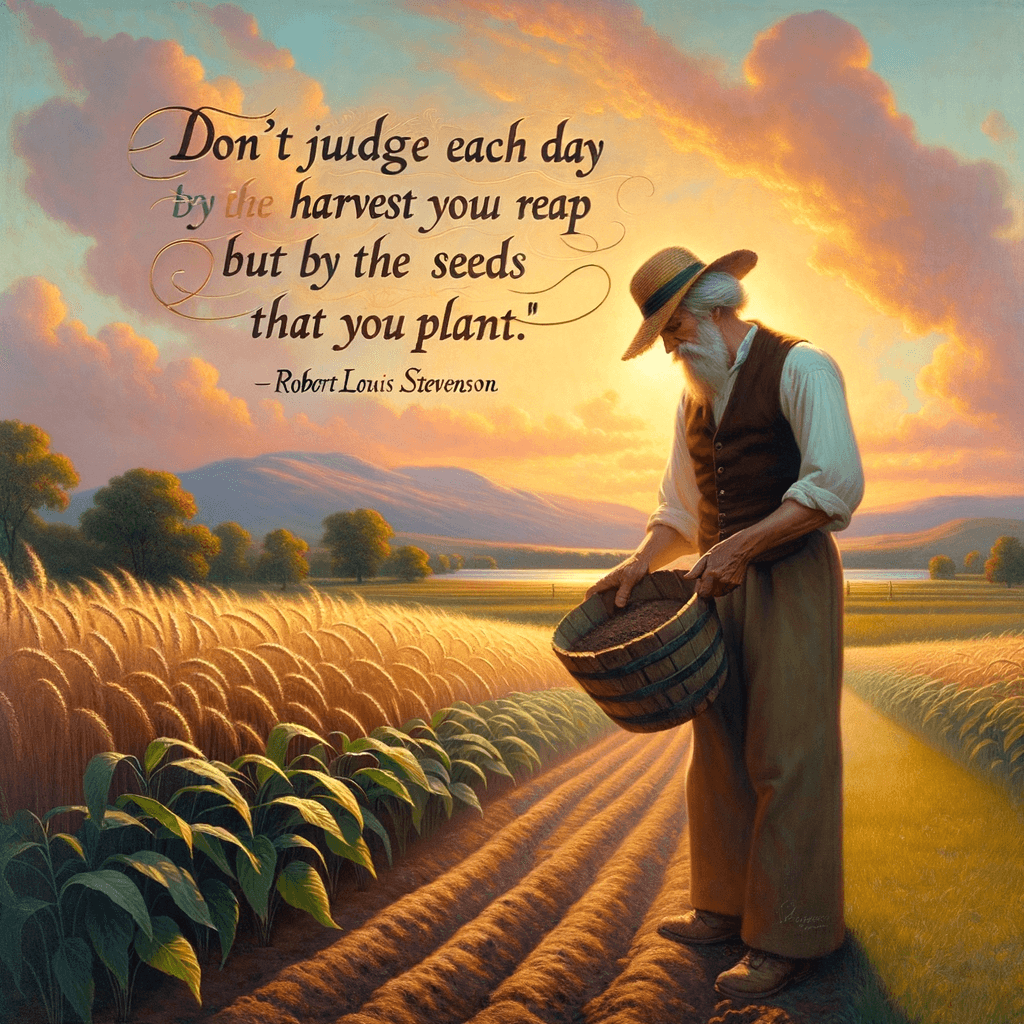
Don't judge each day by the harvest you reap but by the seeds that you plant. — Robert Louis Stevenson
—What lingers after this line?
Focus on Efforts
This quote emphasizes the importance of concentrating on the efforts and actions you take each day rather than the immediate results or rewards. It encourages persistence and patience.
Long-Term Impact
By planting seeds, you are investing in the future. The quote underscores the idea that the actions you take today can lead to meaningful outcomes over time, even if they are not immediately apparent.
Growth and Development
The act of planting seeds is symbolic of personal growth and development. It highlights that progress often starts with small, consistent actions that cumulatively lead to significant change.
Constructive Attitude
This perspective encourages a constructive attitude toward daily life. Instead of being discouraged by lack of immediate success, it promotes a focus on constructive habits and positive contributions.
Philosophical Reflection
Robert Louis Stevenson, a Scottish novelist and travel writer of the 19th century, often imbued his work with philosophical insights. This quote reflects his understanding of the value of perseverance and the significance of one's ongoing efforts.
One-minute reflection
Why might this line matter today, not tomorrow?
Related Quotes
6 selectedSlow progress today is often stable progress tomorrow. Fast growth collapses easily. Slow growth holds. — Timeless Type
Timeless Type
At first glance, slow progress can feel discouraging, especially in a culture that praises speed, sudden breakthroughs, and visible success. Yet the quote reminds us that what seems unimpressive today may become the foun...
Read full interpretation →Sometimes you have to slow down to go fast. — Jeff Olson
Jeff Olson
Jeff Olson’s line begins with a practical paradox: speed is not always created by rushing. Sometimes the quickest path forward requires pausing long enough to see the road clearly, correct mistakes early, and choose acti...
Read full interpretation →Everything that is great in life is the product of slow growth; the newer, and greater, and higher, and nobler the work, the slower is its growth. — William George Jordan
William George Jordan
William George Jordan’s reflection begins with a quiet but demanding truth: the most meaningful achievements rarely arrive quickly. He suggests that greatness is not manufactured in sudden bursts but cultivated through t...
Read full interpretation →You cannot force ideas. Successful ideas are the result of slow growth. — Alexander Graham Bell
Alexander Graham Bell
Alexander Graham Bell’s statement begins with a quiet warning against impatience: ideas cannot be commanded into maturity simply because we desire results. Like plants, they require conditions, time, and repeated attenti...
Read full interpretation →The moments between your milestones are not filler. — Nelou Keramati
Nelou Keramati
Nelou Keramati’s line challenges the habit of treating life as a sequence of major checkpoints: graduations, promotions, weddings, moves, and visible successes. At first glance, everything between these events can seem l...
Read full interpretation →Roses do not bloom hurriedly; for beauty, like any masterpiece, takes time to blossom. — Matshona Dhliwayo
Matshona Dhliwayo
At its heart, Matshona Dhliwayo’s quote reminds us that true beauty cannot be forced. A rose does not rush toward bloom, nor does it apologize for the time required to unfold.
Read full interpretation →More From Author
More from Robert Louis Stevenson →The best things in life are nearest: breath in your nostrils, light in your eyes, flowers at your feet, duties at your hand, the path of right just before you. — Robert Louis Stevenson
At first glance, Stevenson redirects attention away from distant ambitions and toward what is already present. His list begins with breath and light, the most ordinary features of existence, yet he treats them as treasur...
Read full interpretation →The ultimate goal of human life is to become all that you can be. — Robert Louis Stevenson
This quote highlights the importance of striving for self-actualization. It suggests that the primary purpose of life is personal growth and fulfilling one's potential.
Read full interpretation →Keep your fears to yourself, but share your courage with others. — Robert Louis Stevenson
This quote encourages individuals to keep their negative emotions, such as fears, private, while focusing on spreading positivity through acts of courage. By doing so, a person can foster a more uplifting and supportive...
Read full interpretation →Everyone who got where he is had to begin where he was. — Robert Louis Stevenson
This quote highlights the idea that progress and success are gradual. Everyone starts from their current reality and works their way forward through effort and determination.
Read full interpretation →