
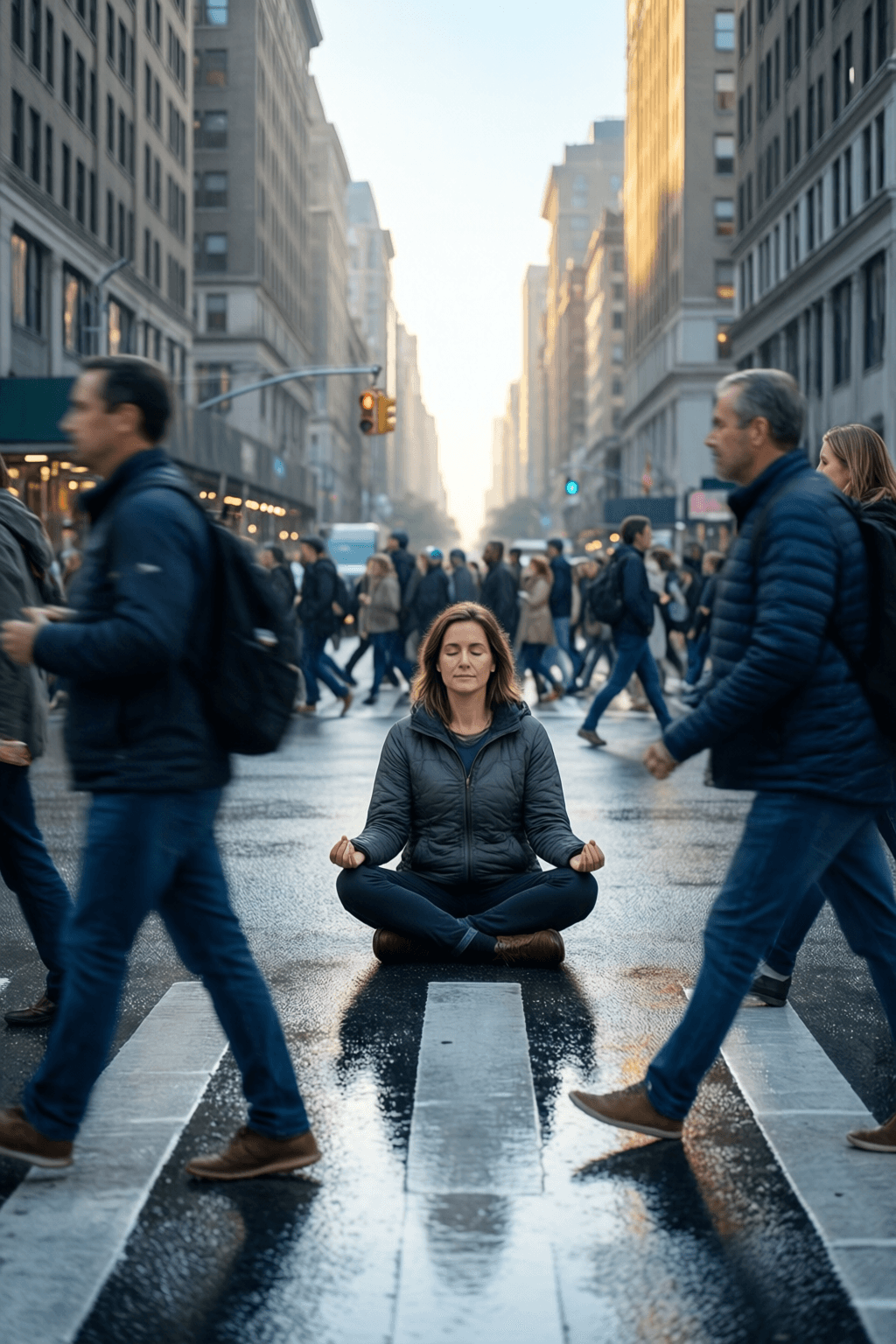
Meditation in the midst of activity is a thousand times superior to meditation in stillness. — Hakuin Ekaku
—What lingers after this line?
The Heart of Hakuin’s Claim
At first glance, Hakuin Ekaku’s statement seems to overturn the usual image of meditation as silence, stillness, and withdrawal. Yet his point is sharper than simple praise of busyness: he suggests that awareness tested in motion is more mature than awareness preserved only in calm conditions. In other words, inner steadiness means more when it survives noise, pressure, and interruption. This insight reflects Hakuin’s larger Zen project in eighteenth-century Japan, where practice was not meant to remain confined to the cushion. If meditation is genuine, it should accompany speaking, working, walking, and deciding. Thus, activity becomes not a distraction from realization but the field in which realization proves its depth.
Why Stillness Is Not the Final Goal
To be sure, still meditation has an essential role. Quiet sitting trains attention, reveals restlessness, and lets the mind settle enough to notice its habits. However, Hakuin implies that stillness is a beginning rather than an endpoint. Calm in a silent room is valuable, but it may remain fragile if it disappears the moment life becomes demanding. For that reason, Zen often treats the cushion as a laboratory, not a refuge. What is learned there must travel outward into ordinary life. Much as a musician proves skill not during practice alone but in performance, a meditator shows understanding when clarity remains available amid deadlines, conflict, and fatigue.
Action as the Real Test of Awareness
From this perspective, activity exposes whether mindfulness is authentic or merely situational. It is easy to feel composed when nothing challenges the mind; it is far harder to remain awake while answering criticism, caring for children, or making difficult choices. Therefore, action serves as a kind of spiritual stress test. This idea echoes broader Buddhist teaching on nonattachment. The Dhammapada, traditionally dated to around the third century BC, repeatedly praises the disciplined mind not because it escapes the world, but because it remains unshaken within it. Hakuin intensifies that principle: meditation in motion is superior precisely because it transforms awareness from a private state into a living capacity.
Zen Practice in Ordinary Tasks
Accordingly, Hakuin’s teaching turns daily routines into practice opportunities. Washing dishes, writing emails, sweeping floors, or speaking with a colleague can all become forms of meditation when done with full presence. Zen literature often honors such ordinary acts; Dogen’s Tenzo Kyokun (1237), for example, treats cooking in a monastery not as lesser work but as a serious path of awakening. This shift is important because it dissolves the boundary between sacred and mundane. One no longer waits for the perfect hour of silence to become attentive. Instead, each task asks the same question: can the mind remain clear, undivided, and responsive here, now, in the middle of life as it is?
The Discipline of Returning in Motion
Naturally, meditation during activity does not mean maintaining some mystical trance while multitasking. Rather, it involves repeatedly returning to the present while events continue to unfold. A parent pauses before reacting in anger, a nurse takes one conscious breath before entering the next room, or a commuter notices tension at a red light and softens it. These are modest acts, yet they reveal the essence of practice. In this way, Hakuin’s teaching becomes deeply practical. The point is not flawless concentration but resilient recollection. Again and again, awareness is lost and found within motion itself. Over time, that rhythm of return builds a steadiness more flexible—and often more transformative—than calm achieved only in isolation.
A Spiritual Vision for the Whole of Life
Finally, Hakuin’s statement carries an ethical as well as contemplative message. If meditation belongs in activity, then wisdom must shape conduct, speech, and relationships, not just inner states. Insight is measured by how one meets other people, how one handles frustration, and how one responds under pressure. The awakened mind is not hidden from life; it appears through life. Seen this way, the saying is not a rejection of stillness but its fulfillment. Silent meditation prepares the ground, while active meditation bears the fruit. Hakuin therefore invites us toward a practice broad enough to include the whole day—where every interruption, obligation, and encounter becomes another chance to embody attention.
Recommended Reading
As an Amazon Associate, we earn from qualifying purchases.
One-minute reflection
What feeling does this quote bring up for you?
Related Quotes
6 selectedIn the midst of movement and chaos, keep stillness inside of you. — Deepak Chopra
Deepak Chopra
This quote by Deepak Chopra emphasizes the importance of maintaining a sense of inner calm and tranquility, even when the external world is chaotic and turbulent.
Read full interpretation →The room you inhabit is the shadow of your mind; clear the space, and you clear the clutter within. — Gaston Bachelard
Gaston Bachelard
Bachelard’s line proposes that the room around us is not merely a physical container but a reflection of our inward condition. In that sense, disorder is rarely just scattered objects; instead, it often signals unresolve...
Read full interpretation →I have a new philosophy. I'm only going to dread one day at a time. — Charles M. Schulz
Charles M. Schulz
At first glance, Charles M. Schulz’s line sounds like a joke, and that is precisely its power.
Read full interpretation →The way to capture the moment is to slow down and look within, to simplify and celebrate the everyday. — Carl Honoré
Carl Honoré
Carl Honoré’s quote begins with a gentle but radical suggestion: if we want to truly capture a moment, we must first stop rushing through it. Rather than treating life as a sequence of tasks to be completed, he asks us t...
Read full interpretation →Being present demands all of us. It may be the hardest thing in the world. — Ryan Holiday
Ryan Holiday
Ryan Holiday’s line frames presence not as a casual mood but as a full-bodied act of attention. To be present, in this sense, is to bring one’s mind, emotions, and will into the same moment instead of scattering them acr...
Read full interpretation →Learn how to exhale, the inhale will take care of itself. — Carla Melucci Ardito
Carla Melucci Ardito
At first glance, Carla Melucci Ardito’s line seems to offer simple advice about breathing, yet it quickly opens into a broader philosophy of living. To learn how to exhale is to practice release: tension, control, fear,...
Read full interpretation →More From Author
More from Hakuin Ekaku →