
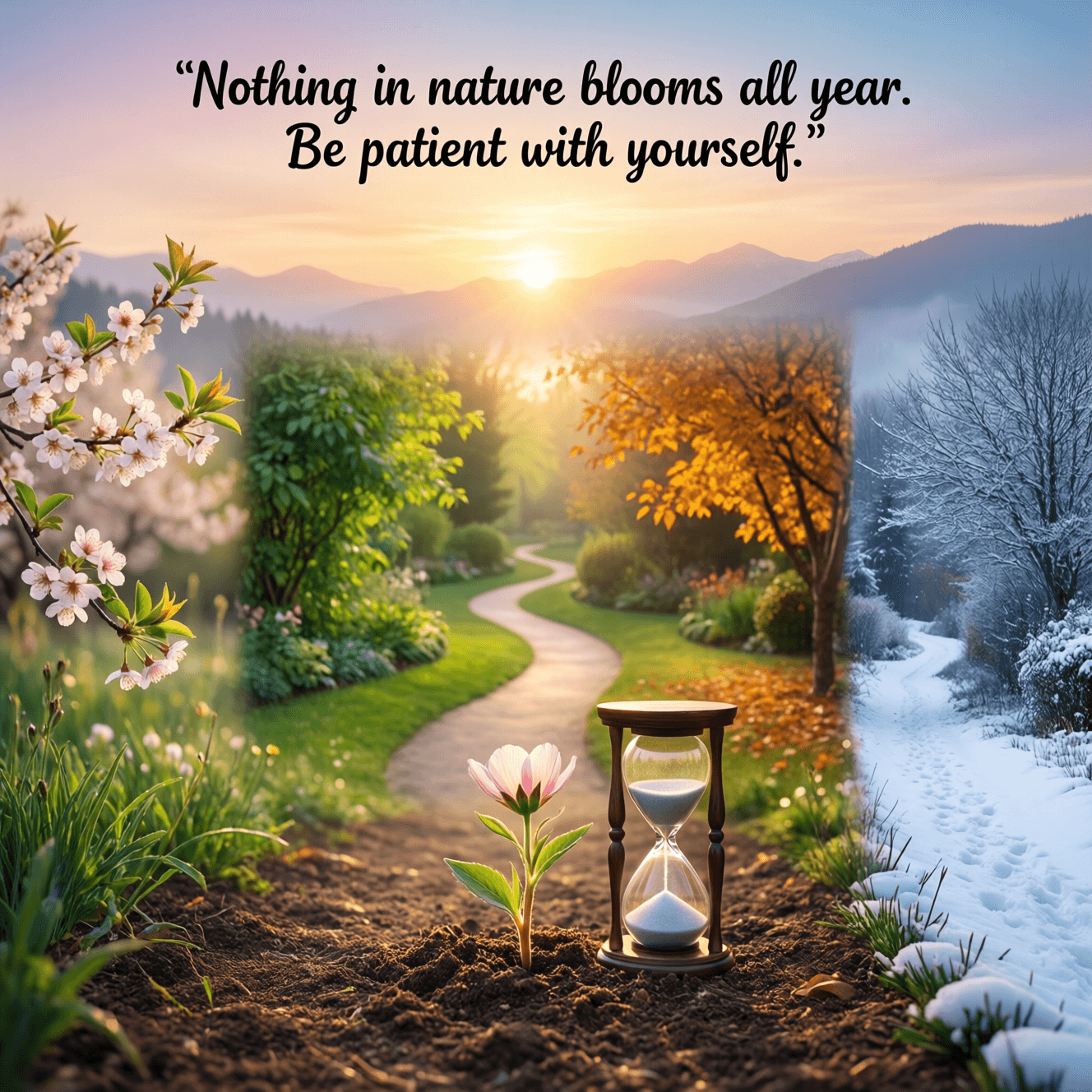
Nothing in nature blooms all year. Be patient with yourself. — Unknown
—What lingers after this line?
A Seasonal Truth About Living
The quote begins with a simple observation: in nature, constant flowering doesn’t exist. Blossoms arrive, peak, and fade, not because something went wrong, but because cycles are the way life sustains itself. Seen this way, the line quietly challenges the modern expectation of nonstop growth, productivity, or happiness. From that natural fact, the message pivots inward: if the earth is allowed rhythms, then so are you. Instead of treating every lull as failure, the quote invites you to interpret pauses as part of an honest human pattern—one that makes renewal possible.
Reframing “Not Blooming” as Necessary
Once we accept cycles, the idea of “not blooming” changes meaning. Dormant seasons—rest, recovery, quiet learning—aren’t empty; they’re preparatory. A tree that stopped conserving energy in winter would not become more productive; it would become vulnerable. In the same way, periods when you feel less inspired or capable can be doing hidden work: rebuilding attention, integrating experience, or restoring emotional reserves. Rather than demanding constant visible progress, the quote suggests a gentler metric: whether you are moving through your season with care.
The Psychology of Self-Patience
From a psychological angle, patience with yourself is closely tied to self-compassion. Kristin Neff’s research on self-compassion (e.g., Neff, 2003) emphasizes treating personal difficulty as part of common humanity rather than as personal deficiency, which can reduce shame and support resilience. Building on that, the quote offers a practical emotional correction: when you’re not “blooming,” your task may not be to force outcomes but to soften the internal pressure. Self-patience is not passivity; it is choosing a supportive stance that helps you recover the capacity to act.
Escaping the Myth of Constant Productivity
The line also critiques a cultural habit: equating worth with output. In many workplaces and online spaces, visibility and momentum are treated as proof of value, making natural slowdowns feel like personal shortcomings. Seen against nature’s example, that standard looks unrealistic. If no ecosystem demands endless blossoming, why should a person be expected to operate like a machine? The quote gently redirects ambition toward sustainability, implying that lasting success often depends on respecting limits instead of denying them.
What Patience Looks Like in Practice
Moving from idea to action, self-patience can be expressed in small, concrete choices: setting smaller goals during hard weeks, keeping routines minimal but consistent, or allowing rest without turning it into a moral debate. It can also mean naming your season—“I’m in recovery,” “I’m regrouping,” “I’m learning”—so you stop using the wrong expectations to judge the present. Over time, these choices build trust with yourself. You begin to believe that you can slow down and still return, which makes it easier to endure the non-blooming stretches without panic or harsh self-criticism.
Hope Embedded in the Cycle
Finally, the quote carries quiet optimism. A season that isn’t flowering is not evidence that flowering is over; it often implies that the conditions are changing toward a future phase. Nature’s cycles reassure us that rest and renewal can coexist, and that the absence of blossoms can be temporary without being trivial. So the closing instruction—“Be patient with yourself”—lands as both comfort and strategy. It asks you to live as part of a rhythm, trusting that growth returns more reliably when it’s allowed to arrive in its own time.
One-minute reflection
What does this quote ask you to notice today?
Related Quotes
6 selectedLoud budgeting is the realization that 'I can't' is a financial boundary, not a personality flaw. — Unknown
Unknown
Loud budgeting begins with a simple mental shift: saying “I can’t” is not a confession of inadequacy, but an act of clarity. The quote reframes refusal as a financial boundary, placing it in the same category as any othe...
Read full interpretation →To be kind to oneself is to understand that even the most beautiful garden needs a season of rest before it can bloom again. — Thich Nhat Hanh
Thich Nhat Hanh
At first glance, Thich Nhat Hanh’s image of the garden transforms self-kindness into something organic rather than indulgent. Just as a garden cannot flower endlessly without pause, the human spirit cannot remain product...
Read full interpretation →We should show kindness to the mind and from time to time grant it the leisure that serves it for sustenance and strength.
Unknown
The quote frames mental life as something deserving of kindness rather than constant extraction. Instead of treating the mind like a machine that should run indefinitely, it suggests an ethic of care: we owe our attentio...
Read full interpretation →Patience is not passive waiting; it is the courage to stand in the middle of a process and trust that the bloom is coming. — Mary Oliver
Mary Oliver
At first glance, patience is often mistaken for mere delay or resignation, yet Mary Oliver overturns that assumption immediately. In her view, patience is not passive waiting but an active inner stance: a decision to rem...
Read full interpretation →Your pace is valid. Healing takes time, not pressure. — Unknown
Unknown
The quote begins by affirming something many people forget during hardship: your pace is valid. In other words, healing is not a race with a finish line everyone must cross at the same speed.
Read full interpretation →Sometimes you have to slow down to go fast. — Jeff Olson
Jeff Olson
Jeff Olson’s line begins with a practical paradox: speed is not always created by rushing. Sometimes the quickest path forward requires pausing long enough to see the road clearly, correct mistakes early, and choose acti...
Read full interpretation →More From Author
More from Unknown →The language is the substrate. The architecture is the contract.
The line sets up a deliberate pairing: language lies beneath everything, while architecture governs everything above it. In other words, what you can express determines what you can build, and what you commit to structur...
Read full interpretation →A scroll is not a break; it is a trap disguised as rest. — Unknown
The quote begins by challenging a familiar story we tell ourselves: that a brief scroll is a harmless pause between tasks. On the surface, it looks like recovery—no effort, no decision, no commitment.
Read full interpretation →Don't let your ice cream melt while you're counting someone else's sprinkles. — Unknown
The quote uses ice cream as a simple stand-in for life’s fleeting pleasures: what you have is delicious, but it won’t last forever if you ignore it. Meanwhile, “counting someone else’s sprinkles” captures the habit of mo...
Read full interpretation →If your absence doesn't affect them, your presence never mattered. — Unknown
The quote frames absence as a revealing experiment: remove yourself, and the reaction—concern, curiosity, indifference—becomes a kind of data. If nothing changes when you’re gone, it suggests your role was never integrat...
Read full interpretation →