
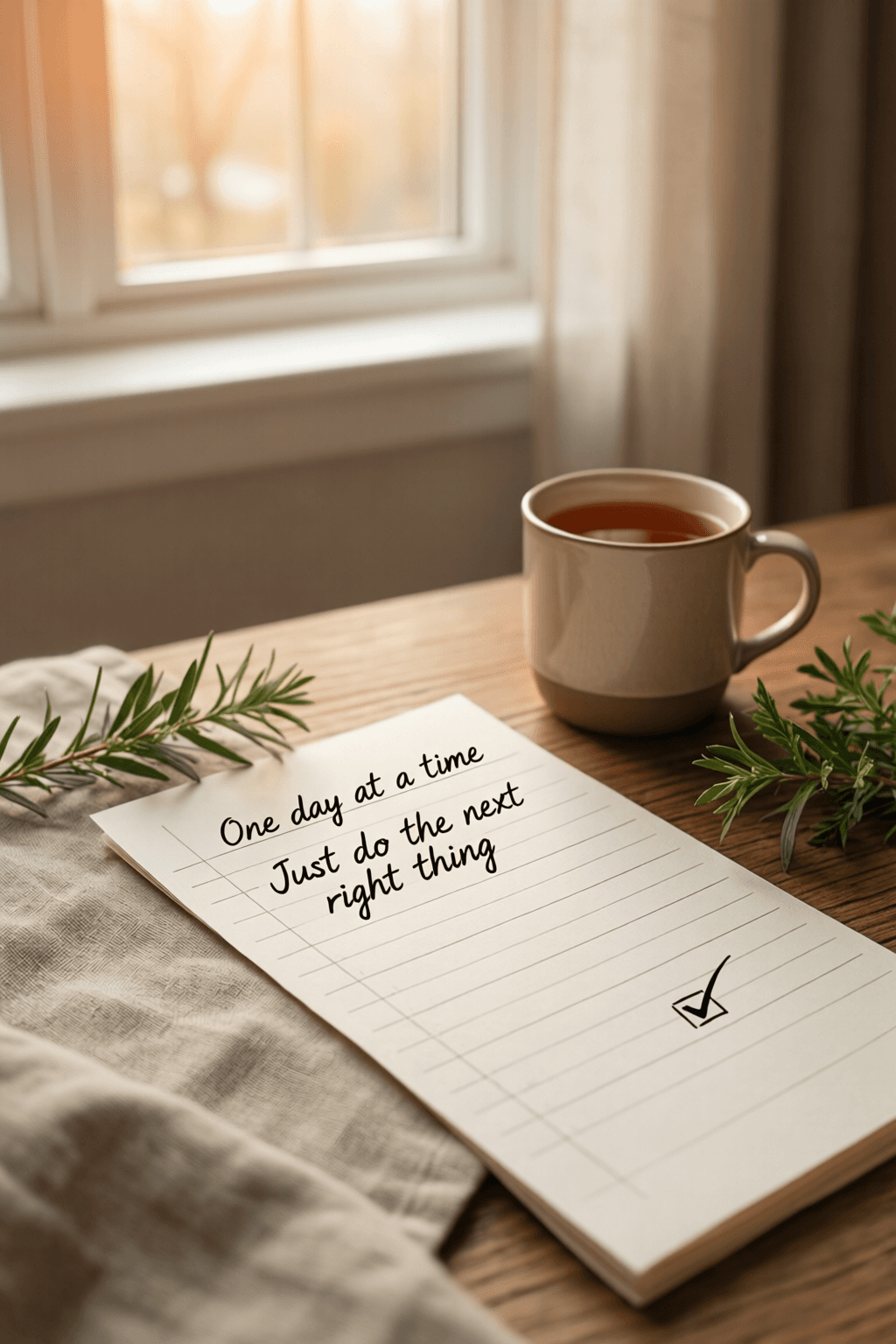
One day at a time. It's the only way to live, really. Just do the next right thing. — Anna Quindlen
—What lingers after this line?
The Power of a Narrow Horizon
At first glance, Anna Quindlen’s advice sounds simple, yet its strength lies in how deliberately it narrows our focus. By urging us to live “one day at a time,” she challenges the exhausting habit of managing an entire future in our heads. Life becomes more livable when it is reduced to the present day and the next necessary action. In that sense, “just do the next right thing” is not a slogan of passivity but of discipline. Rather than waiting for certainty or perfect plans, it asks for moral clarity in small increments. Step by step, this approach turns an overwhelming life into a series of manageable choices.
A Remedy for Modern Overwhelm
From there, the quote speaks directly to a modern condition: chronic overload. Many people live under the pressure of long to-do lists, future anxieties, and constant comparison, so Quindlen’s counsel feels almost radical. It gives permission to stop rehearsing every possible outcome and instead return to what can actually be done now. This wisdom echoes psychological practices that emphasize grounding in the present. Cognitive and behavioral approaches, for instance, often help people break large fears into immediate tasks, because action tends to calm the mind more effectively than rumination. In that way, Quindlen’s line offers not just comfort but a practical method for staying functional.
Moral Clarity in Small Decisions
Yet the quote is about more than stress management; it is also ethical guidance. The phrase “the next right thing” suggests that a good life is built less through grand declarations than through ordinary acts of responsibility, kindness, and restraint. We may not always know the perfect answer, but we often know the next honest one. This idea has deep philosophical roots. Marcus Aurelius writes in his Meditations (c. 180 AD) about meeting each task according to nature and reason, while Alcoholics Anonymous popularized “one day at a time” as a way to make recovery morally and emotionally possible. In both cases, integrity is sustained not in sweeping abstractions but in repeated daily choices.
How Small Steps Create Endurance
Once this mindset takes hold, it becomes a source of resilience. People enduring grief, illness, recovery, or major change often discover that they cannot carry the full weight of tomorrow. What they can do, however, is get through the morning, make one phone call, prepare one meal, or tell one truth. An anecdotal truth found in memoir and caregiving literature alike is that survival frequently depends on shrinking time into bearable units. Therefore, Quindlen’s wisdom is not naive optimism; it is a strategy for endurance. By limiting the frame, we preserve strength. And by doing what is right in the immediate moment, we gradually rebuild a sense of agency that distress so often steals.
A Humble Philosophy of Living
Ultimately, the beauty of Quindlen’s statement is its humility. It does not promise mastery over fate, complete self-knowledge, or a perfectly ordered life. Instead, it proposes a humane alternative: attend to today, and when in doubt, choose the next decent action. That modest pattern, repeated over time, becomes a way of living with both realism and grace. As a result, the quote endures because it honors human limits without surrendering human responsibility. We are not asked to solve existence all at once. We are only asked to inhabit this day faithfully—and then, when the next moment comes, to meet it in the same way.
One-minute reflection
What feeling does this quote bring up for you?
Related Quotes
6 selectedRest for you could look like moving slower as you clean the house or being mindful while you make a meal. It probably means being nicer to yourself. — Jeff Brown
Jeff Brown
At first glance, Jeff Brown’s reflection challenges the common idea that rest only happens when all activity stops. Instead, he suggests that rest can exist inside ordinary moments: in the pace we choose, the attention w...
Read full interpretation →Your worth is not a spreadsheet. You are not a project to be completed, but a life to be experienced. Stop measuring and start breathing. — Anne Lamott
Anne Lamott
Anne Lamott’s quote begins by confronting a habit many people barely notice: treating human value as if it could be tabulated. A spreadsheet symbolizes order, productivity, and comparison, yet it also reduces complexity...
Read full interpretation →The secret of all great undertakings is hard work and self-reliance, but the secret of all great living is to enjoy the small, slow moments in between. — Theodore Roosevelt
Theodore Roosevelt
At its core, Theodore Roosevelt’s reflection proposes that a meaningful life rests on two complementary disciplines. On one side stand hard work and self-reliance, the qualities that make great undertakings possible; on...
Read full interpretation →To be fully alive is to allow yourself the grace of slowing down. — Thich Nhat Hanh
Thich Nhat Hanh
Thich Nhat Hanh’s words begin with a gentle challenge to modern life: we often mistake speed for vitality, as though being busy proves that we are truly living. Yet his insight reverses that assumption.
Read full interpretation →The slower the living, the greater the sense of fullness and satisfaction. — Ann Voskamp
Ann Voskamp
Ann Voskamp’s line proposes a quiet reversal of modern values: instead of equating a full life with a crowded schedule, she links fullness to slowness. At first glance, this seems countercultural, even impractical, becau...
Read full interpretation →Quietude is not a retreat from the world, but a way to inhabit it with more intention and less noise. — Pico Iyer
Pico Iyer
At first glance, quietude may seem like withdrawal, as if silence were simply an escape from obligation and activity. Yet Pico Iyer’s remark overturns that assumption by presenting stillness as a mode of deeper presence.
Read full interpretation →More From Author
More from Anna Quindlen →Books are the plane, and the train, and the road. They are the destination and the journey. — Anna Quindlen
Anna Quindlen’s image of books as “the plane, and the train, and the road” reframes reading as movement rather than mere consumption. Instead of static stacks of paper, books become vehicles that carry us outward and inw...
Read full interpretation →The most important thing in life is to stop saying 'I wish' and start saying 'I will.' — Anna Quindlen
Anna Quindlen’s injunction invites a decisive shift: move from the comfort of imagining to the discomfort of doing. A wish names desire; a will names direction.
Read full interpretation →The thing that is really hard, and really amazing, is giving up on being perfect and starting the work of becoming yourself. — Anna Quindlen
This quote underscores the difficulty of releasing the societal or personal pressure to be perfect. It highlights that true growth begins when you stop striving for perfection and focus on authentic self-discovery.
Read full interpretation →The life you have led doesn’t need to be the only life you have. — Anna Quindlen
This quote emphasizes that individuals are not confined to their past experiences. It encourages embracing change and seeking new paths in life.
Read full interpretation →