
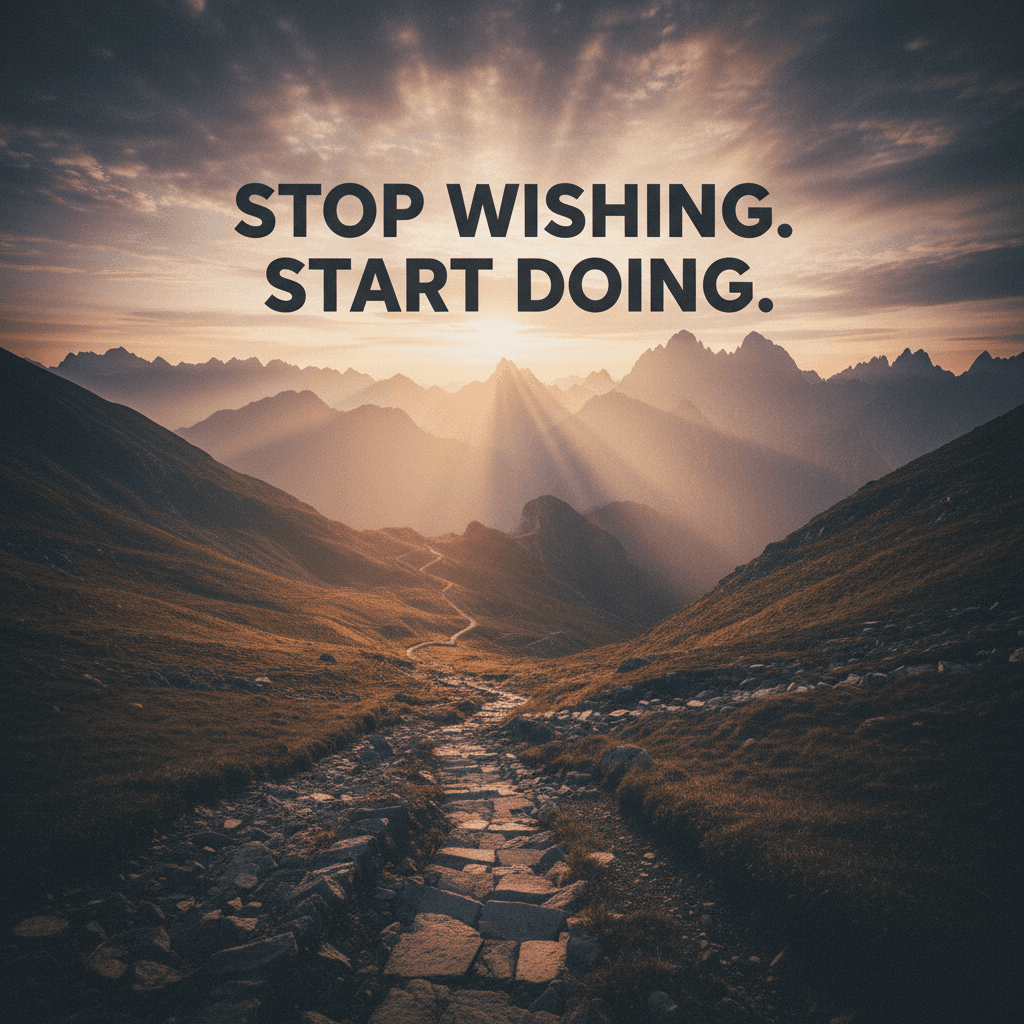
The most important thing in life is to stop saying 'I wish' and start saying 'I will.' — Anna Quindlen
—What lingers after this line?
From Wish to Will
Anna Quindlen’s injunction invites a decisive shift: move from the comfort of imagining to the discomfort of doing. A wish names desire; a will names direction. By replacing 'I wish' with 'I will,' we convert vague hope into a committed stance toward reality, accepting the weight of choice and the responsibility of follow-through. This pivot reshapes identity, because we become the kinds of people who act rather than merely aspire.
The Psychology of Intention
To translate resolve into results, psychology points to implementation intentions—if-then plans that pre‑decide behavior (Gollwitzer, 1999). Saying 'I will run at 7 a.m. in the park if it isn’t raining, and on the treadmill if it is' outsources willpower to a clear script. Likewise, the Theory of Planned Behavior shows that strong intentions coupled with perceived control predict action (Ajzen, 1991). Thus, Quindlen’s 'I will' is not empty bravado; it is the cognitive trigger that organizes context, timing, and obstacles into a practicable path.
Habits Make Will Visible
Yet even the best intention dissolves without repetition. Aristotle’s Nicomachean Ethics (Book II) argues that virtue is formed by habit; we become just by doing just acts. Centuries later, William James in The Principles of Psychology (1890) urged guarding the first act, because habits set like plaster. In this lineage, 'I will' is the spark, but routine is the flame that endures. By ritualizing small, daily steps, willpower is conserved, and identity coheres around consistent action.
Stories of Resolve in Motion
History and culture echo this pattern. John F. Kennedy’s 1962 pledge—'we choose to go to the Moon'—channeled a national 'we will' into engineers’ checklists and astronauts’ training, culminating in Apollo 11’s landing in 1969. On a personal scale, J. K. Rowling wrote in cafés, persisted through multiple rejections, and kept submitting until publication in 1997; perseverance turned a private vow into a public phenomenon. In both cases, a declarative will became coordinated, measurable effort.
Translating Will Into Plans
Practically, 'I will' gains traction when it specifies what, where, and when. The S.M.A.R.T. framing (Doran, 1981) compresses ambition into concrete targets; David Allen’s 'next actions' turn projects into the very next visible step (Getting Things Done, 2001). Moreover, lowering friction—laying out running shoes, scripting a call, pre‑drafting an email—makes the intended behavior the path of least resistance (Fogg, 2009). In this way, will becomes a design problem solved in advance.
Working with Fear and Setbacks
Even so, fear shadows every 'I will.' Stoic premeditatio malorum—rehearsing obstacles—helps convert anxiety into preparation (Seneca, Letters). Meanwhile, a growth mindset reframes failure as data rather than verdict (Dweck, 2006). By precommitting to post‑mortems—what worked, what didn’t, what to change—the inevitable stumbles become scaffolding. Thus, courage is not the absence of fear; it is the discipline of re‑engaging the plan after fear speaks.
Accountability and Shared Commitment
Finally, will strengthens in company. Commitment contracts raise follow‑through; deposit contracts for smoking cessation improved quit rates when people risked their own money (Giné, Karlan, and Zinman, 2010). Team dynamics can also elevate effort: the Köhler effect shows that weaker members increase exertion alongside stronger partners (Hertel, Kerr, and Messé, 2000). By making promises public and pairing with others, we turn 'I will' into 'we will,' multiplying both pressure and support.
One-minute reflection
Where does this idea show up in your life right now?
Related Quotes
6 selectedTo ignite your life you must focus on one thing long enough for it to catch fire. — Gary Keller
Gary Keller
Gary Keller’s quote begins with a simple but demanding idea: transformation rarely comes from scattered effort. To “ignite your life” is to create momentum, meaning, and visible progress, yet that spark needs sustained a...
Read full interpretation →We will either find a way, or make one. — Hannibal Barca
Hannibal Barca
At its core, Hannibal Barca’s line is a declaration that obstacles do not end the story; they merely change the method. Rather than waiting for ideal conditions, he frames action itself as the answer: if a route exists,...
Read full interpretation →If you have a dream, don’t just sit there. Gather courage to believe that you can succeed and leave no stone unturned to make it a reality. — Roopleen
Roopleen
Roopleen’s quote begins with a refusal of passivity: having a dream is not enough if it remains only a private wish. Instead, the statement urges movement, suggesting that aspiration gains meaning only when paired with d...
Read full interpretation →The brick walls are there for a reason... to give us a chance to show how badly we want something. — Randy Pausch
Randy Pausch
At first glance, Randy Pausch’s line turns frustration into meaning. Rather than treating barriers as pointless interruptions, he frames them as tests that reveal the seriousness of our intentions.
Read full interpretation →You cannot command things, but you can command yourself. — Michael D. Pollock
Michael D. Pollock
At first glance, Michael D. Pollock’s line draws a sharp boundary between the outer world and the inner one.
Read full interpretation →If you are not willing to learn, no one can help you. If you are determined to learn, no one can stop you. — Zig Ziglar
Zig Ziglar
Zig Ziglar’s quote begins with a blunt truth: learning cannot be forced from the outside. Teachers, mentors, and books may offer guidance, yet none of them can move a closed mind.
Read full interpretation →More From Author
More from Anna Quindlen →One day at a time. It's the only way to live, really. Just do the next right thing. — Anna Quindlen
At first glance, Anna Quindlen’s advice sounds simple, yet its strength lies in how deliberately it narrows our focus. By urging us to live “one day at a time,” she challenges the exhausting habit of managing an entire f...
Read full interpretation →Books are the plane, and the train, and the road. They are the destination and the journey. — Anna Quindlen
Anna Quindlen’s image of books as “the plane, and the train, and the road” reframes reading as movement rather than mere consumption. Instead of static stacks of paper, books become vehicles that carry us outward and inw...
Read full interpretation →The thing that is really hard, and really amazing, is giving up on being perfect and starting the work of becoming yourself. — Anna Quindlen
This quote underscores the difficulty of releasing the societal or personal pressure to be perfect. It highlights that true growth begins when you stop striving for perfection and focus on authentic self-discovery.
Read full interpretation →The life you have led doesn’t need to be the only life you have. — Anna Quindlen
This quote emphasizes that individuals are not confined to their past experiences. It encourages embracing change and seeking new paths in life.
Read full interpretation →