
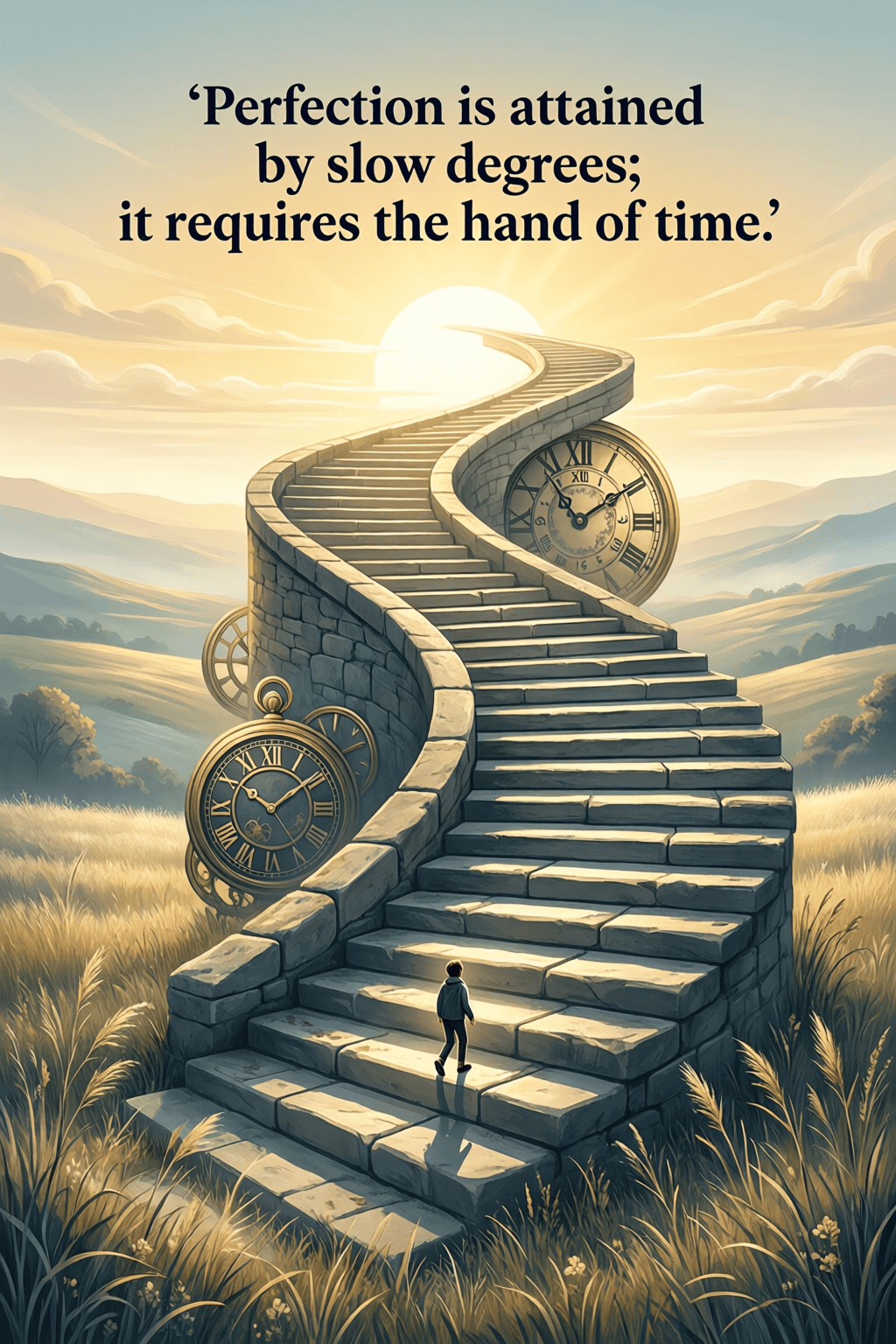
Perfection is attained by slow degrees; it requires the hand of time. — Voltaire
—What lingers after this line?
A Gradual Vision of Excellence
Voltaire’s remark begins with a quiet correction to human impatience: perfection is not seized in a moment but approached step by step. By saying it is attained “by slow degrees,” he frames excellence as a process of accumulation, where each revision, failure, and refinement adds something essential. What looks effortless in the end is usually the visible surface of long, unseen labor. In this way, the quote also resists the fantasy of instant mastery. Rather than glorifying brilliance alone, it honors endurance. Time is not merely a backdrop here; it is an active partner in creation, shaping judgment, deepening skill, and revealing flaws that haste would miss.
Time as a Hidden Craftsman
From that starting point, the phrase “the hand of time” becomes especially striking. Voltaire personifies time as if it were a master artisan, patiently smoothing rough edges that raw effort alone cannot fix. A sculptor may strike the stone, yet only repeated passes produce grace; similarly, character, art, and knowledge mature through sustained contact with experience. This idea appears across intellectual history. Aristotle’s Nicomachean Ethics (4th century BC) suggests virtue is formed by habit, not sudden inspiration. Likewise, cathedral builders in medieval Europe often worked across generations, trusting that beauty worthy of permanence demanded duration. Time, then, is not delay but discipline made visible.
The Moral Lesson Against Impatience
Because of this, Voltaire’s observation carries an ethical lesson as much as an aesthetic one. Impatience often drives people to abandon worthwhile efforts too soon, mistaking incompleteness for failure. Yet the quote implies that unfinished work may simply be work still ripening. To demand perfection prematurely is to misunderstand how growth actually happens. This has a human dimension as well. People often expect instant wisdom, immediate success, or flawless relationships, only to feel defeated when reality proves slower. Voltaire gently argues for humility: if time itself is required, then imperfection is not always a defect but a stage. Patience becomes not passive waiting, but disciplined trust in gradual becoming.
Art, Learning, and Revision
Seen practically, the quote applies powerfully to creative and intellectual life. Great writing is revised, musical technique is drilled, and scientific understanding advances through correction. Charles Darwin’s On the Origin of Species (1859), for instance, emerged after decades of observation and hesitation, showing how major achievements often depend on prolonged incubation rather than sudden certainty. Moreover, learners in every field discover that repetition changes perception itself. A pianist hears errors once invisible; an editor senses awkward phrasing after multiple drafts. With time, standards sharpen alongside ability. Perfection remains elusive, perhaps, but refinement becomes real precisely because slow effort teaches the eye and hand to notice more.
Human Growth Beyond Achievement
Yet Voltaire’s thought extends beyond work into the making of the self. Maturity rarely arrives as a dramatic conversion; instead, it develops through years of reflection, disappointment, restraint, and renewed effort. What we call wisdom is often only experience that has been patiently absorbed. In that sense, time shapes persons much as it shapes masterpieces. Even ordinary life offers proof. A parent grows into patience, a friend into loyalty, and a leader into judgment through repeated encounters with difficulty. These qualities cannot be rushed into existence. Thus the quote ultimately reassures us: becoming better is less about sudden transformation than about remaining faithful to the long, quiet process.
A Rebuttal to the Culture of Speed
Finally, Voltaire’s sentence feels especially relevant in an age that celebrates immediacy. Modern culture prizes rapid results, viral success, and constant optimization, often treating slowness as weakness. Against that pressure, his words defend a deeper rhythm of accomplishment, one in which durability matters more than spectacle and steady progress outranks quick applause. As a result, the quote invites a calmer ambition. It does not discourage striving; rather, it teaches that what is most valuable may require extended seasons of obscurity and effort. Perfection, if it comes at all, comes with time’s touch—slowly, almost imperceptibly, until one day the finished form seems to have grown naturally into being.
One-minute reflection
Where does this idea show up in your life right now?
Related Quotes
6 selectedOnly those who have the patience to do simple things perfectly ever acquire the skill to do difficult things easily. — James J. Corbett
James J. Corbett
At first glance, Corbett’s remark seems to praise modest discipline, yet it points to something deeper: greatness begins with a willingness to repeat basic actions until they become exact. Simple things are rarely truly...
Read full interpretation →Good character is not formed in a week or a month. It is created little by little, day by day. — Heraclitus
Heraclitus
Heraclitus reminds us that good character is not a sudden achievement but a gradual construction. Like a path worn into the earth by repeated footsteps, integrity, patience, courage, and kindness emerge through daily pra...
Read full interpretation →The soul is trained for courage when we show patience under hardships. — Diogenes
Diogenes
Diogenes’ statement begins with a striking reversal: courage is not merely proven in sudden danger but trained through endurance. By saying the soul is strengthened when we show patience under hardship, he presents brave...
Read full interpretation →Patience is not merely a virtue but a fundamental component of craftsmanship; it is the quiet companion that guides the steady hand. — Tadao Ando
Tadao Ando
At first glance, Tadao Ando’s words seem to praise patience as a moral quality, but he goes further by placing it at the center of making. Craftsmanship is not only skill with tools or mastery of materials; it is the dis...
Read full interpretation →Patience is not passive waiting. Patience is active acceptance of the process required to attain your goals and dreams. — Ray Davis
Ray Davis
Ray Davis’s words begin by correcting a common misunderstanding: patience is not the same as doing nothing. Passive waiting suggests resignation, as if time alone will deliver success.
Read full interpretation →Slow progress today is often stable progress tomorrow. Fast growth collapses easily. Slow growth holds. — Timeless Type
Timeless Type
At first glance, slow progress can feel discouraging, especially in a culture that praises speed, sudden breakthroughs, and visible success. Yet the quote reminds us that what seems unimpressive today may become the foun...
Read full interpretation →More From Author
More from Voltaire →The most original writers borrowed one from another. — Voltaire
At first glance, Voltaire’s remark seems to undermine originality by tying it to borrowing. Yet that tension is precisely his point: great writing rarely appears from a vacuum.
Read full interpretation →Appreciation is a wonderful thing. It makes what is excellent in others belong to us as well. — Voltaire
At first glance, Voltaire’s remark seems simple, yet it contains a generous idea: when we truly appreciate another person’s excellence, we do not merely observe it from a distance—we participate in it. Admiration becomes...
Read full interpretation →To my wonderful family, I'm so grateful for every moment we share. — Voltaire
At first glance, this line reads like a brief note of thanks, yet its emotional power comes from how directly it ties gratitude to shared life. By addressing ‘my wonderful family,’ the speaker does more than praise relat...
Read full interpretation →Originality is nothing but judicious imitation. — Voltaire
At first glance, Voltaire’s remark seems self-defeating: how can originality come from imitation? Yet his point is subtler than it appears.
Read full interpretation →