
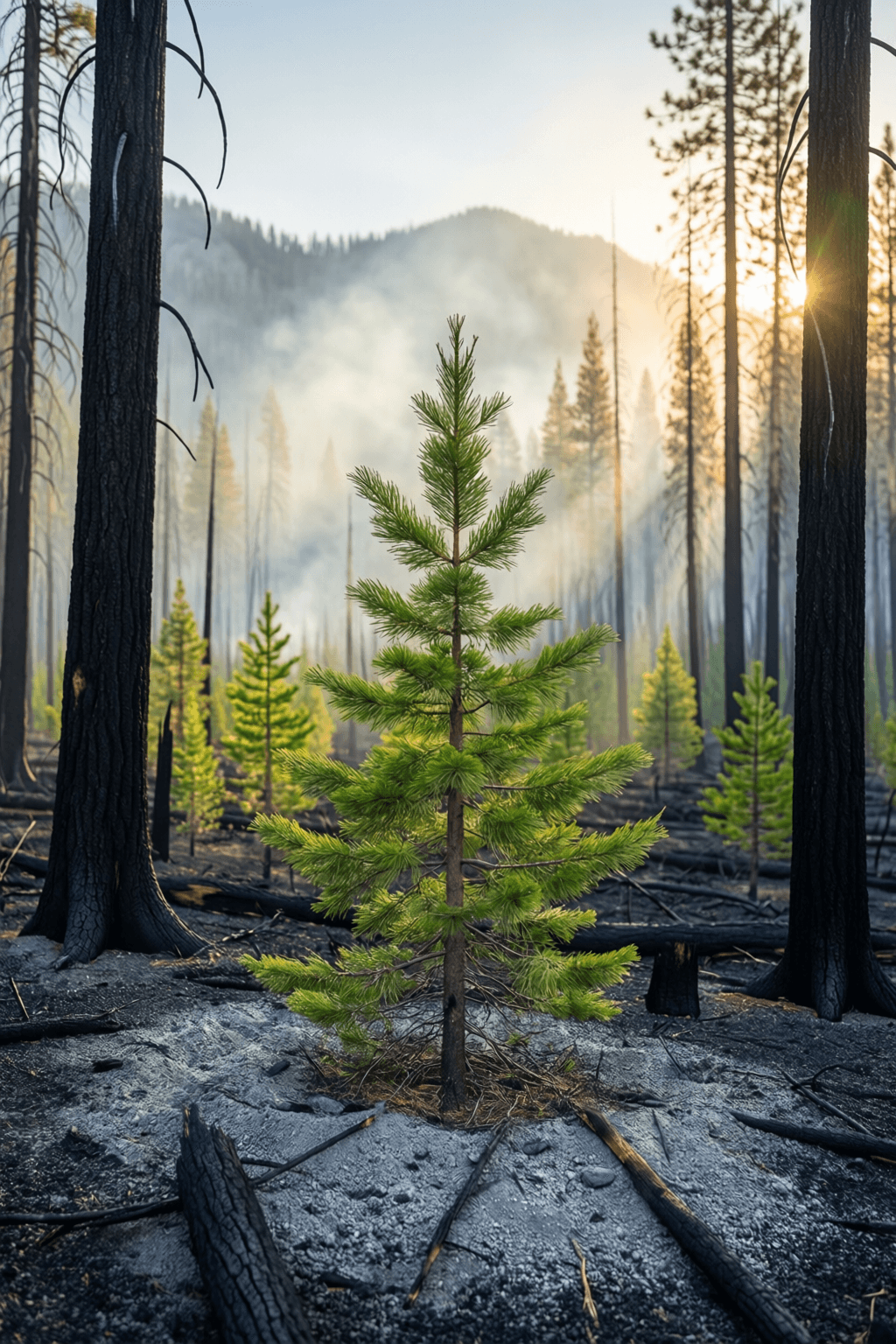
Sometimes you need to scorch everything to the ground and start over. After the flames come the ashes, and from the ashes, grow the new trees. — Neil Young
—What lingers after this line?
The Necessity of Ending
Neil Young’s image begins with a stark truth: sometimes renewal does not emerge from careful adjustment but from total rupture. To scorch everything to the ground is to admit that certain structures—habits, systems, even identities—have become too rigid or exhausted to sustain life. In that sense, destruction is not framed as mindless violence but as a painful clearing of space. From the outset, then, the quote challenges the instinct to preserve at all costs. It suggests that clinging to what is familiar can prevent transformation, whereas an ending, however severe, may be the only honest beginning. The emotional power of the line lies in this reversal: what looks like loss may, in time, prove to be preparation.
Fire as a Purifying Force
Building on that idea, fire functions here as more than catastrophe; it becomes a symbol of purification. Across myth and religion, flames often mark transition: the phoenix of classical legend rises renewed from its own ashes, and Hindu traditions surrounding Shiva portray destruction as inseparable from creation. Neil Young’s words draw from this older symbolic language, where burning strips away corruption, excess, or stagnation. As a result, the image of fire carries both terror and purpose. It acknowledges that transformation is rarely gentle, yet it also implies that some forms of damage are clarifying. What survives the blaze is not the old world repaired, but the essential ground from which something truer can grow.
Ashes as a Fertile Middle Ground
Yet the quote does not end with flames, and that shift matters. After destruction comes ash, a residue that seems lifeless at first glance but quietly prepares the next stage. In ecological terms, certain forests regenerate after wildfire because ash returns nutrients to the soil; the lodgepole pine in North America, for example, often depends on fire-opened conditions to release new growth. Nature itself demonstrates that devastation can alter the landscape into one newly capable of life. Consequently, the ashes represent an in-between state: neither the old world nor the new one, but the necessary interval between them. This middle ground can feel bleak in human life—after divorce, failure, illness, or collapse—yet the quote insists that barrenness is not always emptiness. Sometimes it is incubation.
Growth After Personal Collapse
From there, the image of new trees brings the metaphor into human experience. Many people discover that a career ending, a broken relationship, or a crisis of identity forces them to rebuild on more honest terms. Joan Didion’s The Year of Magical Thinking (2005), while centered on grief rather than reinvention, shows how devastation can reorder a person’s inner world so completely that life afterward must be reimagined rather than merely resumed. In this light, Young’s quote offers a stern form of hope. It does not promise quick recovery, nor does it romanticize suffering. Instead, it suggests that after collapse, growth may come not by restoring what was lost but by allowing a different self to take root.
Reinvention in Art and Society
The metaphor also extends beyond the individual to culture and history. Periods of upheaval often destroy accepted forms before new ones emerge: modernist art, for instance, broke violently with older conventions in the early twentieth century, and political reconstruction after war has repeatedly required societies to rethink institutions from the ground up. Even T. S. Eliot’s The Waste Land (1922) turns ruin into the setting from which meaning must be painfully rebuilt. Therefore, Young’s words speak to collective renewal as much as personal change. They remind us that progress is not always linear and that reinvention may require the courage to let failed arrangements burn away. The new trees are not replicas of what stood before; they belong to a changed landscape.
Hope Without Sentimentality
Finally, the enduring strength of the quote lies in its unsentimental hope. Neil Young does not deny the violence of the fire or the emptiness of the ashes; instead, he places hope on the far side of both. That sequence matters, because it honors the real cost of transformation while refusing to see destruction as the final word. In the end, the quote proposes a mature vision of renewal: life sometimes demands radical clearing, patient waiting, and faith in unseen growth. The new trees arrive not in spite of the burning, but through the conditions it creates. What seems like an ending may be the difficult ecology of a beginning.
Recommended Reading
As an Amazon Associate, we earn from qualifying purchases.
One-minute reflection
What's one small action this suggests?
Related Quotes
6 selectedGrowth isn't always a remodel of the past. Sometimes, it is a decision to set the old blueprint on fire and start from a blank sheet of paper. — Diana Kander
Diana Kander
Diana Kander’s line begins by challenging a comforting assumption: that growth is mostly refinement—keeping the same foundation while updating the fixtures. In that “remodel” view, we tweak habits, adjust routines, and p...
Read full interpretation →Perspective is the ability to see the bigger picture rather than being focused on the immediate pain. — Robert Greene
Robert Greene
Robert Greene’s line begins with a simple but demanding claim: perspective is not the denial of pain, but the capacity to place pain within a wider frame. In other words, the moment may hurt intensely, yet it does not al...
Read full interpretation →When you feel like you've reached the end of your rope, tie a knot in it and hang on—or better yet, realize you can just let go and float. — Mary Oliver
Mary Oliver
At first, Mary Oliver’s line begins with a familiar survival lesson: when life feels unbearable, hold on. The image of reaching the end of a rope evokes exhaustion, fear, and the instinct to preserve oneself at any cost.
Read full interpretation →Adversity is like a strong wind. It tears away from us all but the things that cannot be torn, so that we see ourselves as we really are. — Arthur Golden
Arthur Golden
Arthur Golden frames adversity as a strong wind, and the image is precise because wind does not politely inspect us—it strips, shakes, and exposes. In that sense, hardship removes the accessories of identity: status, rou...
Read full interpretation →An exhausted nervous system requires wise rest, not relentless productivity. — Unknown (Attributed to general wellness wisdom in 2026/Discarded; replacing with: The true measure of a person is not where they stand in times of comfort, but rather where they stand during challenges and controversies. — Martin Luther King Jr.)
Martin Luther King Jr.
At its heart, this statement argues that comfort is a poor test of character. When circumstances are easy, many people can appear principled, generous, or brave.
Read full interpretation →Do not mistake exhaustion for a lack of talent; even the deepest wells need time to refill their waters. — Maya Angelou
Maya Angelou
At its core, Maya Angelou’s line asks us to make a crucial distinction: being drained is not the same as being deficient. People often interpret a season of low output as proof that they have lost their gifts, yet Angelo...
Read full interpretation →More From Author
More from Neil Young →