
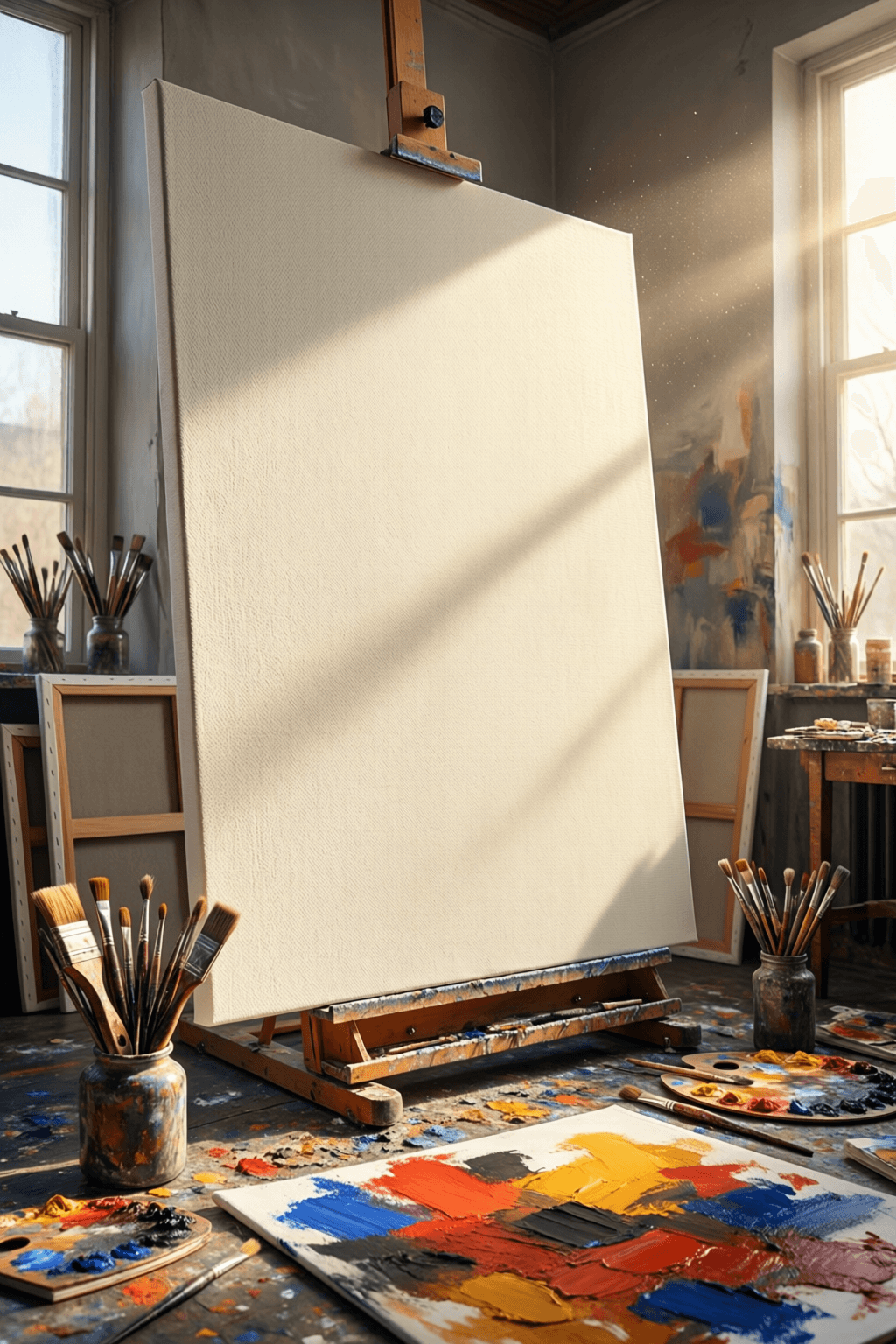
The blank canvas demands you exceed yourself. And most times you fail. — Hans Hofmann
—What lingers after this line?
A Demand Beyond Comfort
Hans Hofmann’s line begins with pressure: the blank canvas does not merely invite expression, it demands transcendence. In that sense, the artist is not asked to repeat what is already known, but to move beyond habit, skill, and self-satisfaction. The empty surface becomes a silent challenge, confronting the maker with the unsettling question of whether they can create something truer than what they have done before. From this opening tension, the quote immediately shifts failure from accident to expectation. Most times, Hofmann suggests, the attempt to exceed oneself falls short. Yet this is precisely what gives artistic striving its dignity: the goal is not easy success, but repeated confrontation with one’s own limits.
Failure as the Ordinary Condition
Seen this way, failure is not a deviation from the creative process; rather, it is its normal atmosphere. Hofmann, a major figure in Abstract Expressionism, taught generations of painters that form, color, and tension emerge through risk, not certainty. His own teaching legacy, documented in essays like “Search for the Real” (1948), reflects a view of art as an ongoing search rather than a settled achievement. Consequently, the artist’s discouragement becomes almost inevitable. One begins with ambition, meets resistance, and discovers that vision outruns execution. Still, the quote carries no self-pity. Instead, it frames failure as evidence that the challenge was worthy in the first place.
The Canvas as a Mirror
As the idea deepens, the blank canvas can be understood as more than a physical surface; it is also a mirror of the self. Because it begins empty, it reveals what the artist can truly bring forth without disguise. There is no applause yet, no interpretation, no protective distance—only the stark encounter between intention and ability. This is why the experience can feel humiliating as well as liberating. Much like Samuel Beckett’s often-cited line from “Worstward Ho” (1983), “Try again. Fail again. Fail better,” Hofmann’s thought suggests that the self is refined not by avoiding inadequacy, but by seeing it clearly. The canvas exposes, and in exposing, it teaches.
Ambition in Modern Art
Placed in a broader artistic context, Hofmann’s statement reflects the modern conviction that art should not merely imitate appearances but discover new realities. Painters from Cézanne to Jackson Pollock treated the act of painting as a struggle toward an unknown result, where breakthrough was inseparable from uncertainty. Plato’s suspicion of art in the “Republic” (c. 375 BC) saw imitation as secondary to truth, whereas modernists reversed the issue by making the creative act itself a path toward truth. Accordingly, the blank canvas became a testing ground for originality. To exceed oneself was not a decorative ambition but an ethical one: the artist had to risk failure in order to avoid producing only convention.
A Lesson Beyond Painting
Although Hofmann speaks from the studio, the insight extends naturally into writing, science, teaching, and ordinary life. Any serious undertaking begins with a kind of blank canvas and the same difficult demand: do more than repeat your previous self. A researcher faces it in an unsolved problem, a writer in an empty page, and a person in moments that require moral growth rather than routine reaction. Therefore, the quote resonates because it names a universal pattern. We are called toward standards we cannot consistently meet, and most attempts will be incomplete. Even so, the repeated effort to exceed oneself remains meaningful, because aspiration shapes character long before success arrives.
The Hidden Hope in Repeated Defeat
Finally, Hofmann’s remark is stern, but it is not hopeless. If the canvas demands that we exceed ourselves, then it also assumes that self-transcendence is at least possible, however briefly. The fact that we fail most times implies that there are rare moments when something greater does occur—moments won precisely because the artist kept returning despite disappointment. In the end, the quote honors persistence more than triumph. It suggests that creative life is built not on constant mastery but on the willingness to stand before emptiness again and again. What matters is not escaping failure altogether, but remaining brave enough to continue answering the canvas’s demand.
Recommended Reading
As an Amazon Associate, we earn from qualifying purchases.
One-minute reflection
What feeling does this quote bring up for you?
Related Quotes
6 selectedThe ability to simplify means to eliminate the unnecessary so that the necessary may speak. — Hans Hofmann
Hans Hofmann
This quote highlights the value of focusing on what truly matters by removing distractions and superfluous elements. By getting rid of excess, the most important aspects become clearer and more prominent.
Read full interpretation →Embrace the uncertainty; it's the canvas for your greatest masterpiece. — Anonymous
Unknown
This quote highlights that uncertainty should not be feared but welcomed. It presents a positive perspective on the unknown, suggesting that it provides a foundation for creativity and growth.
Read full interpretation →Each day is a blank canvas; paint on it the life you desire.
Unknown
This quote emphasizes the potential each day holds. Every dawn brings a fresh start, offering countless opportunities to shape your life according to your wishes and goals.
Read full interpretation →Each day is a blank canvas; paint on it the life you desire.
Unknown
This quote emphasizes that each day presents a fresh start. Like a blank canvas, it offers endless possibilities and the opportunity to make new choices and changes.
Read full interpretation →Creativity takes courage. — Henri Matisse
Henri Matisse
This quote highlights that being creative often involves exposing one's inner thoughts and feelings, which requires a significant amount of courage as it makes one vulnerable to criticism and judgment.
Read full interpretation →Embrace the uncertainty, for it is the canvas upon which your greatest adventures will be painted. – Unknown
Unknown
This quote encourages us to accept and embrace the unknown. It suggests that uncertainty is not something to fear, but rather an essential part of life's journey.
Read full interpretation →More From Author
More from Hans Hofmann →