
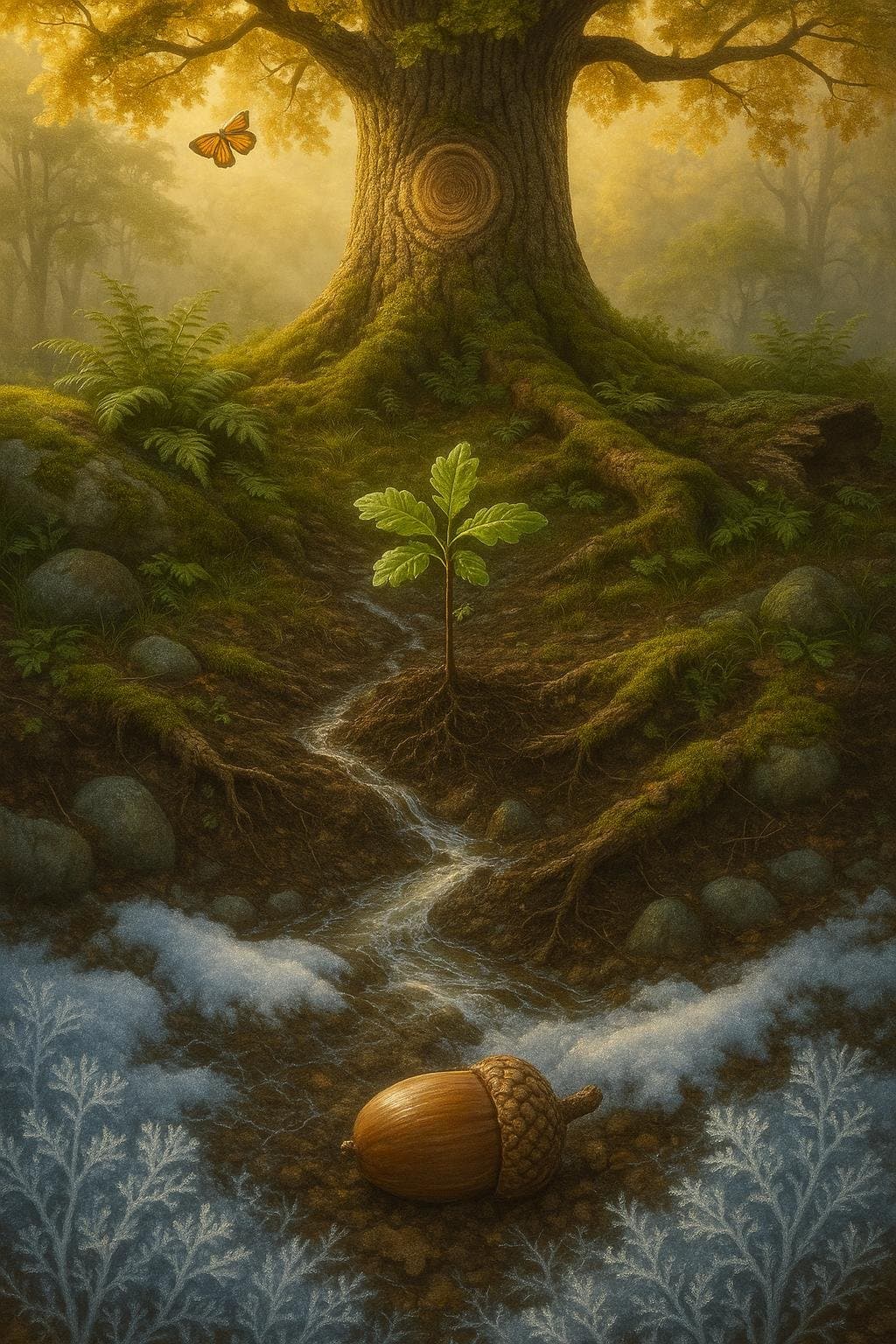
Trust the slow work of God. — Pierre Teilhard de Chardin
—What lingers after this line?
A Prayer from the Trenches
Teilhard wrote this counsel while the world convulsed. In a 1915 letter penned during his service as a World War I stretcher-bearer, he urged a young friend to “trust the slow work of God.” The text appears in The Making of a Mind: Letters from a Soldier 1914–1919 (1965), where the turbulence of battle frames his plea for patient faith. From this crucible, slowness becomes more than piety; it becomes survival. In chaos, quick fixes tempt us, yet Teilhard insists that grace matures on its own timetable. His wartime backdrop reminds us that patience is not passive resignation but an active trust forged under pressure.
Time as the Medium of Grace
Building on that context, the phrase redefines time as the very medium in which God shapes souls. Instead of demanding instant clarity, Teilhard invites us to honor processes—those awkward, half-finished stages when desires are still unformed and motives mixed. Thus, spiritual growth resembles fermentation more than fabrication. Like dough rising out of sight, transformation occurs beneath the surface. The invitation is to consent to being a work-in-progress, trusting that divine artistry prefers curing to coating.
Deep Time and Evolutionary Hope
Moreover, Teilhard’s scientific lens widened his patience. As a Jesuit paleontologist, he read the history of life across eons, then interpreted it spiritually in The Phenomenon of Man (1955). Evolution’s slow arcs suggested a God who works through process and emergence rather than interruption. Consequently, “slow” is not delay but design. The long patience of the universe—stars forming, species adapting—becomes a parable for interior development. Hope, in his view, rests on trusting an Omega-directed unfolding that exceeds our immediate horizons.
Ignatian Discernment in Motion
In the same spirit, Ignatian spirituality trains attention to gradual movements of the heart. The daily Examen notices patterns of consolation and desolation, accepting that clarity ripens over time. Rushing discernment risks confusing transient moods for lasting guidance. Therefore, trusting God’s slow work means letting desire be educated. Ignatius asks us to test attractions, wait through ambiguity, and choose by deeper freedom rather than urgency. Patience becomes the guardrail that keeps discernment honest.
Psychology of Gradual Growth
Likewise, modern psychology confirms that durable change is staged, not sudden. Erik Erikson’s developmental tasks unfold across life (Childhood and Society, 1950), while Prochaska and DiClemente map change through precontemplation to maintenance (1983). Even growth mindset research (Dweck, 2006) emphasizes iterative effort over instant mastery. Seen this way, Teilhard’s counsel aligns with evidence: premature closure—grabbing quick answers to relieve anxiety—produces brittle outcomes. By contrast, steady practice rewires habits and stabilizes identity.
Scriptural Seeds and Seasons
Scripture, too, speaks in agricultural time. James urges believers to “be patient… like the farmer waiting for the precious fruit” (James 5:7–8). Jesus’ parable of the growing seed emphasizes a hidden process—“first the blade, then the ear” (Mark 4:26–29). Ecclesiastes reminds us there is a season for every purpose (Ecclesiastes 3:1). Therefore, biblical imagination normalizes slowness. Faith watches, waters, and waits, trusting that God’s timing is purposeful even when imperceptible.
Practices for Patient Trust
Finally, this trust can be trained. Keep a brief daily Examen to notice subtle growth; name one unfolding desire without forcing its resolution. Adopt a rule of life with small, repeated commitments—Sabbath, service, silence—letting habits do slow work. When urgency spikes, practice a breath-length pause and ask, “What would trusting slowness look like here?” Over time, such practices loosen our grip on outcomes and deepen availability to grace. We do what is ours to do, and we let God take God’s time.
One-minute reflection
Where does this idea show up in your life right now?
Related Quotes
6 selectedDoing what's right sometimes requires patience. — Daisaku Ikeda
Daisaku Ikeda
At first glance, Daisaku Ikeda’s remark sounds simple, yet it points to a difficult truth: ethical action rarely delivers immediate rewards. Doing what is right often means resisting the urge for quick victory, recogniti...
Read full interpretation →Sometimes you have to slow down to go fast. — Jeff Olson
Jeff Olson
Jeff Olson’s line begins with a practical paradox: speed is not always created by rushing. Sometimes the quickest path forward requires pausing long enough to see the road clearly, correct mistakes early, and choose acti...
Read full interpretation →Everything that is great in life is the product of slow growth; the newer, and greater, and higher, and nobler the work, the slower is its growth. — William George Jordan
William George Jordan
William George Jordan’s reflection begins with a quiet but demanding truth: the most meaningful achievements rarely arrive quickly. He suggests that greatness is not manufactured in sudden bursts but cultivated through t...
Read full interpretation →You cannot force ideas. Successful ideas are the result of slow growth. — Alexander Graham Bell
Alexander Graham Bell
Alexander Graham Bell’s statement begins with a quiet warning against impatience: ideas cannot be commanded into maturity simply because we desire results. Like plants, they require conditions, time, and repeated attenti...
Read full interpretation →The moments between your milestones are not filler. — Nelou Keramati
Nelou Keramati
Nelou Keramati’s line challenges the habit of treating life as a sequence of major checkpoints: graduations, promotions, weddings, moves, and visible successes. At first glance, everything between these events can seem l...
Read full interpretation →Roses do not bloom hurriedly; for beauty, like any masterpiece, takes time to blossom. — Matshona Dhliwayo
Matshona Dhliwayo
At its heart, Matshona Dhliwayo’s quote reminds us that true beauty cannot be forced. A rose does not rush toward bloom, nor does it apologize for the time required to unfold.
Read full interpretation →More From Author
More from Pierre Teilhard de Chardin →Joy is a sign of the presence of God. — Pierre Teilhard de Chardin
This quote conveys that genuine joy is an indication of a deeper spiritual connection. It implies that experiencing joy is a reflection of God's presence in one's life or surroundings.
Read full interpretation →We are not human beings having a spiritual experience; we are spiritual beings having a human experience. — Pierre Teilhard de Chardin
This quote suggests that our essence is inherently spiritual, and our human existence is a temporary journey. It shifts the focus from viewing life as purely physical to considering a deeper, spiritual dimension.
Read full interpretation →The essence of being is to evolve. — Pierre Teilhard de Chardin
This quote suggests that evolution—continuous development and transformation—is at the core of what it means to exist.
Read full interpretation →