
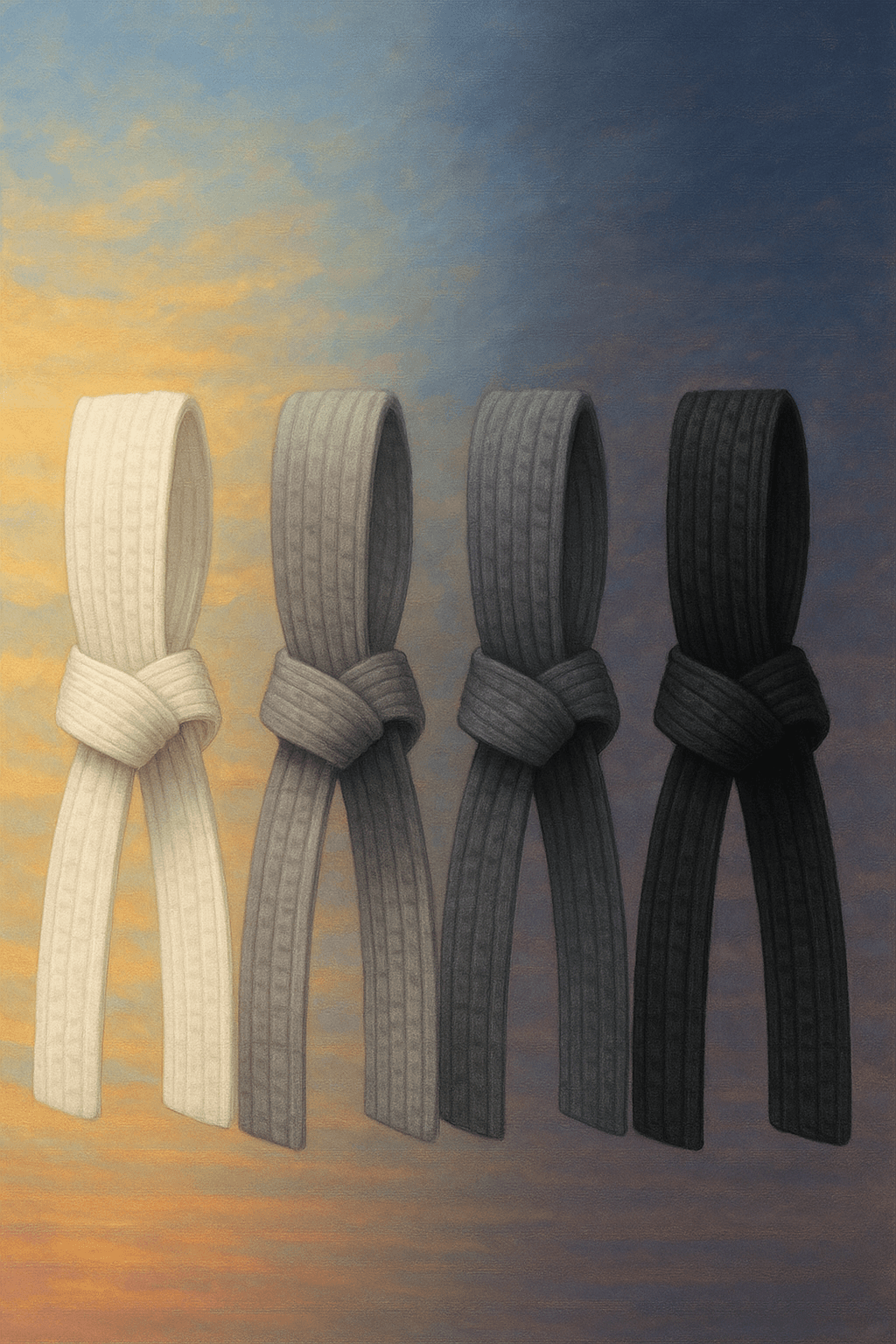
A black belt is just a white belt who never gave up. — Unknown Japanese Proverb, popularized by various martial artists
—What lingers after this line?
The Humble Beginnings of Mastery
Every martial arts journey starts with the crisp, unblemished white belt—a universal symbol of new beginnings and untapped potential. The proverb suggests that greatness is not an innate trait possessed by a select few, but rather the end result of consistent effort. Echoes of this wisdom can be found throughout Japanese martial philosophy, such as the concept of 'shoshin,' or 'beginner’s mind,' which reminds even the highest-ranked practitioners to remain humble and open to learning.
Enduring Through Failure and Frustration
Transitioning from white to black belt is seldom a linear path. Along the way, setbacks, plateaus, and moments of self-doubt are inevitable. Yet, as the saying highlights, perseverance is what distinguishes the dedicated student from those who quit. Judo founder Jigoro Kano emphasized 'maximum efficiency with minimum effort'—yet achieving such efficiency requires countless hours of imperfect practice, learning from mistakes, and returning to the mat after every fall.
The Significance of Belt Progression
The color change from white to black is not merely ceremonial; it serves as a visual affirmation of accumulated experience. Each belt earned marks a period of growth and the overcoming of specific challenges. Bruce Lee often spoke of 'daily decrease,' referring to the gradual shedding of bad habits and unnecessary forms. Thus, the belts stand not for innate talent but for the layers of discipline and resilience cultivated over time.
Lessons Beyond Martial Arts
Moving from this specific context, the white-to-black belt metaphor has found resonance in broader discussions of mastery. In creative pursuits, academic study, or entrepreneurship, initial enthusiasm often wanes in the face of obstacles. Psychologist Angela Duckworth’s research on 'grit' underscores the role of sustained effort over raw ability in determining long-term success—a sentiment that this proverb captures succinctly.
Gratitude and Lifelong Learning at the Journey’s End
Finally, many who attain the coveted black belt realize it is not an endpoint but a new beginning. In many Japanese traditions, the black belt wearer starts over as a student of deeper truths, embracing the humility of a perpetual learner. Thus, the proverb’s wisdom comes full circle, encouraging all—inside and outside the dojo—to combine persistence with humility and gratitude for every step along the way.
Recommended Reading
As an Amazon Associate, we earn from qualifying purchases.
One-minute reflection
Where does this idea show up in your life right now?
Related Quotes
6 selectedAnything worth having is worth waiting for, and everything worth doing is worth doing with patience. — Confucius
Confucius
At its core, this saying ties value to delay. Confucius suggests that truly meaningful things do not arrive instantly; instead, they ask us to endure uncertainty, effort, and time.
Read full interpretation →True craftsmanship is found in the willingness to return to the task, not for perfection, but for the beauty of the work itself. — Ursula K. Le Guin
Ursula K. Le Guin
At its core, Ursula K. Le Guin’s statement shifts attention away from flawless results and toward a deeper kind of dedication.
Read full interpretation →You cannot have everything in the present. The road to mastery requires patience. — Robert Greene
Robert Greene
Robert Greene’s statement begins with a hard truth: life does not yield all rewards at once. By saying, “You cannot have everything in the present,” he challenges the modern temptation to expect instant results, instant...
Read full interpretation →The very desire to find shortcuts makes you eminently unsuited for any kind of mastery. — Robert Greene
Robert Greene
Robert Greene’s statement cuts against a common modern instinct: the wish to advance quickly while avoiding the slow, repetitive labor that excellence demands. At first glance, shortcuts seem practical, even efficient.
Read full interpretation →You must always be willing to work without applause. — Ernest Hemingway
Ernest Hemingway
Hemingway’s line points first to a stern but liberating truth: meaningful work often happens in silence, long before anyone notices it. In this view, applause is not the engine of effort but only an occasional byproduct.
Read full interpretation →Discipline is rarely enjoyable, but almost always profitable. — Darrin Patrick
Darrin Patrick
At first glance, Darrin Patrick’s observation sounds almost severe: discipline is seldom pleasant, yet it nearly always yields returns. The quote reframes discomfort as an investment rather than a punishment.
Read full interpretation →