
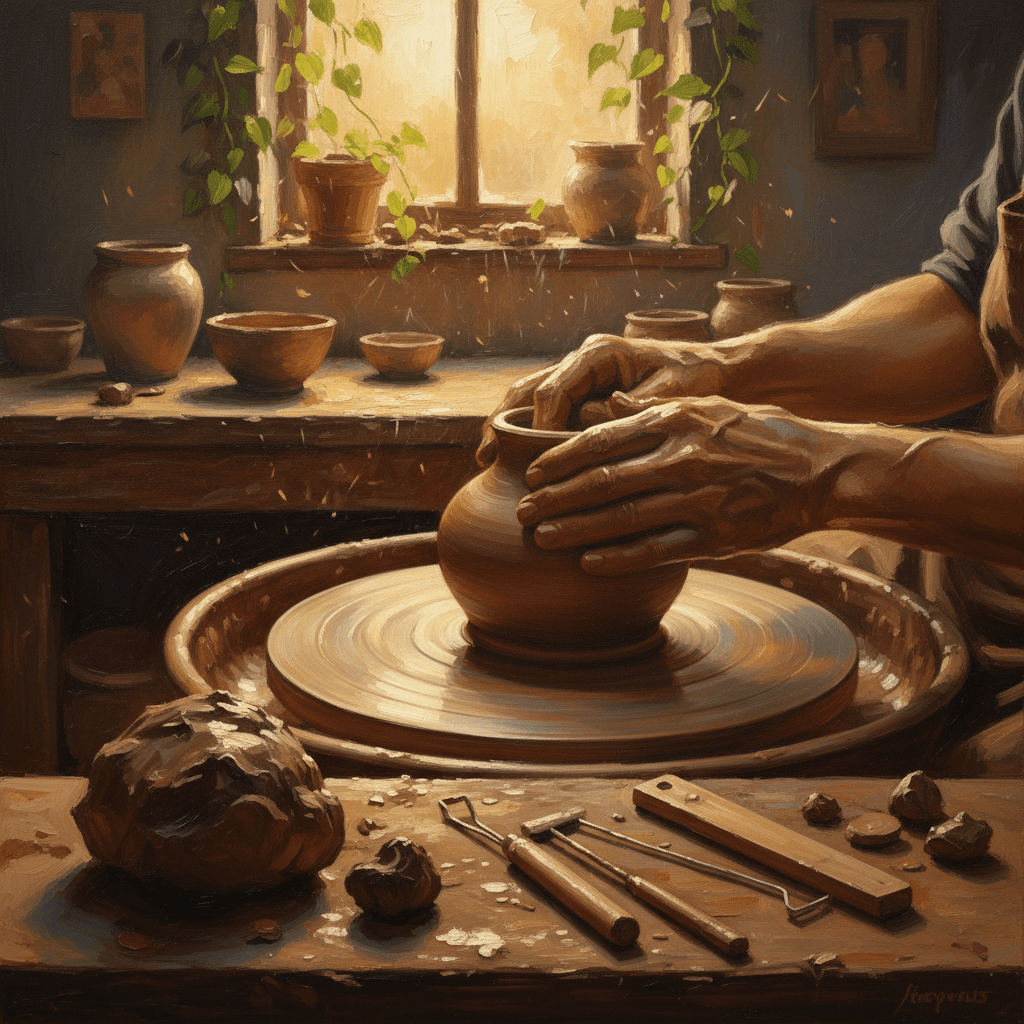
Make art of the labor; beauty rewards persistent hands. — Derek Walcott
—What lingers after this line?
Walcott’s Imperative: Art From Work
At first glance, Walcott’s imperative asks us to reverse the usual hierarchy: don’t work for the art; make the work itself the art. Born in St. Lucia, Walcott wrote of fishermen, masons, seamstresses—hands that memorize tides and threads—suggesting that beauty arises from disciplined attention to ordinary labor. In his Nobel Lecture (1992), 'The Antilles: Fragments of Epic Memory,' he evokes the patient reassembly of broken shards into a whole vessel, a metaphor for craft shaped by persistence. Thus the aphorism is less a slogan than a method: attend, repeat, refine. Beauty, in this view, is not a sudden visitation but a cumulative verdict—bestowed on those who refuse to abandon the task.
From Inspiration to Method
Building on this, the line challenges the myth of the capricious muse by relocating creativity in routine. Research on deliberate practice shows that mastery stems from structured repetition with feedback (Anders Ericsson and Robert Pool, 'Peak,' 2016). Scales for musicians, daily pages for writers, and drills for coders are not glamorous, yet they transform muscle memory and perception. By iterating a narrow skill until it becomes intuitive, the maker frees attention for nuance and surprise. Consequently, persistence is not mere grit; it is an architecture for insight, converting time into compound interest that beauty eventually pays out.
Repetition as Revelation
History bears this out. Paul Cézanne painted Mont Sainte-Victoire dozens of times (c. 1885–1906), each canvas refining structure and light; repetition revealed possibilities a single attempt could not. In Leipzig, J. S. Bach produced cantatas almost weekly (1723–1750), forging complexity through steady cadence rather than sporadic epiphany. And Rainer Maria Rilke’s portrait of Auguste Rodin emphasizes relentless work over romantic inspiration—'one must work,' he insists in 'Auguste Rodin' (1903). Across these workshops, the reward emerges gradually: persistence teaches the eye what to see and the hand how to answer.
Knowledge That Lives in the Hands
Yet the maxim is not only about schedules; it is also about how knowledge settles into the body. Richard Sennett’s 'The Craftsman' (2008) describes how feedback from tools and materials—drag of the plane, tack of the dough—guides judgment that words can’t capture. Likewise, Sōetsu Yanagi’s 'The Unknown Craftsman' (1972) celebrates humble mastery born from repeated acts until the hands seem to think for themselves. When labor is treated as art, attention heightens: the curve of a bowl, the rhythm of a sentence, the way a seam lies flat. Beauty then appears not as decoration, but as the clarity of well-learned motion.
Elevating the Everyday
Consequently, Walcott’s line applies to everyday tasks that rarely claim the name of art. Seamus Heaney’s poem 'Digging' (1966) turns the spade’s steady rhythm into a poet’s ethic: write as his forebears dug. In the same spirit, a teacher refining a lesson plan, a nurse perfecting a bandage wrap, or a developer tightening tests can pursue small perfections. Set a simple standard, iterate until it is reliable, and keep a log so learning accrues. Over time, the task begins to gleam; beauty rewards not ceremony, but care enacted repeatedly.
From Personal Craft to Shared Culture
Finally, persistence shapes communities as well as individuals. The Arts and Crafts movement—voiced by William Morris in 'The Lesser Arts' (1877)—argued for 'useful beauty' achieved through honest workmanship, an ethic echoed in Shaker design and their motto, 'Hands to work, hearts to God.' In contemporary culture, the same principle animates open‑source projects, where elegant tools emerge commit by commit. Through shared standards and patient revision, groups turn collective labor into artifacts that endure. In this wider frame, beauty’s reward is more than a polished object; it is a culture of stewardship that outlasts the maker.
One-minute reflection
What's one small action this suggests?
Related Quotes
6 selectedThe beauty of a finely worked object points to the beauty of the craftsmanship. — Paul Klee
Paul Klee
Paul Klee’s statement begins with a simple but powerful observation: a beautiful object does not merely please the eye; it points beyond itself to the intelligence, patience, and skill that shaped it. The object becomes...
Read full interpretation →Quality, manual labor, and a lot of time: that is the essence of craftsmanship. — Katarzyna Maniak
Katarzyna Maniak
At its core, Katarzyna Maniak’s statement reduces craftsmanship to three inseparable elements: quality, manual labor, and time. Rather than treating a finished object as merely a product, the quote frames it as the visib...
Read full interpretation →The beauty of craftsmanship is that it is a dialogue with time, a slow resistance against the rush of the world. — Richard Sennett
Richard Sennett
At its core, Richard Sennett’s line presents craftsmanship as more than skilled labor; it becomes a moral and temporal stance. To make something carefully is to refuse the culture of haste, where speed is often mistaken...
Read full interpretation →True craftsmanship is found in the willingness to return to the task, not for perfection, but for the beauty of the work itself. — Ursula K. Le Guin
Ursula K. Le Guin
At its core, Ursula K. Le Guin’s statement shifts attention away from flawless results and toward a deeper kind of dedication.
Read full interpretation →The beauty of craftsmanship points to the beauty of the source of the craftsmanship. — Frank Lloyd Wright
Frank Lloyd Wright
Frank Lloyd Wright’s remark begins with a simple observation: when we encounter exquisite craftsmanship, we are moved not only by the object itself but also by the mind and spirit behind it. A finely joined chair, a care...
Read full interpretation →Craftsmanship means an uncompromising dedication to excellence and durability. It means doing a job to the very best of your ability, simply because that is the basis of integrity. — The Craftsmanship Initiative
The Craftsmanship Initiative
At its core, this statement defines craftsmanship as more than technical skill; it presents excellence as an ethical obligation. To work with care, precision, and patience is not merely to produce something attractive or...
Read full interpretation →More From Author
More from Derek Walcott →