
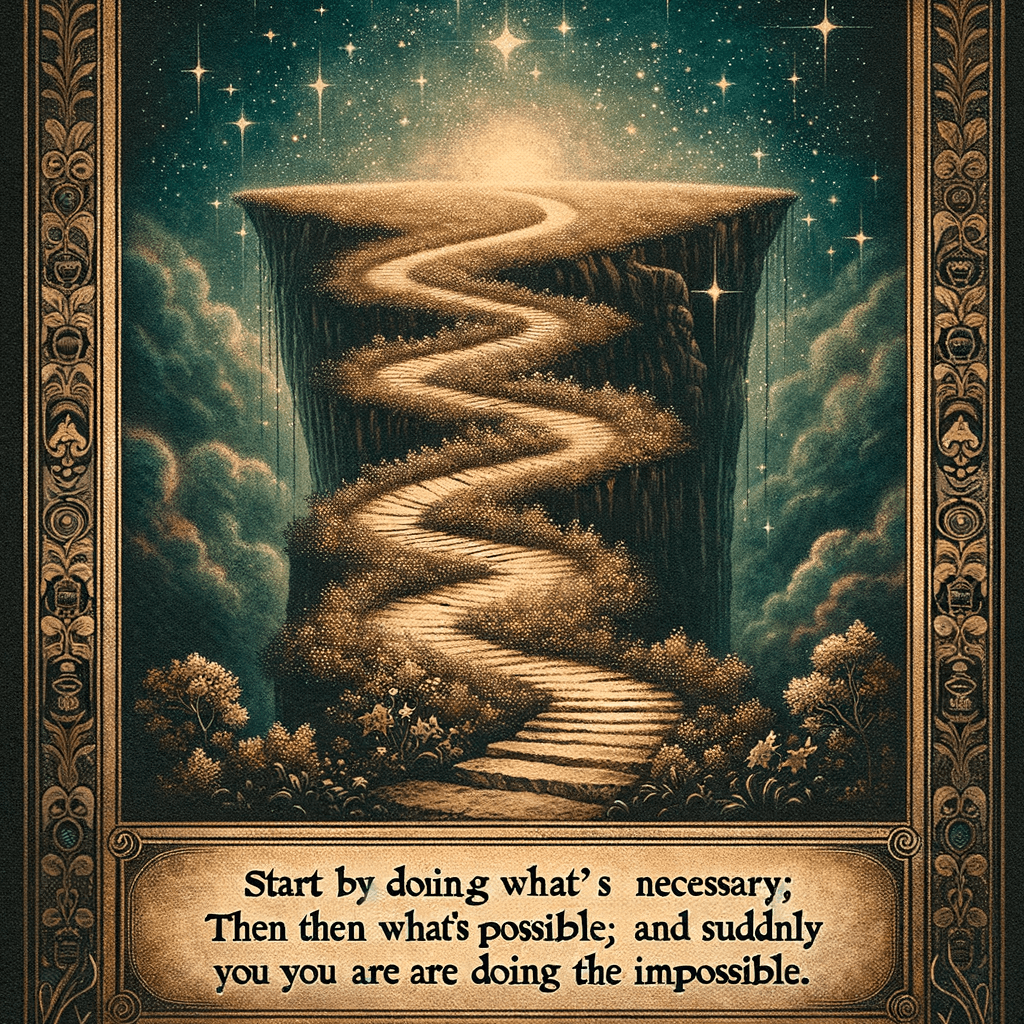
Start by doing what's necessary; then do what's possible; and suddenly you are doing the impossible. — Francis of Assisi
—What lingers after this line?
Step-by-Step Approach
This quote emphasizes the importance of taking a gradual approach to achieving goals. Starting with necessary tasks lays a foundation for further progress.
Gradual Progress
It highlights that by consistently accomplishing small, achievable tasks, you build momentum and capability to tackle more difficult challenges.
Achieving the Impossible
The idea is that what once seemed impossible can become achievable through persistent effort and incremental improvement. Over time, your ability to take on greater tasks increases.
Mindset and Perseverance
The quote underscores the power of a positive mindset and perseverance. Believing that small efforts matter can lead you to accomplish things you never thought possible.
Historical Context
Francis of Assisi, an Italian Catholic friar and preacher, founded the Franciscan Order in the early 13th century. His teachings often emphasized humility, simplicity, and gradual progress in spiritual and practical matters.
One-minute reflection
Why might this line matter today, not tomorrow?
Related Quotes
6 selectedStart by doing what's necessary; then do what's possible; and suddenly you are doing the impossible. — Francis of Assisi
Francis of Assisi
This quote emphasizes the importance of beginning with essential tasks before progressively tackling more ambitious ones. It suggests that great achievements are built step by step.
Read full interpretation →Everything seems impossible until it is done. - Nelson Mandela
Nelson Mandela
This quote highlights the notion that difficult tasks often seem insurmountable at first. However, with perseverance and determination, what once seemed impossible can ultimately be achieved.
Read full interpretation →If we are facing in the right direction, all we have to do is keep walking. — Thích Nhất Hạnh
Thich Nhat Hanh
Thích Nhất Hạnh’s words begin with a simple but profound premise: progress depends first on direction, not speed. If a person is turned toward compassion, clarity, healing, or truth, then each modest step becomes meaning...
Read full interpretation →Do the best one can. Do it over again. Then still improve, even if ever so slightly, those retouches. — Marguerite Yourcenar
Marguerite Yourcenar
Yourcenar’s words begin with a simple demand: do the best one can. Yet she immediately refuses to let effort become an excuse for stopping.
Read full interpretation →A good-enough novel violently written now is better than a perfect novel meticulously written never. — Elizabeth Gilbert
Elizabeth Gilbert
Elizabeth Gilbert’s line immediately shifts the argument from artistic purity to artistic existence. A “good-enough” novel, even one “violently written,” has entered the world and can move, provoke, or comfort someone; b...
Read full interpretation →There is no road too long to the man who advances deliberately and without undue haste; there are no honors too distant to the man who prepares himself for them with patience. — Jean de La Bruyère
Jean de La Bruyère
At its core, La Bruyère’s line praises steady movement over restless speed. A long road feels intimidating only when seen all at once; once it is broken into deliberate steps, distance loses much of its power.
Read full interpretation →More From Author
More from Francis of Assisi →He who works with his hands and his head is a craftsman. He who works with his hands and his head and his heart is an artist. — Francis of Assisi
Francis of Assisi draws a graceful line between skill and art by adding one decisive element: the heart. In his view, working with the hands and the head produces competence, discipline, and useful creation—the marks of...
Read full interpretation →Start by doing what's necessary; then do what's possible; and suddenly you are doing the impossible. — Francis of Assisi
This quote emphasizes the importance of beginning with essential tasks before progressively tackling more ambitious ones. It suggests that great achievements are built step by step.
Read full interpretation →A single sunbeam is enough to drive away many shadows. — Francis of Assisi
This quote illustrates how even the smallest amount of positivity, symbolized by a sunbeam, has the power to drive away negativity, depicted as shadows. It emphasizes that hope, no matter how small, can dispel despair or...
Read full interpretation →For it is in giving that we receive. — Francis of Assisi
This quote reflects the idea that by giving selflessly to others, we gain something even greater in return, whether it’s gratitude, joy, or spiritual fulfillment.
Read full interpretation →