
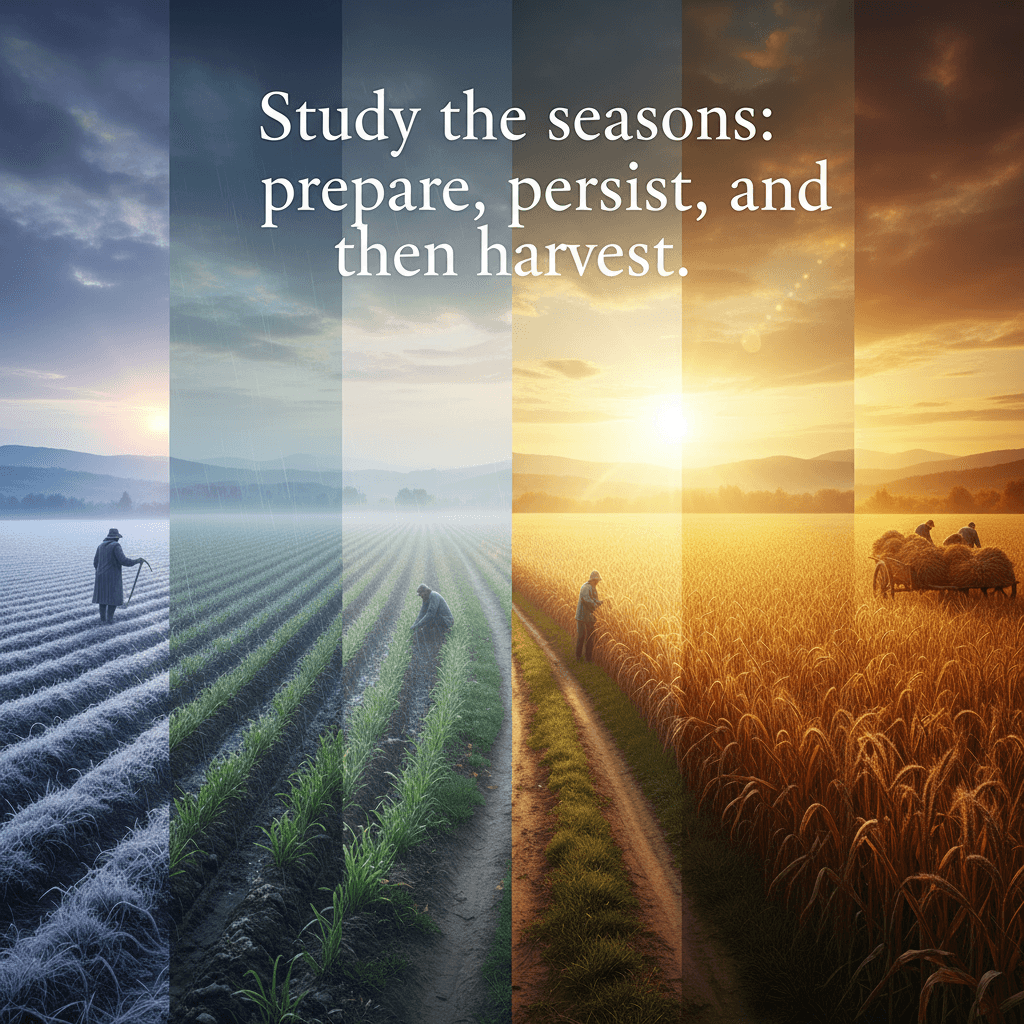
Study the seasons: prepare, persist, and then harvest. — Sun Tzu
—What lingers after this line?
Reading Time: Seasons as Strategic Intelligence
To begin, the admonition to “study the seasons” echoes Sun Tzu’s insistence on assessing “Heaven,” meaning cold and heat, night and day, and the times and seasons, before acting. The Art of War (c. 5th century BCE) treats timing not as decoration but as decisive terrain; commanders who read cycles correctly choose battles that suit them and avoid those that don’t. Thus, seasonality becomes intelligence: it reveals when resources are abundant, when morale is brittle, and when movement is feasible. By making time a domain to be surveyed like any landscape, Sun Tzu reframes success as the harmony between preparation and the calendar, reminding us that even superior skill fails when it runs against the grain of nature and circumstance.
Preparation: Quiet Work That Makes Victory Inevitable
From that insight follows preparation—the patient, often invisible labor that makes later gains look effortless. Logistics, alliances, and redundancy are sown like seed; when the climate turns favorable, they sprout. Classical historians understood this; Livy’s History of Rome (c. 25 BCE) portrays Hannibal’s Alpine crossing as a feat paid for by inadequate seasonal alignment—bravery up front, attrition in the snows afterward. Preparation is therefore not mere stockpiling; it is alignment with the clock. Gather intelligence, test assumptions, train replacements, and pre-position supplies, and the same action that once seemed risky becomes, in season, almost routine. In this way, preparation converts uncertainty into optionality, ensuring that when opportunity ripens, you are already standing in the right field.
Persistence: Enduring Friction in the Execution Phase
Once underway, persistence holds the middle. Carl von Clausewitz’s On War (1832) names this drag “friction”—the thousand small resistances that turn plans into endurance tests. Here, steadiness, not spectacle, creates compounding advantage: incremental repairs, measured tempo, and disciplined feedback loops keep momentum alive when enthusiasm fades. The endurance of Ernest Shackleton’s crew (1915–1916), surviving Antarctic isolation through routine and morale, illustrates how persistence converts hard seasons into survivable corridors. Crucially, persistence is not stubbornness; it is adaptive stamina. By revisiting assumptions and adjusting routes without abandoning the destination, leaders keep the hinge between preparation and harvest from rusting shut, carrying their teams through the unglamorous miles where most efforts quietly fail.
Harvest: Consolidate, Learn, and Avoid Overreach
Consequently, when results arrive, the task is to harvest without exhausting the soil. Sun Tzu warns that prolonged campaigns deplete the state; the Art of War cautions against victories that cost more than the enemy’s defeat. True harvest means consolidation: secure logistics, retire debts, rotate people, codify lessons, and convert transient wins into durable capacity. Moreover, restraint is strategic—pressing beyond the season risks blight. Just as a farmer leaves gleanings for reseeding, wise leaders reinvest a portion of gains into resilience: training, maintenance, and reserves. By closing the loop—celebrating, auditing, and redeploying—the harvest becomes a beginning rather than a burnout, preparing the ground for the next favorable cycle.
Modern Cycles: Markets, Projects, and Policy
Extending this logic to modern arenas, sound timing governs launches and reforms. Agile’s Manifesto (2001) institutionalizes short seasons—sprints—for building, testing, and adjusting before scaling. Similarly, the Toyota Production System emphasizes takt time—aligning work cadence to demand—to avoid both famine (idle capacity) and flood (overproduction), as Taiichi Ohno describes in Toyota Production System (1978). Policy makers, too, stage reforms: pilot, iterate, then rollout when public and institutional readiness peaks. In each case, studying the seasons means reading demand curves, budget cycles, and social mood; preparing converts insight into options; persistence carries teams through mid-project turbulence; and harvesting secures adoption, savings, or market share without eroding future flexibility.
Personal Application: Designing a Life in Seasons
Finally, individuals can live this cadence deliberately. Sports science formalized periodization—alternating phases of base building, intensity, and taper—to peak at the right moment; Lev Matveyev (1965) popularized the model that coaches still adapt today. Careers benefit from similar arcs: seasons of learning, shipping, and reflection prevent chronic overtraining and underrecovery. Even within days, ultradian rhythms suggest pulsed focus and renewal. By treating energy, attention, and relationships as fields with planting and reaping times, you replace guilt with design. Prepare by skill-building and network cultivation, persist through deep work blocks and feedback-driven refinement, and harvest by negotiating raises, publishing results, or launching ventures—then reinvest. Thus, the seasonal frame scales from battlefield to body, aligning ambition with time.
Recommended Reading
As an Amazon Associate, we earn from qualifying purchases.
One-minute reflection
What feeling does this quote bring up for you?
Related Quotes
6 selectedYou can't just give up on someone because the situation's not ideal; great relationships are built on perseverance. — Catherine Gilbert Murdock
Catherine Gilbert Murdock
At its core, Catherine Gilbert Murdock’s quote rejects the idea that love should survive only under perfect conditions. She suggests that meaningful relationships are not proven when everything is easy, but when people c...
Read full interpretation →I'm not telling you it is going to be easy, I'm telling you it is going to be worth it. — Art Williams
Art Williams
At its core, Art Williams’s statement rejects the comforting myth that meaningful goals should unfold smoothly. Instead, it draws a sharper distinction: difficulty is not a sign to quit, but often evidence that something...
Read full interpretation →There is no such thing as a dead end. You simply have to pave a new path. — Success Magazine Contributors
Success Magazine Contributors
At its core, this quote rejects the finality that the phrase “dead end” usually implies. Instead of treating a blocked route as proof of failure, it invites us to see interruption as a demand for invention.
Read full interpretation →Do not despise the bottom rungs of the ladder; they are what allow you to climb. — Publilius Syrus
Publilius Syrus
Publilius Syrus condenses a life lesson into a simple image: the ladder cannot be climbed without its lowest rungs. At first glance, the saying defends modest beginnings, reminding us that what seems small, menial, or un...
Read full interpretation →Consistency is not a grand, dramatic act; it is the small, boring choice to show up again even when your internal weather is stormy. — Atomic Habits (James Clear)
Atomic Habits (James Clear
James Clear’s line from Atomic Habits reframes consistency as something far less glamorous than popular culture often suggests. Rather than a heroic burst of motivation, it is the ordinary decision to return to the task,...
Read full interpretation →Anything worth having is worth waiting for, and everything worth doing is worth doing with patience. — Confucius
Confucius
At its core, this saying ties value to delay. Confucius suggests that truly meaningful things do not arrive instantly; instead, they ask us to endure uncertainty, effort, and time.
Read full interpretation →More From Author
More from Sun Tzu →There are not more than five musical notes, yet their combinations give rise to more melodies than can ever be heard. — Sun Tzu
Sun Tzu’s remark begins with a disarmingly small inventory: just a handful of musical notes. Yet the point is not about music alone—it is about strategy’s habit of hiding abundance inside simplicity.
Read full interpretation →Find the bridge between intent and action, and cross it deliberately. — Sun Tzu
The quote frames a familiar human problem: intention often feels like progress, yet it can remain safely abstract unless it becomes action. By naming a “bridge,” it implies there is a real gap—made of doubt, distraction,...
Read full interpretation →Measure each move by purpose, and victory becomes a natural result. — Sun Tzu
Sun Tzu’s line reframes victory as an outcome of disciplined intent rather than a lucky break or a last-minute burst of effort. When every move is measured by purpose, actions stop being reactive and start forming a cohe...
Read full interpretation →Measure success by what you build, not by what you avoid. — Sun Tzu
Sun Tzu’s line shifts the definition of success away from a defensive mindset and toward tangible creation. Rather than treating life like a minefield where the goal is simply to survive unscathed, it argues that the tru...
Read full interpretation →