
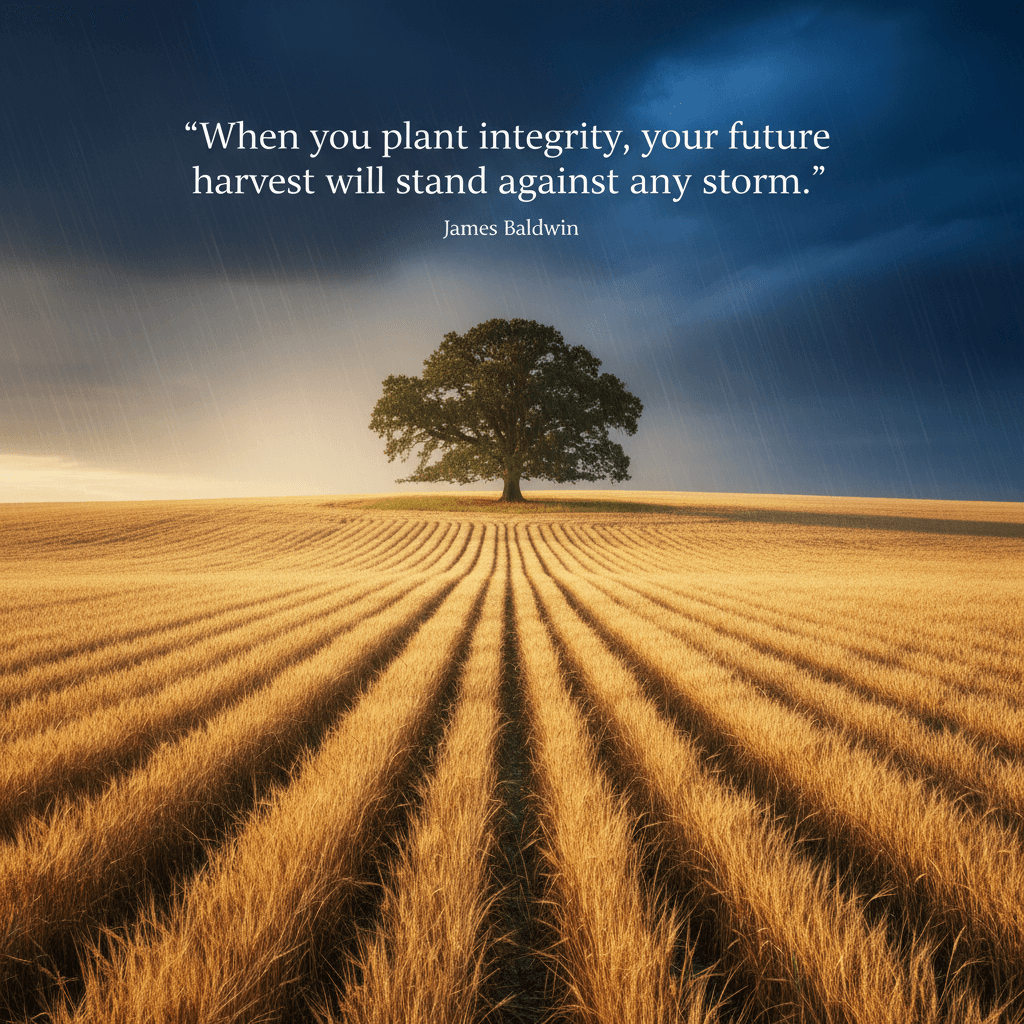
When you plant integrity, your future harvest will stand against any storm. — James Baldwin
—What lingers after this line?
The Seed and the Season
First, the agrarian metaphor makes the principle visceral: integrity is a seed, not a slogan. To plant it is to choose consistent, honest action before the weather turns, accepting that roots deepen slowly and out of sight. Storms—crises, temptations, public scrutiny—will certainly come, but a crop grown from principled choices bears tensile strength that quick fixes cannot supply. In other words, the harvest is not luck; it is cultivated durability. Thus the quote reframes virtue from lofty ideal to practical agriculture: prepare the field now, endure the wind later.
Baldwin's Weathered Moral Landscape
Building on this image, Baldwin’s life and prose show how truth-telling fortifies the soul against historical tempests. In Notes of a Native Son (1955), he insists on facing painful facts without rancor or denial; in The Fire Next Time (1963), he argues that love is a rigorous discipline, not a sentiment. These works read like weather reports and repair manuals at once: they diagnose the storm and prescribe integrity as the only shelter that does not become a prison. Consequently, the aphorism’s confidence is earned—Baldwin knew that moral clarity, sown early, is what keeps the house from collapsing when the winds of history rise.
Resilience as Ethical Compound Interest
Moreover, research suggests integrity compounds over time. Character Strengths and Virtues by Peterson and Seligman (2004) treats honesty as a core virtue linked to well-being and perseverance. In organizational life, the Mayer–Davis–Schoorman model (1995) shows that integrity is a pillar of trustworthiness, which in turn predicts cooperation and performance under stress. Like compound interest, small ethical deposits—kept promises, transparent decisions, fair processes—accumulate into a reserve that cushions shocks. When disruption hits, this reserve converts into resilience: people grant grace, systems bend rather than break, and leaders can act without hemorrhaging credibility.
Case Studies of Stormproof Trust
Consider how crises reveal the crop. During the 1982 Tylenol poisonings, Johnson & Johnson pulled products nationwide at great cost, aligning with its Credo; the public trust that followed became a competitive moat often cited in business ethics courses. Similarly, after a devastating 1995 fire, Malden Mills’ CEO Aaron Feuerstein kept workers on payroll—an act of integrity that won fierce loyalty even as financial headwinds remained. These stories echo Baldwin’s thesis: integrity planted in quiet seasons yields reputational ballast when waves crest, transforming catastrophe from an ending into a passage.
Practices That Plant Integrity Daily
In practice, planting integrity means ritualizing truth and repair. Set precommitments—codes of conduct with enforcement teeth—before dilemmas arise; publish decisions and criteria to reduce hidden corners; and when errors occur, engage in swift disclosure and amends. Hospital disclosure-and-apology programs have lowered litigation costs and improved safety cultures (Kachalia et al., 2010), illustrating how transparent repair strengthens, rather than weakens, standing. In personal life, micro-habits—documented commitments, checklists, and inviting dissent—till the soil so that when pressure mounts, defaults lean toward honesty instead of expediency.
Community Fields and Shared Harvests
Finally, integrity scales from persons to polities. Elinor Ostrom’s Governing the Commons (1990) shows communities enduring environmental shocks by enforcing fair, transparent rules they trust, while Robert Putnam’s Bowling Alone (2000) links social capital to civic resilience. The implication is communal: when many people plant integrity, the shared harvest is a culture robust enough to face storms together. Thus Baldwin’s insight closes the loop—private virtue becomes public infrastructure, and the weather, however fierce, meets fields already rooted in truth.
One-minute reflection
Where does this idea show up in your life right now?
Related Quotes
6 selectedExcellence is the capacity to take pain. It is the refusal to let a difficult season define a permanent limit. — James Baldwin
James Baldwin
Baldwin’s line strips “excellence” of its usual polish—talent, prestige, or effortless success—and recasts it as a practiced toughness. In this view, excellence begins where comfort ends: it is the capacity to endure pai...
Read full interpretation →Resilience is not just enduring the storm; it is learning to harvest the rain to nourish the roots you've already planted. — Elizabeth Edwards
Elizabeth Edwards
At first glance, Elizabeth Edwards rejects the common image of resilience as simple endurance. To ‘endure the storm’ suggests gritting one’s teeth and waiting for suffering to pass, yet her metaphor quickly moves further...
Read full interpretation →Turn hurt into a lesson the future can learn from — James Baldwin
James Baldwin
James Baldwin’s line begins with a simple but demanding shift: hurt is not merely something to endure, but something to translate. Pain, in this view, is raw material—an experience that can remain a private injury or bec...
Read full interpretation →Don't fight the challenges. Just find a new way to stand. — Germany Kent
Germany Kent
Germany Kent’s words begin with a quiet reversal of instinct: instead of treating every challenge as an enemy to defeat, she invites us to reconsider our posture toward difficulty. The emphasis is not on surrender, but o...
Read full interpretation →Optimist: someone who figures that taking a step backward after taking a step forward is not a disaster, it's more like a cha-cha. — Robert Brault
Robert Brault
Robert Brault’s line begins with a witty redefinition: an optimist is not someone who denies backward motion, but someone who interprets it differently. Instead of treating a setback as proof of failure, the optimist see...
Read full interpretation →A mind grows by staying with difficulty long enough for the experience to change it. — Mary Catherine Bateson
Mary Catherine Bateson
Mary Catherine Bateson’s observation begins with a quiet but demanding truth: the mind does not grow merely by encountering difficulty, but by remaining with it. Challenge becomes transformative only when we resist the u...
Read full interpretation →More From Author
More from James Baldwin →Perhaps home is not a place but simply an irrevocable condition. — James Baldwin
At first glance, Baldwin overturns a familiar assumption: home is usually imagined as a house, a street, or a homeland on a map. Yet his phrase suggests something deeper and less movable, a condition that lives within a...
Read full interpretation →Rarely are we more exposed than when we are being kind. — James Baldwin
At first glance, Baldwin’s line appears simple, yet it quickly reveals a harder truth: kindness is never merely polite behavior. When we are kind, we lower our defenses and allow another person to see what we value, what...
Read full interpretation →People who shut their eyes to reality simply invite their own destruction. — James Baldwin
James Baldwin frames denial not as a harmless coping mechanism but as a decision with consequences. By “shut[ting] their eyes,” he points to willful blindness—choosing comfort over truth—and suggests that reality does no...
Read full interpretation →People who cannot suffer can never grow up, can never discover who they are. — James Baldwin
James Baldwin’s claim binds two ideas we often separate: maturity and suffering. To “grow up,” in his sense, is not simply to age or acquire skills; it is to undergo experiences that test the stories we tell about oursel...
Read full interpretation →