
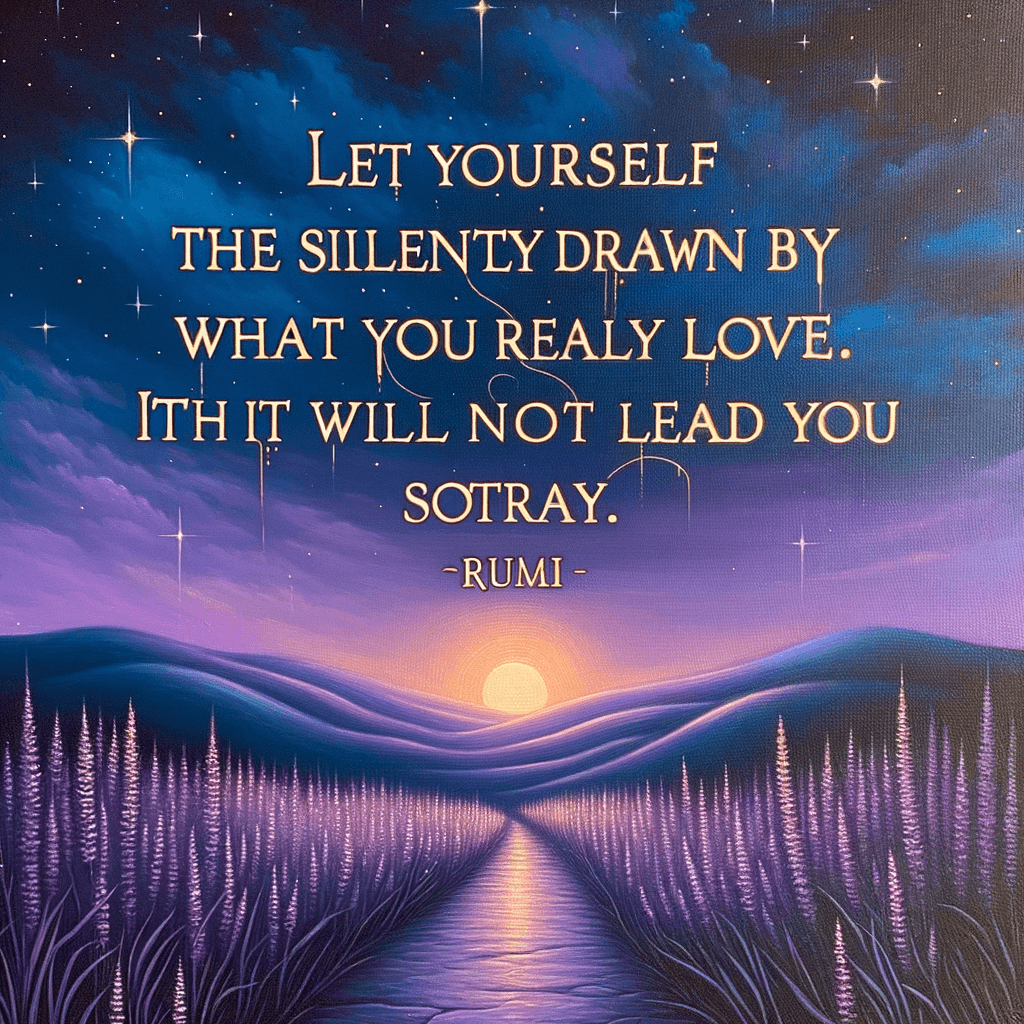
Let yourself be silently drawn by the strange pull of what you really love. It will not lead you astray. - Rumi
—What lingers after this line?
Inner Guidance
This quote emphasizes the importance of listening to your inner desires and inclinations. It suggests that what you truly love holds the key to your true path and happiness.
Intuition and Trust
Rumi encourages trusting your intuition and inner passions. By following what you genuinely love, you are likely to find fulfillment and purpose.
Passion and Purpose
The 'strange pull' refers to the inexplicable attraction towards something that resonates deeply with you. This powerful draw can guide you toward your life's purpose.
Avoiding Missteps
According to Rumi, when you follow your true passions, you are led on a path that is authentic and meaningful, and you are less likely to go astray.
Philosophical and Spiritual Insight
Rumi, a Persian poet and Sufi mystic, often incorporates themes of divine love and inner enlightenment in his writings. This quote reflects his belief in the spiritual significance of following one's true calling.
One-minute reflection
What's one small action this suggests?
Related Quotes
6 selectedStart where the heart is honest, and steps will follow the truth. — Rumi
Rumi
Rumi’s line frames life as a journey where the starting point matters as much as the destination: “where the heart is honest.” In this view, honesty is not merely factual accuracy but an inner alignment—wanting what we s...
Read full interpretation →Let silence and surrender teach you the next bold move. — Rumi
Rumi
At first hearing, Rumi’s counsel seems contradictory: how can silence and surrender produce a bold move? Yet the paradox is the point.
Read full interpretation →Quietly and without fuss, you must trust your own heart. Your instincts are more reliable than the noise of the world. — Clarissa Pinkola Estés
Clarissa Pinkola Estés
At its core, Clarissa Pinkola Estés’s line invites a quiet act of courage: to believe that the heart can perceive truths the outside world often obscures. Rather than demanding dramatic rebellion, she emphasizes trust ex...
Read full interpretation →You do not need to do more. You need to feel more aligned. — Seff Bray
Seff Bray
At first glance, Seff Bray’s line challenges a deeply ingrained belief: that progress always comes from adding more effort, more action, and more output. Instead, it proposes that the real issue is often not how much we...
Read full interpretation →Stand where your heart points, even if your feet tremble — Frida Kahlo
Frida Kahlo
Frida Kahlo’s line frames the heart as a compass: not a sentimental impulse, but an inner conviction that points toward what feels most true. “Stand where your heart points” implies choosing a position—an identity, a rel...
Read full interpretation →Your hands hold the map; your steps must trust it. — Rabindranath Tagore
Rabindranath Tagore
Tagore’s line begins with a simple image: you possess a map, yet you still have to walk. In other words, knowledge, plans, and guidance are valuable, but they do not replace the lived act of moving forward.
Read full interpretation →More From Author
More from Rumi →Everything that happens is a form of instruction if you choose to listen. — Rumi
At its core, Rumi’s line reframes ordinary experience as a living classroom. Nothing is merely random noise if one approaches it with attention; instead, each success, disappointment, encounter, or delay carries the poss...
Read full interpretation →Do not mistake movement for progress; a spinning top stays in one place, while a seed grows by staying rooted in the dark. — Rumi
Rumi’s image draws an immediate contrast between busyness and true development. A spinning top dazzles with speed and motion, yet it remains fixed in essentially the same place.
Read full interpretation →You don't need to escape the chaos to find peace—it's already inside you, waiting to be remembered. — Rumi
At first glance, Rumi’s line overturns a common assumption: that peace must be found by fleeing noise, conflict, or uncertainty. Instead, he suggests that peace is not an external destination but an inner condition alrea...
Read full interpretation →Confidence is silent. Insecurities are loud. Do not feel the need to broadcast your worth to a world that doesn't understand your path. — Rumi
At its core, this saying contrasts two very different emotional states: confidence, which rests quietly within, and insecurity, which seeks constant outward expression. The point is not that confident people never speak,...
Read full interpretation →