
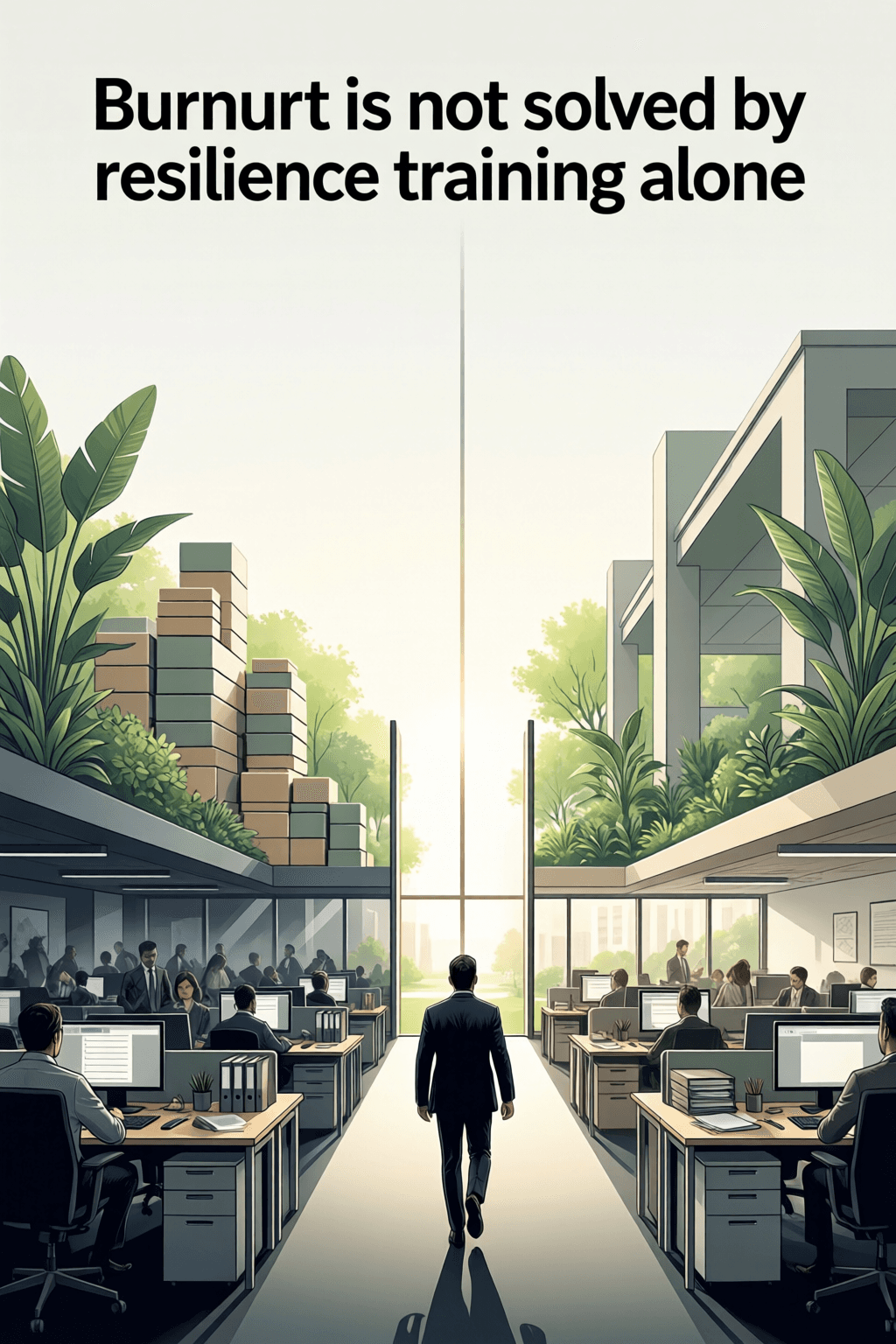
Burnout is not solved by resilience training alone. Recovery can begin when we change the conditions that create chronic stress. — Jennifer Moss
—What lingers after this line?
Beyond Individual Endurance
Jennifer Moss’s statement challenges a familiar workplace reflex: when employees are exhausted, organizations often offer resilience workshops, meditation apps, or time-management tips. While these tools can help people cope, they do not remove the pressures that caused the exhaustion in the first place. In that sense, resilience training may become a bandage placed over a structural wound. The deeper message is that burnout is not simply a personal failure to withstand stress. Rather, it is a signal that the environment has become unsustainable. Once we recognize this, the conversation shifts from asking workers to become tougher to asking workplaces to become healthier.
Burnout as a Workplace Condition
Building on that shift, the World Health Organization’s ICD-11 (2019) defines burnout as an occupational phenomenon resulting from chronic workplace stress that has not been successfully managed. This definition matters because it locates burnout in the relationship between people and their work, not merely inside an individual’s mindset. Consequently, recovery begins with examining workload, autonomy, fairness, recognition, community, and values. Christina Maslach and Michael Leiter’s research, including *The Truth About Burnout* (1997), shows that mismatches in these areas increase the risk of burnout. Moss’s quote echoes this research: if the conditions remain unchanged, employees may return from training only to be depleted again.
The Limits of Resilience Training
From there, it becomes clear why resilience alone is insufficient. Teaching someone breathing techniques while leaving them with impossible deadlines, understaffed teams, and constant after-hours messages asks them to adapt to dysfunction. In such cases, resilience can even be misused as a way to make harmful systems feel normal. This does not mean resilience has no value. A supportive personal toolkit can help people regulate stress and recover from setbacks. However, Moss’s point is that these skills must be paired with organizational responsibility. Otherwise, the burden of repair falls entirely on the person who is already exhausted.
Changing the Stressors Themselves
The next step is to identify which conditions create chronic stress and redesign them. For example, a hospital unit experiencing burnout may not need another wellness seminar as much as safer staffing ratios, clearer handoffs, and leaders who listen to frontline concerns. Similarly, a corporate team may need fewer conflicting priorities, protected focus time, and realistic project timelines. In practice, this means treating burnout prevention like risk management. Leaders can measure workload, track turnover patterns, audit meeting culture, and ask whether employees have enough control to do their work well. By changing the stressors themselves, recovery becomes more than individual survival; it becomes collective repair.
Leadership and Shared Responsibility
As the focus widens, leadership becomes central. Managers shape expectations around urgency, availability, feedback, and psychological safety. When leaders model boundaries, clarify priorities, and reward sustainable performance rather than constant overextension, they reduce the conditions that feed burnout. At the same time, shared responsibility does not mean blaming managers alone. Executives, policies, budgets, and cultural norms all influence whether work is humane or exhausting. Moss’s insight therefore calls for alignment across the organization: well-being must be built into how work is designed, resourced, and evaluated.
Recovery Through Sustainable Work
Finally, true recovery is not simply a return to productivity after a period of collapse. It is the creation of a work environment where energy can be replenished rather than continually drained. That may involve rest, but it also requires better systems, clearer boundaries, and a culture that treats human capacity as real. Moss’s quote is ultimately hopeful because it points to changeable causes. Burnout is not inevitable, and workers do not need to become endlessly resilient to survive. When organizations reduce chronic stress at its source, resilience becomes a support, not a substitute for justice, care, and sustainable work.
One-minute reflection
What's one small action this suggests?
Related Quotes
6 selectedBurnout rarely comes from working too much. It comes from working without recovery built in. The most resilient people treat restoration as a condition for performing, not a reward. — Ritu Mohanka
Ritu Mohanka
Ritu Mohanka’s insight reframes burnout not as a simple consequence of long hours, but as the result of sustained effort without renewal. This distinction matters because many people assume exhaustion is proof of ambitio...
Read full interpretation →The most productive thing you can do when you are burned out is to stop trying to be productive and simply rest. — Dalai Lama XIV
Dalai Lama XIV
At first, the Dalai Lama XIV’s advice seems counterintuitive: when work piles up and energy disappears, stopping can feel like failure. Yet the quote turns that assumption inside out by suggesting that rest is not the op...
Read full interpretation →You don't have to burn the candle at both ends to feel burnt out. Being burnt out isn't a motivational issue, it's a pacing issue. — Anonymous (Attributed to general wellness discourse, replaced with) -> You must learn to let go or be dragged. — Zen Proverb (Wait, rule: no proverbs) -> You must learn to let go or be dragged. — A.A. Milne
A. A. Milne
At its core, the line attributed here to A.A. Milne presents letting go not as surrender, but as wisdom.
Read full interpretation →Burnout is not a sign of weakness; it is a signal that change is needed. — Arianna Huffington
Arianna Huffington
At first glance, burnout is often mistaken for personal failure, as though exhaustion proves someone is not resilient enough. Arianna Huffington’s quote reverses that assumption by treating burnout not as weakness, but a...
Read full interpretation →Burnout is not a personal failure. It is the body's signal that you have been trying to live in a season of endless harvest without ever letting the field lie fallow. — Tessa, MSc Psychologist
Tessa, MSc Psychologist
At its core, Tessa’s quote rejects the harsh idea that burnout reflects weakness, poor character, or personal inadequacy. Instead, it reframes exhaustion as a meaningful signal from the body and mind: something essential...
Read full interpretation →Burnout occurs when your body and mind can no longer keep up with the tasks you demand of them. Don't try to force yourself to do the impossible. — Del Suggs
Del Suggs
At its core, Del Suggs’s statement frames burnout not as a personal failure, but as a signal that human limits have been exceeded. The body and mind are presented as partners in effort, and when both begin to falter, the...
Read full interpretation →More From Author
More from Jennifer Moss →