
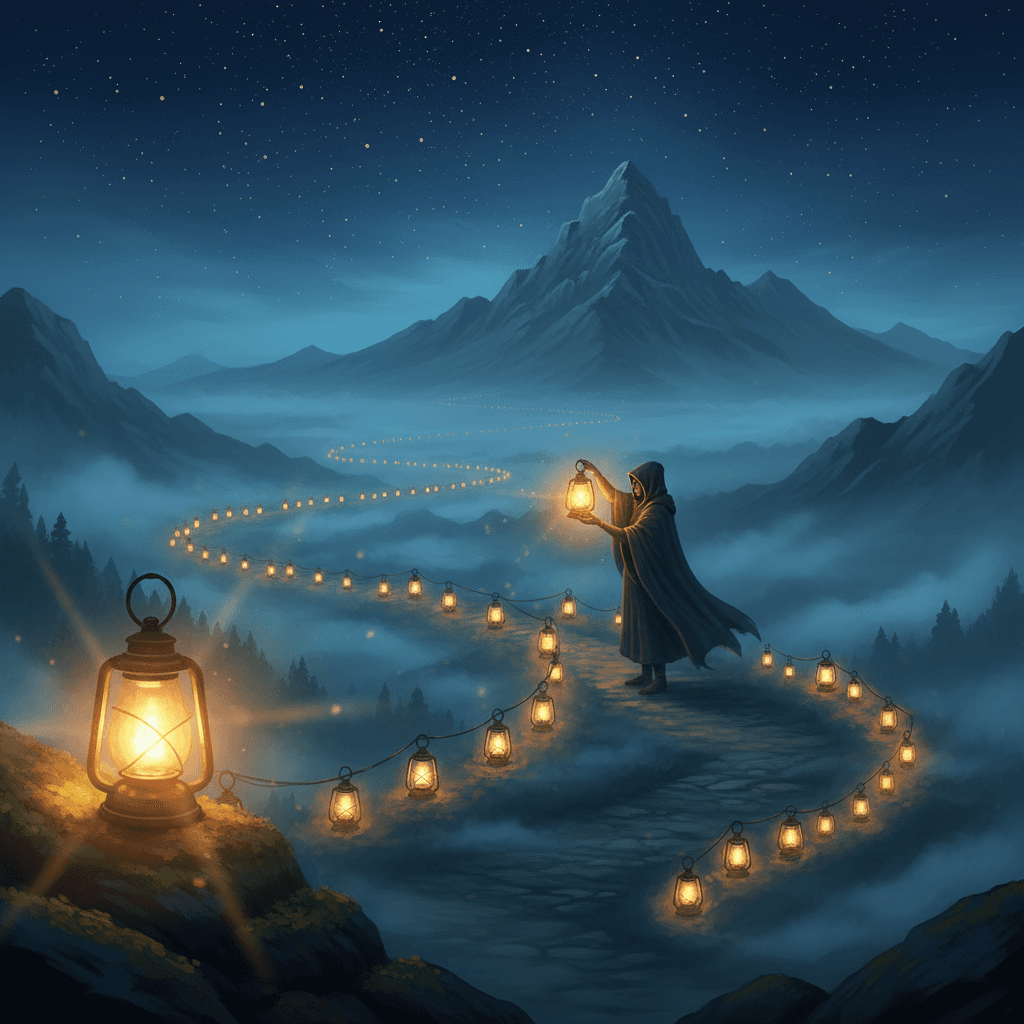
Gather small victories like lanterns; together they banish doubt — Rainer Maria Rilke
—What lingers after this line?
Lanterns in the Fog of Self-Doubt
To begin, the metaphor casts each small victory as a point of light, practical rather than ornamental. Doubt rarely disappears in one blaze; it recedes step by step as the path grows visible. Like travelers stringing lanterns along a misty road, we illuminate the next few meters, then the next, until progress itself becomes proof. In this framing, triumph is not a distant summit but a series of reachable ledges; the light accumulates, and with it, our confidence to ascend.
Rilke’s Patient Art of Becoming
Moving to Rilke, the counsel echoes his gentler, slower philosophy of growth. In Letters to a Young Poet (1903–1908), he advises, “live the questions now,” trusting that answers ripen with time. Small victories are those lived questions—daily lines drafted, a practiced scale, one measured act of courage. Likewise, “You must change your life,” from Archaic Torso of Apollo (1908), suggests transformation begins not with a single conversion but with steady, luminous acts. Thus Rilke’s spirit sanctifies the incremental, making each win a candle placed before uncertainty.
Why Small Wins Work: The Science
Building on this, research shows that progress—even modest—fuels motivation. Teresa Amabile and Steven Kramer’s The Progress Principle (2011) documents how minor daily advances boost emotion and performance at work. Earlier, Karl Weick’s “Small Wins” (Administrative Science Quarterly, 1984) argued that breaking daunting problems into solvable pieces prevents paralysis. Neurocognitively, small completions trigger rewarding feedback, reinforcing effort and sharpening attention. Momentum then becomes less a mystic force than a repeating loop: a clear action, a visible result, and renewed willingness to continue.
Designing Days to Harvest Victories
From theory to practice, the key is designing for winnable moments. Define actions that finish in minutes—send the email, sketch the outline, walk ten minutes—so you can mark them done. Keep a brief “lantern log” to record completions; the visible chain guards against the forgetfulness of bad moods. BJ Fogg’s Tiny Habits (2020) shows how anchoring micro-actions to existing routines—after coffee, one stretch—creates reliable cues. As these victories accumulate, you earn the right to scale them, much as a trail brightens when each stake is lit.
Stories from Craft and Creation
Consider Thomas Edison’s line—after many trials with the light bulb—that he found “10,000 ways that won’t work,” a wry nod to iterative discovery. Similarly, Beethoven’s sketchbooks reveal symphonies birthed through fragments and revisions rather than bolt-from-heaven perfection. These anecdotes illustrate a shared pattern: artisans convert overwhelming aspirations into a cadence of doable tasks. Each completion narrows uncertainty, until what seemed impossible becomes merely unfinished.
From Me to We: Collective Momentum
Extending this to teams, collective lanterns matter as much as personal ones. Brief daily stand-ups in agile practice create visible progress and unblock next steps; Kanban boards externalize flow so wins are seen, not guessed. The U.S. Army’s After Action Review (c. 1984) institutionalized small, frequent learning loops, turning mistakes into fuel for the next iteration. When groups witness each other’s micro-wins, they inherit confidence by contagion, and doubt struggles to find a foothold.
Resilience When the Night Feels Long
Finally, in darker seasons, small victories become therapeutic. Behavioral activation in clinical psychology (e.g., Martell, Addis, and Jacobson, 2001) prescribes modest, values-aligned actions to counter inertia; mood often follows movement. Thus, even when certainty is unavailable, agency remains. One phone call, one page, one walk: each act places a new light along the edge of fear. String enough of them together, and the night, though still night, is navigable—and doubt, outnumbered, recedes.
One-minute reflection
What feeling does this quote bring up for you?
Related Quotes
6 selectedDance with difficulty until it yields a new rhythm of strength. — Rainer Maria Rilke
Rainer Maria Rilke
Rilke’s line reframes difficulty from something to defeat into something to move with. To “dance” implies contact, attention, and responsiveness—an active relationship rather than a battle of will.
Read full interpretation →Don't fight the challenges. Just find a new way to stand. — Germany Kent
Germany Kent
Germany Kent’s words begin with a quiet reversal of instinct: instead of treating every challenge as an enemy to defeat, she invites us to reconsider our posture toward difficulty. The emphasis is not on surrender, but o...
Read full interpretation →Optimist: someone who figures that taking a step backward after taking a step forward is not a disaster, it's more like a cha-cha. — Robert Brault
Robert Brault
Robert Brault’s line begins with a witty redefinition: an optimist is not someone who denies backward motion, but someone who interprets it differently. Instead of treating a setback as proof of failure, the optimist see...
Read full interpretation →A mind grows by staying with difficulty long enough for the experience to change it. — Mary Catherine Bateson
Mary Catherine Bateson
Mary Catherine Bateson’s observation begins with a quiet but demanding truth: the mind does not grow merely by encountering difficulty, but by remaining with it. Challenge becomes transformative only when we resist the u...
Read full interpretation →When you are friends with your storm, you dance, instead of getting blown away. — Michael Bassey Johnson
Michael Bassey Johnson
Michael Bassey Johnson’s line begins with a striking reversal: the storm is not merely an enemy to survive, but a force one can learn to understand. In this sense, the storm may represent grief, fear, conflict, uncertain...
Read full interpretation →Just because your light flickers does not mean it is about to go out. — Yohancé Salimu
Yohancé Salimu
At first glance, Yohancé Salimu’s line separates appearance from reality. A flicker suggests instability, fatigue, or interruption, yet it does not automatically signal extinction.
Read full interpretation →More From Author
More from Rainer Maria Rilke →To love is not about merging. It is a noble calling for the individual to ripen, to differentiate, to become a world in oneself in response to another. — Rainer Maria Rilke
At first glance, Rilke challenges one of romance’s most familiar ideals: the desire to ‘become one.’ Instead, he argues that genuine love is not a collapse of boundaries but a deepened encounter between two distinct peop...
Read full interpretation →Everything is blooming most recklessly; if it were voices instead of colors, there would be an unbelievable shrieking into the heart of the night. — Rainer Maria Rilke
At first glance, Rilke turns a peaceful image of blooming nature into something almost overwhelming. Flowers do not merely open; they burst forth “most recklessly,” suggesting a vitality so abundant that it exceeds calm...
Read full interpretation →And now let us believe in a long year that is given to us, new, untouched, full of things that have never been. — Rainer Maria Rilke
Rilke opens by shifting the tone from planning to believing: the year is “given to us,” implying something received rather than conquered. This framing matters because it replaces the pressure of achievement with the hum...
Read full interpretation →The purpose of life is to be defeated by greater and greater things. — Rainer Maria Rilke
Rainer Maria Rilke’s line treats “defeat” not as failure to avoid, but as a destination worth moving toward. The purpose of life, in this view, is measured by what can humble us—truths, beauties, responsibilities, or ide...
Read full interpretation →