
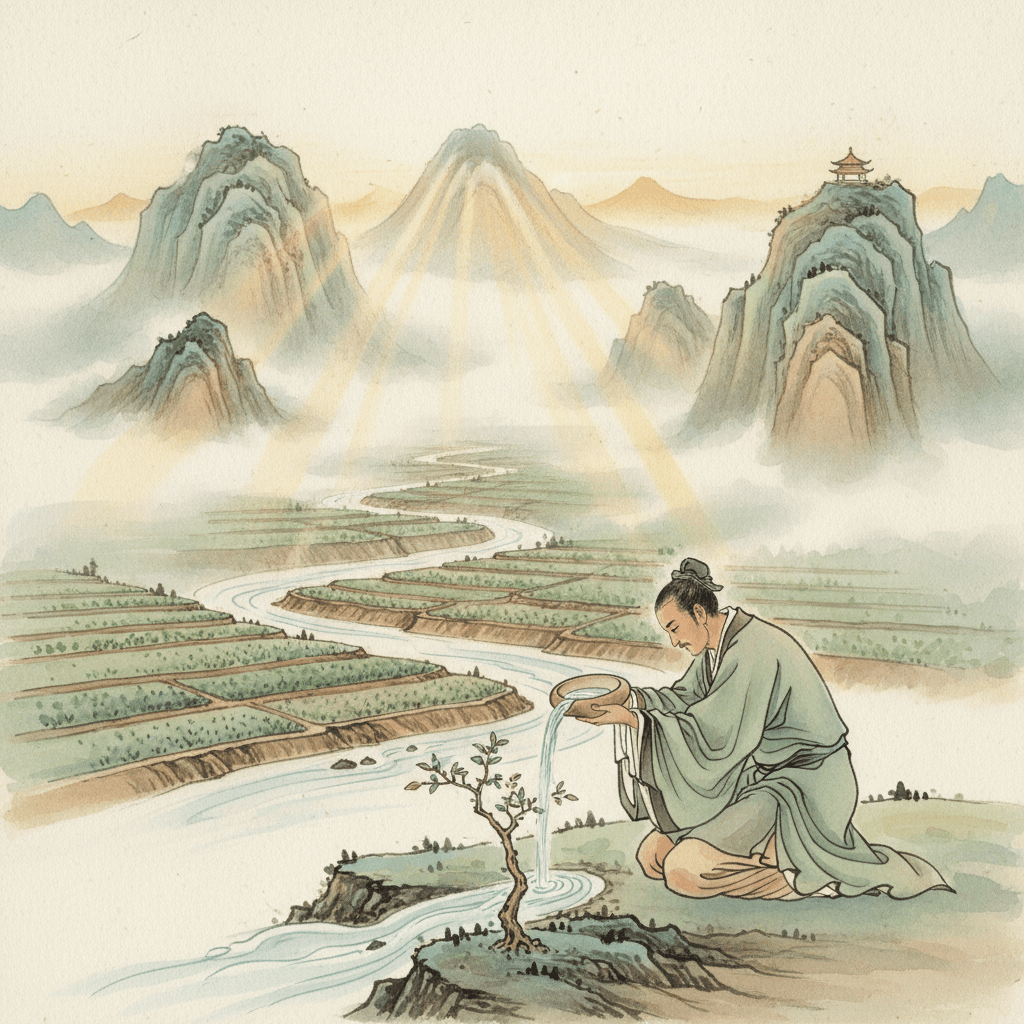
If you would take, you must first give; this is the beginning of intelligence. — Lao Tzu
—What lingers after this line?
Interdependence as the Seed of Wisdom
Lao Tzu's line proposes a counterintuitive rule: intelligent action begins with contribution. In the Daodejing (c. 4th century BCE), chapter 81 observes that the sage does not hoard; the more he gives to others, the more he has. To take wisely, one must understand the currents that sustain exchange—trust, reputation, and mutual benefit. Seeing these relations clearly is the birth of intelligence: it reframes gain not as extraction but as participation in a living circuit.
Daoist Metaphors—Water, Emptiness, and Return
Building on that, Daoist metaphors show how giving creates flow. Water, praised in chapter 8, benefits all and does not contend; it nourishes precisely because it yields. Likewise, the usefulness of the wheel and the vessel in chapter 11 depends on empty space, a deliberate giving-up that makes room for others. Chapter 40 adds that reversal is the movement of the Dao: what departs returns. In this light, offering value first is not moral adornment; it is alignment with the way processes cycle back, so that what you release can eventually return as support.
Game Theory—Cooperate First to Prosper
Moving from ancient wisdom to modern models, game theory reaches a similar conclusion. In Robert Axelrod's The Evolution of Cooperation (1984), strategies that start by cooperating—famously tit for tat—consistently outperform those that begin by taking. Give first, reciprocate cooperation, and respond proportionally to betrayal: this mix of generosity and memory earns higher long-run payoffs in repeated games. The lesson generalizes beyond laboratories; when interactions recur, initial giving signals intent, invites reciprocity, and sets norms that make later gains possible.
Social Psychology—Reciprocity in Daily Exchanges
Moreover, social psychology documents reciprocity as a robust human impulse. Robert Cialdini's Influence (1984) catalogs how small favors lead to unexpected returns, from free samples that boost purchases to unsolicited help that elicits helping back. A classic field note by sociologist Phillip Kunz (1976) found that sending holiday cards to strangers produced a surprising flood of replies, simply because people felt obliged to return the gesture. Giving first, then, is not naivete; it activates a predictable social rule.
Negotiation and Leadership—Create Before You Claim
In negotiation and leadership, the same logic appears as create value before you claim. Fisher and Ury's Getting to Yes (1981) urges parties to reveal interests and invent options for mutual gain, because expanding the pie enables fairer slices. Lax and Sebenius's 3-D Negotiation (2006) extends this advice to the deal's setup: map stakeholders, build coalitions, and make low-cost, high-value trades early. By giving information, credit, or small concessions upfront, you earn trust and shape a zone where your later asks are both larger and more acceptable.
Practicing Give-First Intelligence—Boundaries and Resilience
Finally, practicing give-first intelligence requires boundaries and an eye for systems. Choose arenas with repeated interaction, visible reputation, and feedback, where reciprocity can compound. Elinor Ostrom's Governing the Commons (1990) shows communities sustaining shared resources through norms of contribution, monitoring, and graduated sanctions—mechanisms that protect givers from exploitation. On teams, begin by offering help or sharing credit, then ask for what you need. In this balanced posture, generosity seeds the very networks that will carry your returns.
One-minute reflection
What's one small action this suggests?
Related Quotes
6 selectedKindness in words creates confidence. Kindness in thinking creates profoundness. Kindness in giving creates love. — Lao Tzu
Lao Tzu
Using kind words when communicating with others helps build trust and self-assurance, both in oneself and in those who receive them.
Read full interpretation →The wise man does not lay up his own treasures. The more he gives to others, the more he has for his own. — Lao Tzu
Lao Tzu
Lao Tzu describes a wise person as someone who does not hoard wealth but instead gives freely to others.
Read full interpretation →I have found that if you love life, life will love you back. — Arthur Rubinstein
Arthur Rubinstein
At its heart, Arthur Rubinstein’s remark suggests that life answers the attitude we bring to it. To love life is not to deny pain or difficulty; rather, it is to meet experience with receptivity, gratitude, and enthusias...
Read full interpretation →You don't have to be a billionaire to believe you can make a difference. Give your time, give your love, or simply give a smile. — Steve Goodier
Steve Goodier
At its core, Steve Goodier’s quote challenges the idea that influence belongs only to the wealthy or powerful. By placing time, love, and even a smile alongside money, he broadens generosity into something almost anyone...
Read full interpretation →Takers must have no limits, because givers never do. — Iyanla Vanzant
Iyanla Vanzant
At first glance, Iyanla Vanzant’s line sounds almost humorous, yet its irony cuts deeply. If givers continue offering time, energy, money, or emotional labor without pause, then takers are effectively trained to expect a...
Read full interpretation →In the ordinary life, we hardly realize that we receive a great deal more than we give, and that it is only with gratitude that life becomes rich. — Dietrich Bonhoeffer
Dietrich Bonhoeffer
Bonhoeffer begins with a quiet but unsettling observation: most of us move through ordinary life without noticing how much we constantly receive. From language and education to food, care, and companionship, our days are...
Read full interpretation →More From Author
More from Lao Tzu →Do you have the patience to wait until your mud settles and the water is clear? — Lao Tzu
Lao Tzu’s question frames patience not as passive delay but as an active kind of wisdom. The image of muddy water settling on its own suggests that confusion often clears not through force, but through restraint.
Read full interpretation →Anything that is living must have a rest. If it does not rest, it will lose its strength. — Lao Tzu
Lao Tzu’s insight begins with a simple observation: all living things move in cycles, not in endless exertion. By saying that anything alive must rest, he frames rest not as laziness but as a biological and spiritual nec...
Read full interpretation →Yield and overcome, bend and be straight. — Lao Tzu
At first glance, Lao Tzu’s line seems contradictory: how can yielding lead to overcoming, or bending result in straightness? Yet this paradox lies at the heart of Taoist thought.
Read full interpretation →Confidence is silent. Insecurities are loud. — (Skipped due to author uncertainty) -> Let's use: A truly strong person does not need to dominate. — Lao Tzu
At its core, Lao Tzu’s saying reframes strength as something inward rather than theatrical. A truly strong person, in this view, does not need to overpower others to prove worth, because genuine power is already settled...
Read full interpretation →