
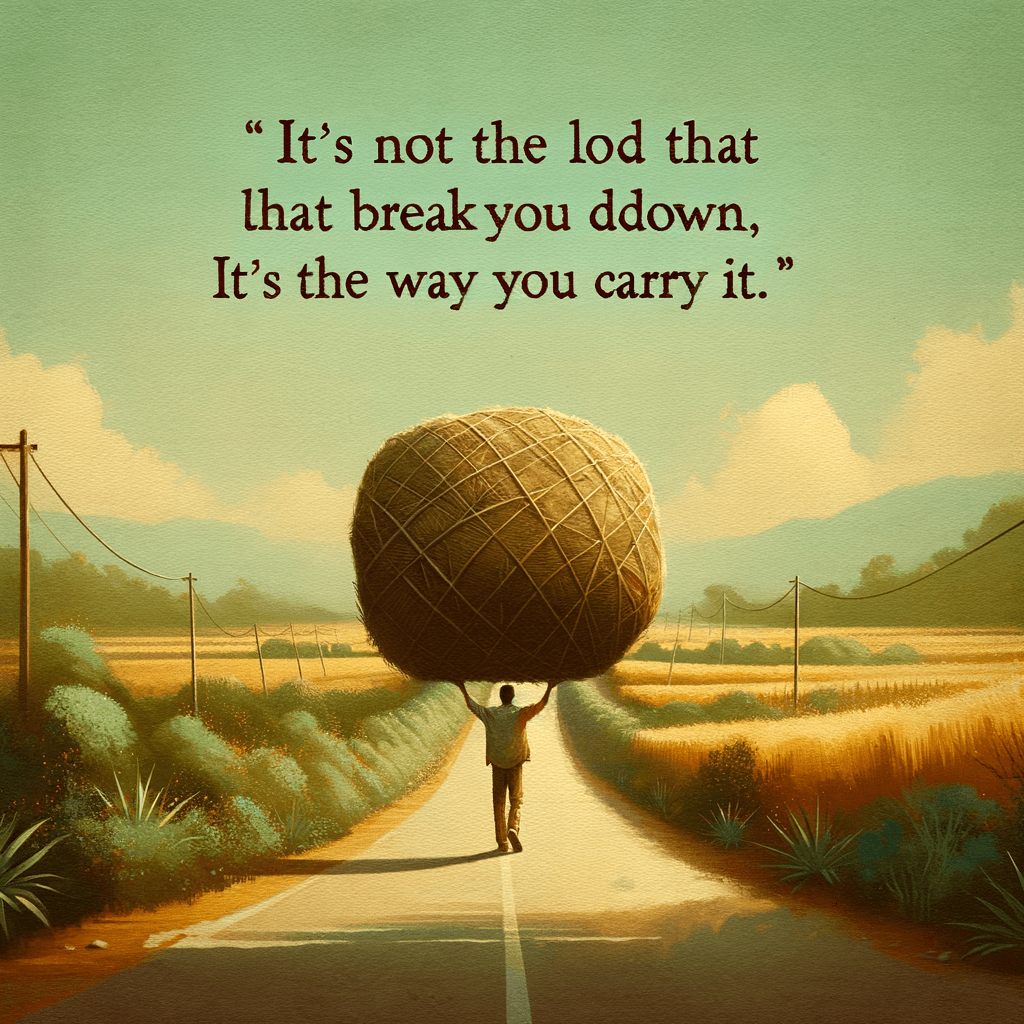
It's not the load that breaks you down, it's the way you carry it. — Lou Holtz
—What lingers after this line?
Perspective on Challenges
This quote emphasizes that the burden itself is not the cause of one's downfall, but rather the approach and mindset in handling the challenges are key.
Resilience and Adaptability
It suggests that resilience and the ability to adapt are crucial for overcoming difficulties. How one manages stress and pressure can significantly impact their well-being and success.
Coping Mechanisms
Effective coping mechanisms and strategies are implied as essential. Learning how to distribute weight, seek support, and maintain balance can prevent being overwhelmed.
Mental Attitude
The quote underscores the importance of maintaining a positive and constructive mental attitude. A healthy mindset can transform how challenges are perceived and dealt with.
Lou Holtz's Background
Lou Holtz is a renowned American football coach and motivational speaker. His experiences in coaching likely informed his insights on stress management, teamwork, and perseverance.
One-minute reflection
Where does this idea show up in your life right now?
Related Quotes
6 selectedDon't fight the challenges. Just find a new way to stand. — Germany Kent
Germany Kent
Germany Kent’s words begin with a quiet reversal of instinct: instead of treating every challenge as an enemy to defeat, she invites us to reconsider our posture toward difficulty. The emphasis is not on surrender, but o...
Read full interpretation →Optimist: someone who figures that taking a step backward after taking a step forward is not a disaster, it's more like a cha-cha. — Robert Brault
Robert Brault
Robert Brault’s line begins with a witty redefinition: an optimist is not someone who denies backward motion, but someone who interprets it differently. Instead of treating a setback as proof of failure, the optimist see...
Read full interpretation →A mind grows by staying with difficulty long enough for the experience to change it. — Mary Catherine Bateson
Mary Catherine Bateson
Mary Catherine Bateson’s observation begins with a quiet but demanding truth: the mind does not grow merely by encountering difficulty, but by remaining with it. Challenge becomes transformative only when we resist the u...
Read full interpretation →When you are friends with your storm, you dance, instead of getting blown away. — Michael Bassey Johnson
Michael Bassey Johnson
Michael Bassey Johnson’s line begins with a striking reversal: the storm is not merely an enemy to survive, but a force one can learn to understand. In this sense, the storm may represent grief, fear, conflict, uncertain...
Read full interpretation →Just because your light flickers does not mean it is about to go out. — Yohancé Salimu
Yohancé Salimu
At first glance, Yohancé Salimu’s line separates appearance from reality. A flicker suggests instability, fatigue, or interruption, yet it does not automatically signal extinction.
Read full interpretation →When something in your life dies—whether it be a job, a hobby, or a dream—I encourage you not to focus on what could have been but instead to look for the new life and the new opportunities that result. — Ryan Hall
Ryan Hall
Ryan Hall frames loss as a kind of death, and that metaphor immediately broadens the quote beyond grief in the literal sense. A job can end, a cherished hobby can fade, and a long-held dream can collapse; yet in each cas...
Read full interpretation →More From Author
More from Lou Holtz →If you want to be successful, discipline is non-negotiable. — Lou Holtz
Lou Holtz’s statement reduces success to a hard but clarifying truth: talent, ambition, and opportunity matter, yet none of them can reliably substitute for discipline. In other words, discipline is not an optional enhan...
Read full interpretation →When all is said and done, more is said than done. — Lou Holtz
Lou Holtz’s quip distills a stubborn truth: in many endeavors, output skews toward conversation rather than completion. We discuss goals, outline plans, and celebrate intentions, yet the ledger of finished work remains t...
Read full interpretation →Ability is what you're capable of doing. Motivation determines what you do. Attitude determines how well you do it. — Lou Holtz
Lou Holtz compresses the journey from capacity to excellence into three levers: ability, motivation, and attitude. Together they form a sequence—what you can do, what you choose to do, and how well you do it—shaping outc...
Read full interpretation →