
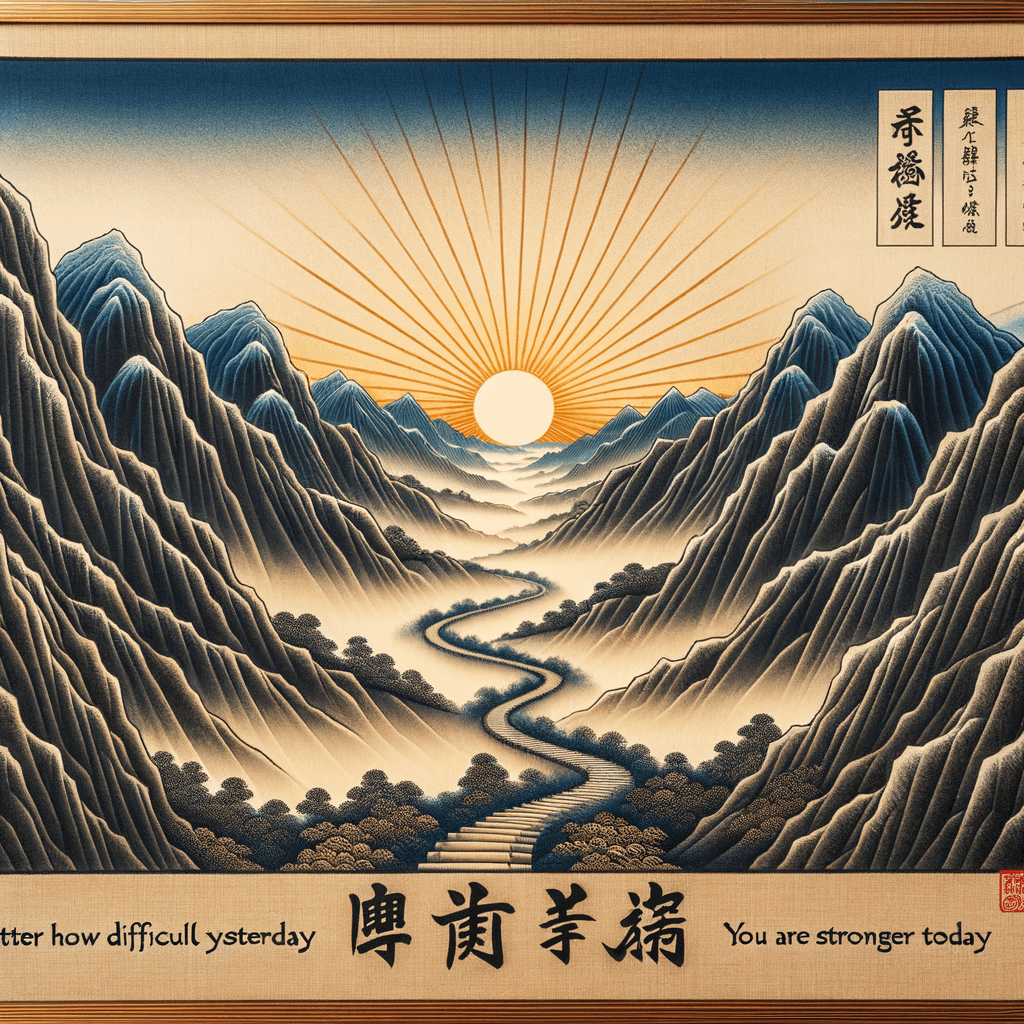
No matter how difficult yesterday was, you are stronger today. — Japanese Proverb
—What lingers after this line?
Resilience and Growth
This proverb highlights the concept of resilience, suggesting that overcoming challenges and hardships makes a person stronger. Each difficult experience contributes to personal growth and fortitude.
Optimism and Hope
It conveys a message of optimism, encouraging individuals to look forward to the future with hope. No matter how tough the past may have been, the new day brings a renewed strength and potential for improvement.
Learning from Adversity
The proverb implies that difficult experiences serve as valuable lessons that contribute to one's development. Each obstacle faced and conquered adds to one's wisdom and resilience.
Daily Renewal
It emphasizes the idea of daily renewal and self-improvement. Each day provides an opportunity to build on past experiences and become better equipped to handle future challenges.
Cultural Context
Japanese culture places a strong emphasis on perseverance (known as 'ganbaru') and learning from hardships. This proverb reflects these cultural values by underscoring the importance of enduring and growing stronger through life's difficulties.
One-minute reflection
What's one small action this suggests?
Related Quotes
6 selectedThe bamboo that bends is stronger than the oak that resists. - Japanese Proverb
Japanese Proverb
This proverb emphasizes the strength found in adaptability and flexibility. Bamboo, which bends with the wind, can withstand forces that a rigid oak might not, suggesting that being flexible allows one to endure challeng...
Read full interpretation →No matter how difficult the past, you can always begin again today. — Jack Kornfield
Jack Kornfield
Jack Kornfield’s words offer a quiet but powerful assurance: the past may shape us, yet it does not have to imprison us. By saying we can begin again today, he shifts attention from what cannot be changed to what can sti...
Read full interpretation →Instead of trying to build the perfect life in which to dwell, we can fortify and master the vehicle through which we traverse it. — Designing the Mind
Designing the Mind
The quote from Designing the Mind begins by challenging a common assumption: that peace depends on arranging life into ideal conditions. Rather than waiting for the perfect home, career, relationship, or routine, it redi...
Read full interpretation →Don't fight the challenges. Just find a new way to stand. — Germany Kent
Germany Kent
Germany Kent’s words begin with a quiet reversal of instinct: instead of treating every challenge as an enemy to defeat, she invites us to reconsider our posture toward difficulty. The emphasis is not on surrender, but o...
Read full interpretation →Optimist: someone who figures that taking a step backward after taking a step forward is not a disaster, it's more like a cha-cha. — Robert Brault
Robert Brault
Robert Brault’s line begins with a witty redefinition: an optimist is not someone who denies backward motion, but someone who interprets it differently. Instead of treating a setback as proof of failure, the optimist see...
Read full interpretation →A mind grows by staying with difficulty long enough for the experience to change it. — Mary Catherine Bateson
Mary Catherine Bateson
Mary Catherine Bateson’s observation begins with a quiet but demanding truth: the mind does not grow merely by encountering difficulty, but by remaining with it. Challenge becomes transformative only when we resist the u...
Read full interpretation →More From Author
More from Japanese Proverb →Even the monkey falls from the tree. — Japanese Proverb
“Even the monkey falls from the tree” begins with a vivid picture: a creature built for climbing still loses its grip. By choosing an expert climber rather than a novice, the proverb makes its point gently but firmly—ski...
Read full interpretation →The bamboo that bends is stronger than the oak that resists. - Japanese Proverb
This proverb emphasizes the strength found in adaptability and flexibility. Bamboo, which bends with the wind, can withstand forces that a rigid oak might not, suggesting that being flexible allows one to endure challeng...
Read full interpretation →The wind howls, but the mountain remains still. - Japanese Proverb
This proverb symbolizes the strength and resilience of one who remains unaffected by external turbulence. Just as the mountain stands firm despite the howling wind, a person can maintain their composure and stability ami...
Read full interpretation →When there is no wind, row. - Japanese Proverb
This proverb emphasizes the importance of relying on oneself. When external circumstances do not support your progress, you must take action and create your own momentum.
Read full interpretation →