
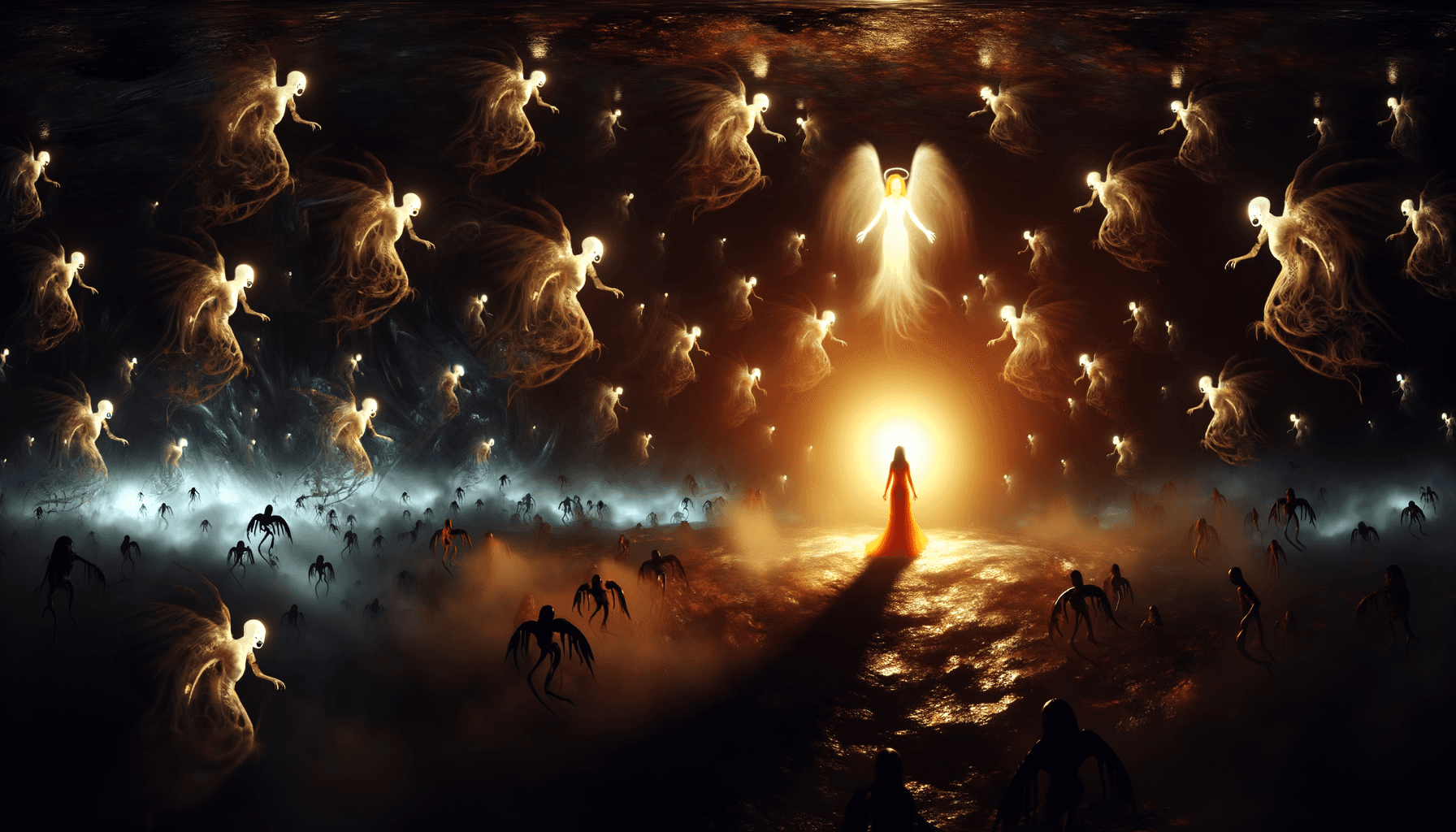
One may tolerate a world of demons for the sake of an angel. — Virginia Woolf
—What lingers after this line?
Endurance for Love
This quote highlights the idea that people are willing to endure immense difficulties or hardships (symbolized by 'demons') for the presence of someone truly cherished (the 'angel').
Contrast Between Good and Evil
Woolf contrasts suffering and darkness with the presence of goodness and light, emphasizing how the existence of something pure and beautiful can make enduring hardships worthwhile.
Devotion and Sacrifice
The quote reflects how love and deep admiration inspire individuals to persist through life's struggles, reinforcing the theme of selfless devotion.
Psychological and Emotional Strength
It suggests that the hope or love for something virtuous grants individuals the emotional resilience needed to withstand life's challenges.
Virginia Woolf's Literary Themes
As a modernist writer, Woolf explored themes of existential struggles, love, and human endurance. This quote aligns with her introspective style and deep understanding of human emotions.
One-minute reflection
What's one small action this suggests?
Related Quotes
6 selectedWe cultivate a very small field, but we love it, knowing that God does not require great achievements but a heart that holds back nothing. — Thubten Chodron
Thubten Chodron
At its core, Thubten Chodron’s quote overturns the common belief that worth depends on scale. The image of a “very small field” suggests a life of modest responsibilities, limited influence, or quiet service.
Read full interpretation →The cost of your new life is your old one. — Brianna Wiest
Brianna Wiest
Brianna Wiest’s line frames transformation as a direct trade: to step into a “new life,” you must pay with the familiar structures of the “old one.” Rather than promising effortless reinvention, the quote insists that me...
Read full interpretation →Burnout is about resentment. You beat it by knowing exactly what it is you're giving up that makes you resentful. — Marissa Mayer
Marissa Mayer
Marissa Mayer’s claim pivots burnout away from pure exhaustion and toward a more specific emotional marker: resentment. In this framing, fatigue is often the surface symptom, while resentment is the deeper alarm that som...
Read full interpretation →Seek the narrow path that leads to meaning rather than the wide road that promises ease. — Kahlil Gibran
Kahlil Gibran
Gibran frames life as a landscape with diverging routes: one broad and welcoming, the other narrow and demanding. The wide road “promises ease,” offering quick comfort, social approval, or convenient habits that reduce f...
Read full interpretation →For you, a thousand times over. — Khaled Hosseini
Khaled Hosseini
Hosseini’s line, “For you, a thousand times over,” condenses an entire relationship into one unflinching promise. Uttered by Hassan in *The Kite Runner* (2003), it captures loyalty so deep that repetition—“a thousand tim...
Read full interpretation →Give me liberty, or give me death! — Patrick Henry
Patrick Henry
This famous declaration by Patrick Henry serves as a powerful call to action for the pursuit of freedom. It emphasizes the importance of liberty as a fundamental right worth fighting for.
Read full interpretation →More From Author
More from Virginia Woolf →We are not here to fit into a mold, but to break the ones that keep our most honest work hidden. — Virginia Woolf
At its core, Virginia Woolf’s statement rejects the quiet pressure to adapt ourselves to preexisting expectations. To “fit into a mold” suggests becoming legible, acceptable, and predictable at the cost of what is most i...
Read full interpretation →There is a kind of victory in good sense about not wanting to be everything at once. — Virginia Woolf
Virginia Woolf’s line turns an apparent restraint into a form of triumph. Rather than treating ambition without boundaries as admirable, she suggests that good sense lies in refusing the exhausting wish to be everything...
Read full interpretation →The artist is a sort of emotional archivist, recording the truth of a moment before it slips away into the digital noise. — Virginia Woolf
At its core, the quote imagines the artist as someone who rescues experience from disappearance. A feeling, a gesture, or a passing atmosphere can fade almost as soon as it arrives; therefore, the artist’s work becomes a...
Read full interpretation →Clarity is the counterbalance of complexity. - Virginia Woolf
Virginia Woolf’s remark frames thought and expression as a delicate balance rather than a simple choice. Complexity is often unavoidable because reality is layered, contradictory, and difficult to reduce; yet without cla...
Read full interpretation →