
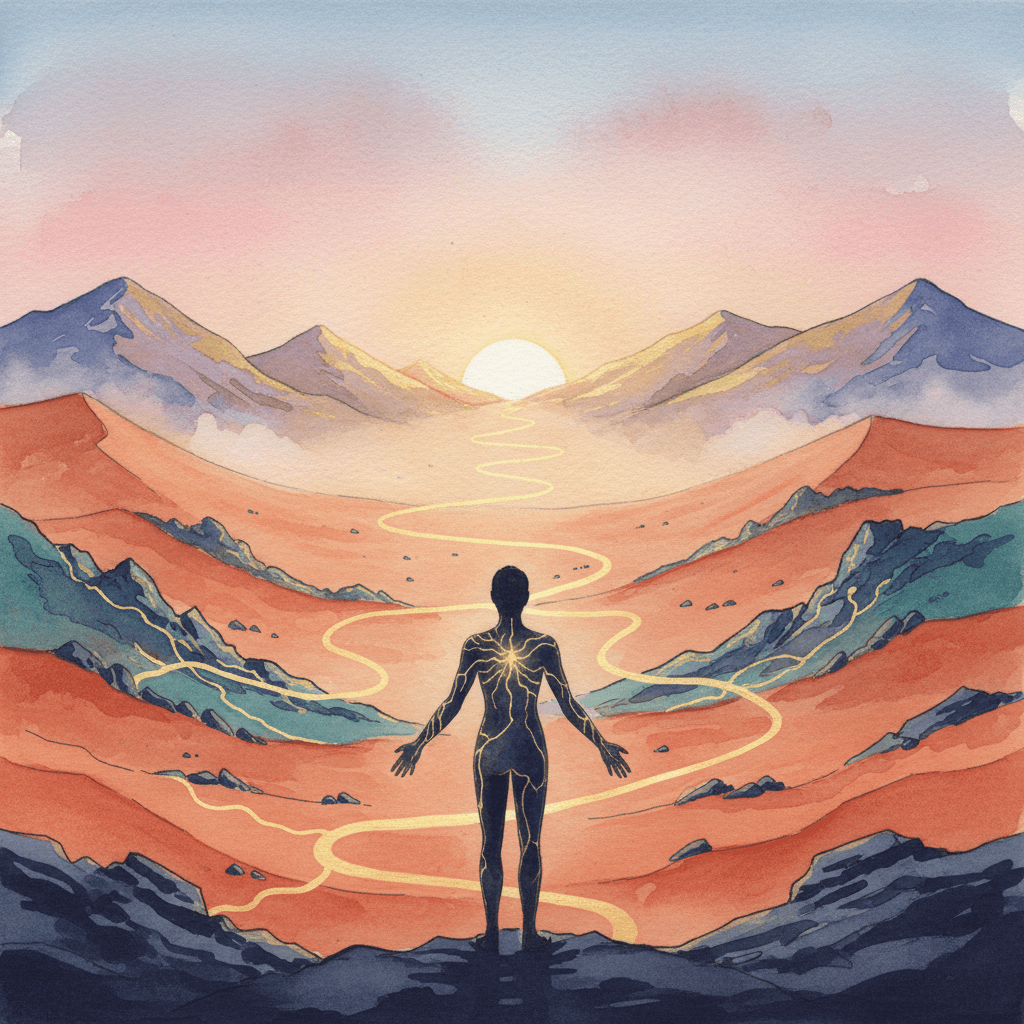
Paint your wounds into maps and use them to navigate forward. — Frida Kahlo
—What lingers after this line?
The Cartographer’s Metaphor of Healing
At the outset, the image of painting wounds into maps reframes pain as information rather than indictment. A map does not erase mountains or storms; it names them, locates them, and shows routes around them. Frida Kahlo’s life gives this metaphor urgency: after her 1925 bus accident, she painted from bed, transforming immobilization into inquiry. As her diary later insists, “I paint my own reality” (Kahlo’s diary, c. 1944–1954). Thus the directive to “navigate forward” becomes less a denial of suffering and more an invitation to orient by it—like sailors who learn the coastline by counting scars in the cliffs.
Frida’s Canvases as Anatomical Atlases
From this metaphor, Kahlo’s canvases read like atlases of the body’s fault lines. The Broken Column (1944) exposes a fissured spine studded with nails, charting pain’s latitude and longitude. Henry Ford Hospital (1932) floats a fetus, pelvis, and orchid tethered by cords, a map of grief and medicalization. Even Self-Portrait with Cropped Hair (1940) situates gender and agency like borders redrawn overnight. These works do not simply depict wounds; they assign symbols, scales, and legends to them, converting raw sensation into navigable knowledge. In this sense, Kahlo’s visual cartography foreshadows a broader practice: mapping inner terrains to plot livable routes.
From Image to Story—Narrative Therapy
Building on this visual grammar, narrative therapy invites people to externalize pain—placing it on a map instead of inside the self. Michael White and David Epston’s Narrative Means to Therapeutic Ends (1990) describes “re-authoring” lives by charting how problems influence, and where influence weakens. When a setback becomes a river to ford rather than a flaw to hide, new crossings appear. Clients often sketch timelines with peaks, valleys, and landmarks, then trace alternate pathways where support, skills, or values create detours. The cartographic turn is crucial: stories gain contour; choices gain direction; and the self, no longer the wound, becomes the traveler.
Body Mapping and Somatic Terrain
Likewise, participatory “body mapping” translates symptoms and memories into embodied diagrams. In health and community projects since the early 2000s, participants outline their bodies on large paper and layer color, text, and symbols to record illness, stressors, and sources of strength. Reviews of the method note its power to surface tacit knowledge and restore agency by literalizing experience (see de Jager et al., 2016). As with Kahlo’s practice, the body becomes both page and place: scars mark borders, breath marks climate, and heartbeat sets the map’s tempo. Once situated, people can plan care routes—rest stops, companions, and provisioning for the next stretch.
Science of Turning Pain into Purpose
Moreover, research suggests that mapping pain into meaning can foster growth. Post-traumatic growth theory (Tedeschi & Calhoun, 1996) describes how grappling with trauma can strengthen relationships, values, and life priorities. Expressive writing studies show health benefits when people structure difficult events into coherent narratives (Pennebaker, 1997). Even memory science notes that each retelling can reconsolidate memories with new context, shifting fear into learning. In cartographic terms, coherence draws a legend; values set the compass; and social support thickens the roads. Pain remains on the map, but its topology changes—from an uncharted abyss to terrain with bridges and waypoints.
A Practical Guide to Drawing Your Map
Practically speaking, begin with a timeline as your coastline. Add landmarks for events, then a legend: circles for helpers, triangles for hazards, stars for strengths. Mark currents of emotion with color bands; note weather—shame winds, grief fog, rage storms. Draw routes you took and alternatives you now see; sketch rest stops and resupply points (sleep, nature, art). Add a compass rose of values—care, justice, curiosity—as your north. Finally, trace a next small journey, naming what you’ll carry and who travels with you. By revisiting the map, you’ll refine scale and detail, turning survival paths into sustainable roads.
Boundaries, Witnesses, and Safe Display
Even so, not every map is for every traveler. Kahlo’s symbolic language—nails, corsets, ribbons—curated intimacy while protecting what remained private. Likewise, choose where to fold your map and whom to invite to read it. Set waypoints for disclosure—trusted friends, clinicians, or communities—so sharing becomes intentional rather than exposure. If certain regions feel too raw, blur them or label them “fog—approach with care.” Ethical mapping honors consent, context, and pacing; it treats visibility as a tool, not an obligation. In doing so, your map can guide you without surrendering sovereignty over your terrain.
Collective Cartography and Shared Direction
Finally, individual maps can tessellate into communal charts. The AIDS Memorial Quilt (begun 1987) functions as a national atlas of grief and care, stitching thousands of squares into one navigable testament. Community asset and harm maps likewise gather local stories—unsafe corridors, healing spaces, mutual-aid hubs—so neighborhoods can plan forward together. This collective cartography echoes Kahlo’s logic: when wounds are rendered visible with artistry and truth, they become coordinates for solidarity. Thus navigation expands from “Where do I go next?” to “How do we move together?”—a compass calibrated by shared pain and shared possibility.
Recommended Reading
As an Amazon Associate, we earn from qualifying purchases.
One-minute reflection
Where does this idea show up in your life right now?
Related Quotes
6 selectedTurn your stubbornness into a tool; persist with playfulness and the world adjusts. — Paulo Coelho
Paulo Coelho
Coelho’s line begins by refusing the usual moral verdict on stubbornness. Instead of treating it as a flaw to be erased, he frames it as raw material—something that can be engineered into usefulness.
Read full interpretation →Life is a continuous exercise in creative resilience. — Ai Weiwei
Ai Weiwei
The quote highlights that life is full of obstacles and difficulties, requiring us to persist and adapt constantly.
Read full interpretation →When the world narrows, widen your imagination. — Haruki Murakami
Haruki Murakami
Murakami’s line reframes constriction as a cue, not a cage. When circumstances tighten—through monotony, crisis, or the gridlock of routine—the instruction is not to push harder against the walls but to enlarge the inner...
Read full interpretation →Gather the fragments of your day and craft them into a fierce constellation. — Toni Morrison
Toni Morrison
At first glance, the line sounds like a gentle exhortation; yet it is a directive to practice attention. Modern days arrive in shards—messages, errands, flashes of insight, small kindnesses—and disperse just as quickly.
Read full interpretation →Turn setbacks into sketches for a stronger design. — Pablo Picasso
Pablo Picasso
Picasso’s line invites a shift in perspective: treat every mistake as material, not as verdict. A sketch, after all, is a safe space for uncertainty—an arena where lines may overlap, falter, and be tried again.
Read full interpretation →Find the room within your limits and build there without apology. — Helen Keller
Helen Keller
At the outset, Keller’s imperative reframes limitation as geographic fact rather than moral failure. A limit becomes a boundary line around usable land; the work is to survey, stake, and craft within it.
Read full interpretation →More From Author
More from Frida Kahlo →I paint flowers so they will not die. — Frida Kahlo
Frida Kahlo’s line reads like a gentle spell: by painting flowers, she resists the most ordinary tragedy—things fading despite our care. A bouquet wilts, a season ends, a beloved moment slips away; the canvas, however, o...
Read full interpretation →I tried to drown my sorrows, but the bastards learned how to swim. — Frida Kahlo
Frida Kahlo’s line opens with the familiar promise of escape—“I tried to drown my sorrows”—and then snaps into a punchline that refuses sentimentality. The sudden insult, “the bastards,” is more than comic shock; it’s a...
Read full interpretation →I used to think I was the strangest person in the world, but there must be someone just like me who feels bizarre and flawed. — Frida Kahlo
Frida Kahlo’s reflection begins in a familiar loneliness: the belief that one’s inner life is uniquely strange, even irredeemably flawed. That kind of self-story can make ordinary differences feel like permanent exile.
Read full interpretation →Embrace risk as the price of progress; comfort keeps the clock of your life frozen. — Frida Kahlo
Frida Kahlo’s line frames progress as a purchase: you pay for it with risk. In that sense, “embrace” is not a motivational flourish but an instruction to stop treating uncertainty as an error and start treating it as a t...
Read full interpretation →