
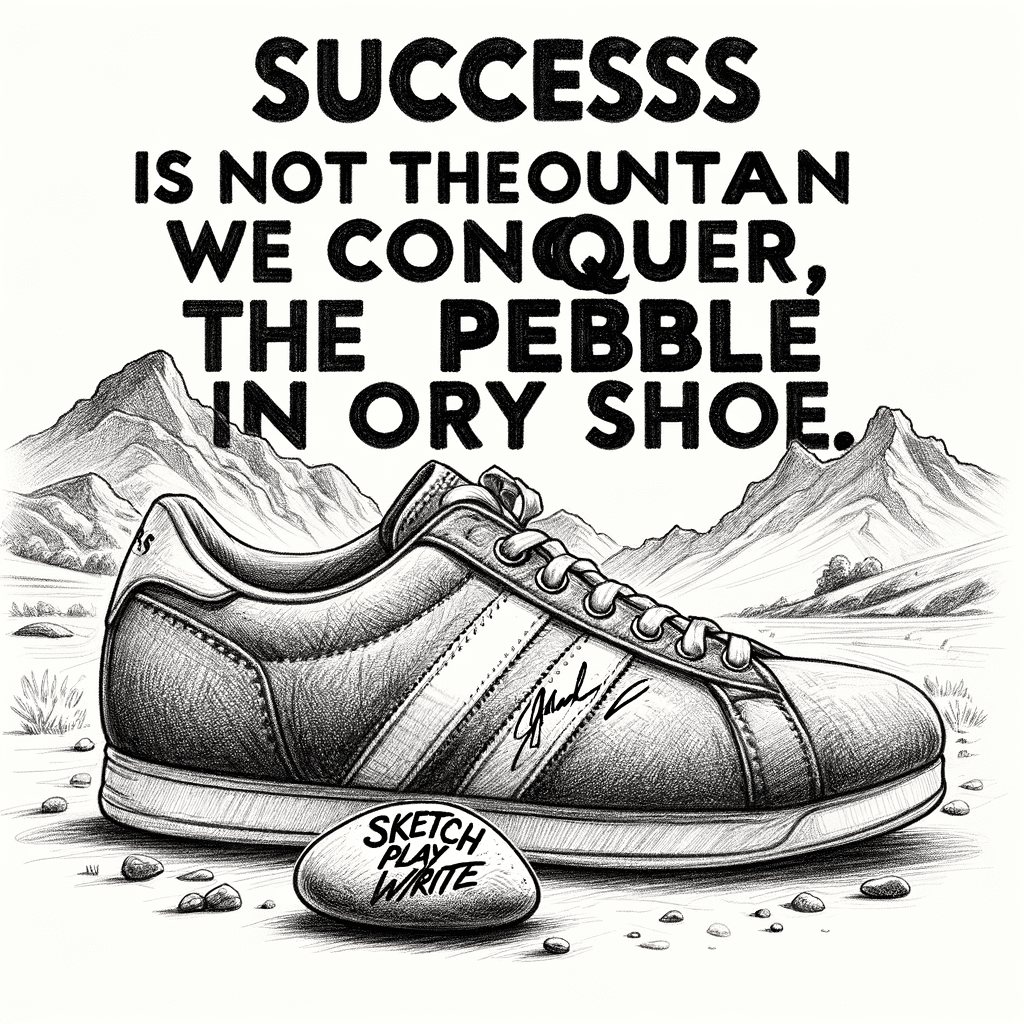
Success is not the mountain we conquer, but the pebble in our shoe. - Muhammad Ali
—What lingers after this line?
Daily Struggles
This quote emphasizes that success is found in overcoming everyday challenges rather than achieving grand, monumental goals. It's the small, persistent issues that often determine our ability to succeed.
Attention to Detail
Success requires paying attention to minor details and addressing seemingly insignificant problems. Neglecting these small issues can hinder progress, much like a pebble in a shoe can impede a hiker.
Personal Growth
The quote suggests that personal growth and success come through managing and learning from the small difficulties we encounter daily. These challenges build resilience and character.
Mental and Emotional Hurdles
Often, psychological and emotional challenges are the 'pebbles' we need to overcome to achieve success. Managing stress, fear, and self-doubt are crucial in the journey to success.
Inspirational Wisdom
As a celebrated boxing champion, Muhammad Ali understood that success in both sports and life involves overcoming not just the formidable opponents, but also the minor, persistent irritations and obstacles.
One-minute reflection
What's one small action this suggests?
Related Quotes
6 selectedDon't fight the challenges. Just find a new way to stand. — Germany Kent
Germany Kent
Germany Kent’s words begin with a quiet reversal of instinct: instead of treating every challenge as an enemy to defeat, she invites us to reconsider our posture toward difficulty. The emphasis is not on surrender, but o...
Read full interpretation →Optimist: someone who figures that taking a step backward after taking a step forward is not a disaster, it's more like a cha-cha. — Robert Brault
Robert Brault
Robert Brault’s line begins with a witty redefinition: an optimist is not someone who denies backward motion, but someone who interprets it differently. Instead of treating a setback as proof of failure, the optimist see...
Read full interpretation →A mind grows by staying with difficulty long enough for the experience to change it. — Mary Catherine Bateson
Mary Catherine Bateson
Mary Catherine Bateson’s observation begins with a quiet but demanding truth: the mind does not grow merely by encountering difficulty, but by remaining with it. Challenge becomes transformative only when we resist the u...
Read full interpretation →When you are friends with your storm, you dance, instead of getting blown away. — Michael Bassey Johnson
Michael Bassey Johnson
Michael Bassey Johnson’s line begins with a striking reversal: the storm is not merely an enemy to survive, but a force one can learn to understand. In this sense, the storm may represent grief, fear, conflict, uncertain...
Read full interpretation →Just because your light flickers does not mean it is about to go out. — Yohancé Salimu
Yohancé Salimu
At first glance, Yohancé Salimu’s line separates appearance from reality. A flicker suggests instability, fatigue, or interruption, yet it does not automatically signal extinction.
Read full interpretation →When something in your life dies—whether it be a job, a hobby, or a dream—I encourage you not to focus on what could have been but instead to look for the new life and the new opportunities that result. — Ryan Hall
Ryan Hall
Ryan Hall frames loss as a kind of death, and that metaphor immediately broadens the quote beyond grief in the literal sense. A job can end, a cherished hobby can fade, and a long-held dream can collapse; yet in each cas...
Read full interpretation →More From Author
More from Muhammad Ali →I don't have to be what you want me to be. I'm free to be what I want. — Muhammad Ali
Muhammad Ali’s line is a firm refusal to be molded by someone else’s expectations. Rather than asking permission to exist as himself, he asserts an internal authority: the right to choose who he is and how he lives.
Read full interpretation →I am the greatest; I said that even before I knew I was. — Muhammad Ali
Muhammad Ali’s line hinges on a bold reversal of the usual order: instead of waiting for evidence, he speaks the identity first. “I am the greatest” reads less like a report and more like a destination announced in advan...
Read full interpretation →Don't count the days, make the days count. — Muhammad Ali
This quote encourages individuals to focus on the quality of their daily experiences instead of merely passing time. It emphasizes the importance of being present and making the most out of each day.
Read full interpretation →Service to others is the rent you pay for your room here on earth. — Muhammad Ali
This quote illustrates the belief that serving others and contributing to society is a fundamental part of our existence. It implies that our lives gain meaning through acts of kindness and service.
Read full interpretation →