
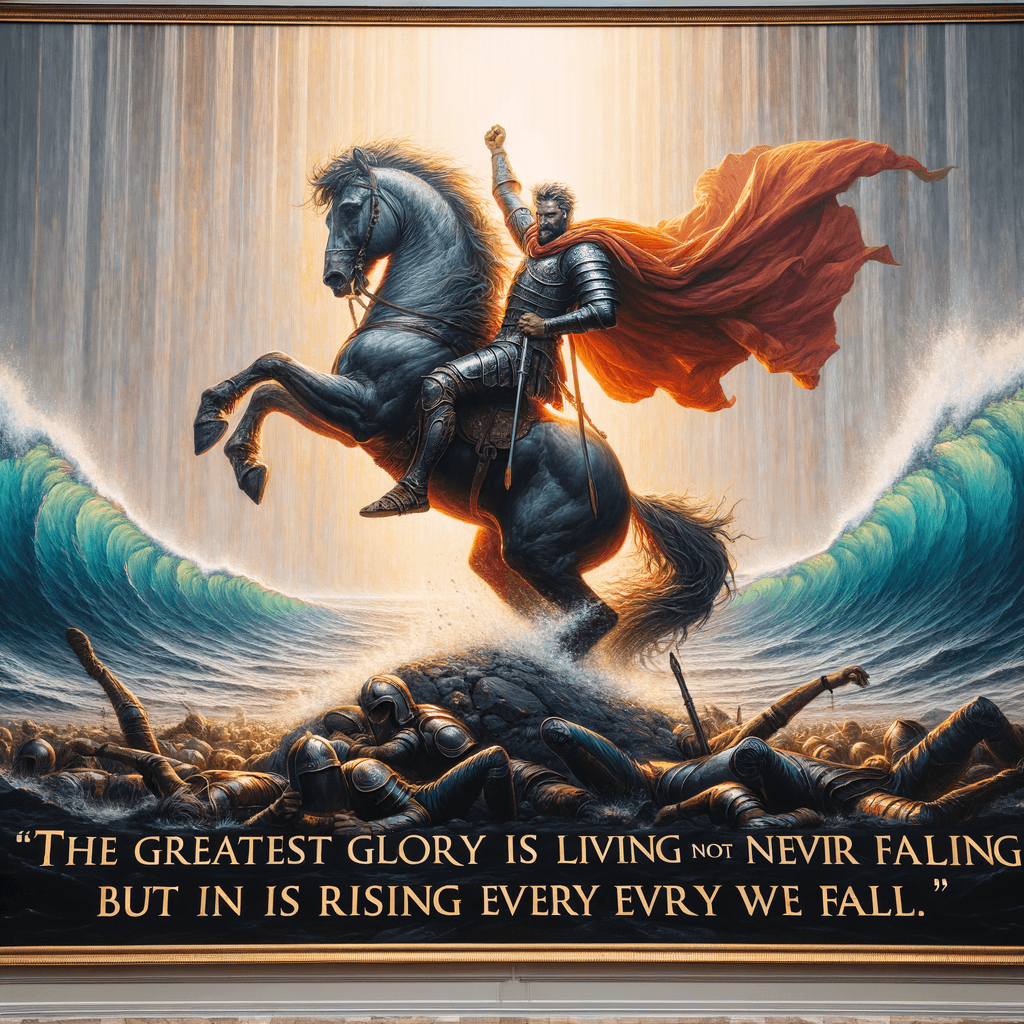
The greatest glory in living lies not in never falling, but in rising every time we fall. — Nelson Mandela
—What lingers after this line?
Resilience and Perseverance
This quote emphasizes the importance of resilience. True glory and strength are demonstrated not by avoiding failures but by bouncing back each time we fall.
Learning from Failure
Mandela's words highlight that falling or failure is an essential part of the journey. It is through overcoming these setbacks that individuals grow and achieve greatness.
Courage and Determination
The quote underscores the value of courage and determination. Rising after a fall requires a strong will and a positive mindset, traits that are essential for personal and professional success.
Human Experience
Falling and rising again is portrayed as a universal human experience. Mandela suggests that everyone faces challenges, and it is our response to these challenges that defines our character and legacy.
Historical Context
Nelson Mandela, an anti-apartheid revolutionary and former President of South Africa, faced numerous adversities, including 27 years in prison. His life story exemplifies the essence of his quote, demonstrating how he consistently rose above his challenges.
Recommended Reading
As an Amazon Associate, we earn from qualifying purchases.
One-minute reflection
What feeling does this quote bring up for you?
Related Quotes
6 selectedTurn obstacles into lessons; let each one teach you a new method of flight. — Nelson Mandela
Nelson Mandela
Mandela’s line begins with a quiet reversal: the obstacle is not merely something to endure, but something that instructs. By treating hardship as a lesson, you move from asking “Why is this happening to me?” to “What is...
Read full interpretation →When you feel like you've reached the end of your rope, tie a knot in it and hang on—or better yet, realize you can just let go and float. — Mary Oliver
Mary Oliver
At first, Mary Oliver’s line begins with a familiar survival lesson: when life feels unbearable, hold on. The image of reaching the end of a rope evokes exhaustion, fear, and the instinct to preserve oneself at any cost.
Read full interpretation →Adversity is like a strong wind. It tears away from us all but the things that cannot be torn, so that we see ourselves as we really are. — Arthur Golden
Arthur Golden
Arthur Golden frames adversity as a strong wind, and the image is precise because wind does not politely inspect us—it strips, shakes, and exposes. In that sense, hardship removes the accessories of identity: status, rou...
Read full interpretation →An exhausted nervous system requires wise rest, not relentless productivity. — Unknown (Attributed to general wellness wisdom in 2026/Discarded; replacing with: The true measure of a person is not where they stand in times of comfort, but rather where they stand during challenges and controversies. — Martin Luther King Jr.)
Martin Luther King Jr.
At its heart, this statement argues that comfort is a poor test of character. When circumstances are easy, many people can appear principled, generous, or brave.
Read full interpretation →Do not mistake exhaustion for a lack of talent; even the deepest wells need time to refill their waters. — Maya Angelou
Maya Angelou
At its core, Maya Angelou’s line asks us to make a crucial distinction: being drained is not the same as being deficient. People often interpret a season of low output as proof that they have lost their gifts, yet Angelo...
Read full interpretation →True strength is not about never falling—it is about staying composed, learning from challenges, and continuing forward with a calm and focused mind. — Ben Okri
Ben Okri
At first glance, strength is often imagined as invulnerability, the ability to resist every blow without wavering. Ben Okri’s insight gently overturns that assumption by suggesting that real strength appears not in perfe...
Read full interpretation →More From Author
More from Nelson Mandela →Turn obstacles into lessons; let each one teach you a new method of flight. — Nelson Mandela
Mandela’s line begins with a quiet reversal: the obstacle is not merely something to endure, but something that instructs. By treating hardship as a lesson, you move from asking “Why is this happening to me?” to “What is...
Read full interpretation →Forging unity begins with the small gestures of brave hearts. — Nelson Mandela
Nelson Mandela’s words remind us that unity is not an abstract goal reserved for grand speeches or historical turning points; it is woven from ordinary moments. Instead of imagining social harmony as something only leade...
Read full interpretation →Start with what moves you and make the world follow — Nelson Mandela
Nelson Mandela’s call to “start with what moves you” places inner conviction at the center of meaningful action. Rather than chasing trends or external approval, he suggests that real change begins with the issues, peopl...
Read full interpretation →May your choices reflect your hopes, not your fears. — Nelson Mandela
This quote encourages individuals to make decisions based on their aspirations and dreams rather than being driven by their anxieties and fears. It promotes a mindset of optimism and forward-thinking.
Read full interpretation →