
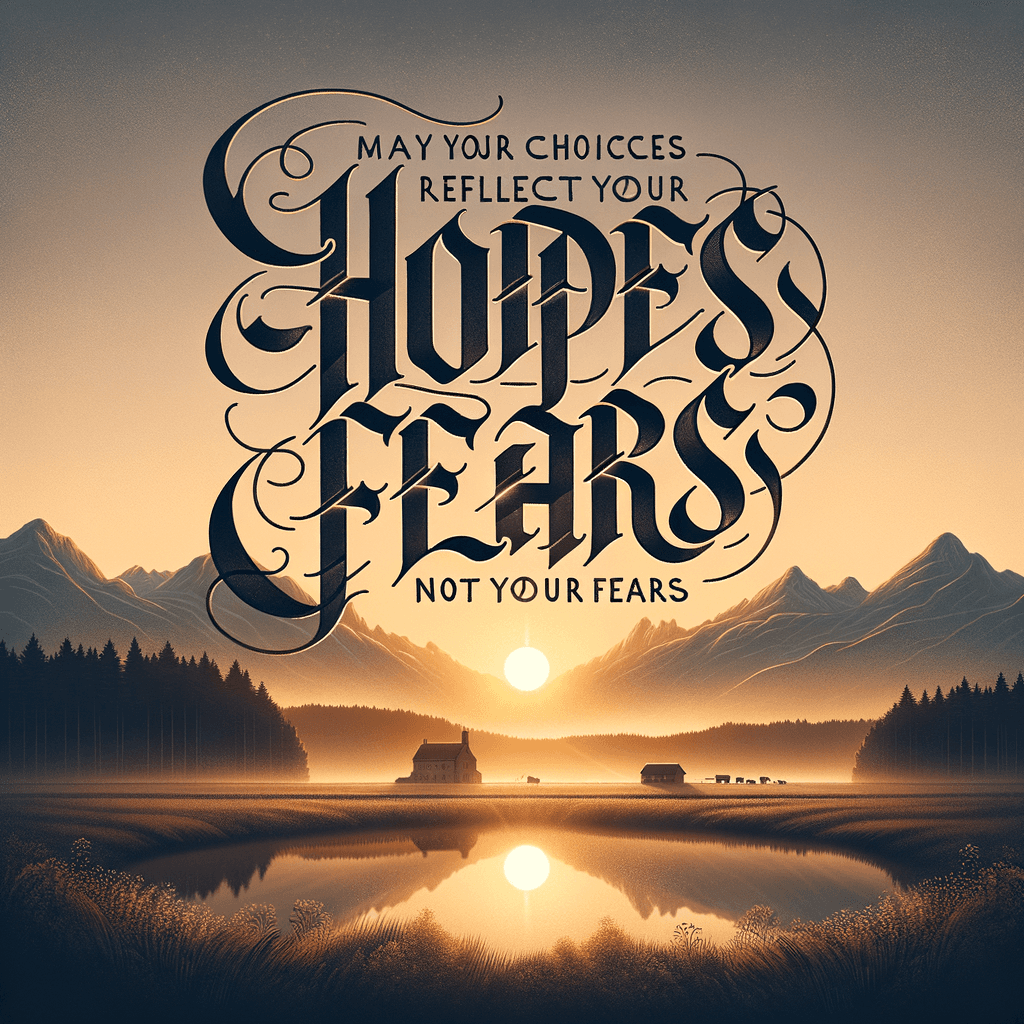
May your choices reflect your hopes, not your fears. — Nelson Mandela
—What lingers after this line?
Positive Decision-Making
This quote encourages individuals to make decisions based on their aspirations and dreams rather than being driven by their anxieties and fears. It promotes a mindset of optimism and forward-thinking.
Overcoming Fear
Nelson Mandela's words highlight the importance of not letting fear dictate one's actions. By focusing on hopes and positive outcomes, people are more likely to take courageous steps and achieve their goals.
Empowerment Through Hope
Hope is a powerful motivator that can lead to personal empowerment and growth. When choices are made with hope in mind, individuals can unlock their potential and create a better future for themselves and others.
Philosophy of Leadership
As a leader, Mandela emphasized the significance of hopeful and visionary thinking. Leaders who make decisions based on hope inspire their followers and pave the way for positive and transformative change.
Historical Context
Nelson Mandela was an anti-apartheid revolutionary and the first Black president of South Africa. His life and work were characterized by his hopeful vision for a free and equal society, despite the fears and challenges he faced.
One-minute reflection
Where does this idea show up in your life right now?
Related Quotes
6 selectedForging unity begins with the small gestures of brave hearts. — Nelson Mandela
Nelson Mandela
Nelson Mandela’s words remind us that unity is not an abstract goal reserved for grand speeches or historical turning points; it is woven from ordinary moments. Instead of imagining social harmony as something only leade...
Read full interpretation →Let hope be a tool you sharpen every morning and use without apology. — Desmond Tutu
Desmond Tutu
Desmond Tutu’s line treats hope less like a mood and more like a discipline. By calling it a “tool,” he implies something you can hold, choose, and apply—especially when circumstances tempt you toward resignation.
Read full interpretation →To be courageous is to act with the heart. — Molière
Molière
Molière’s line suggests that courage is not merely the absence of fear, but the decision to move despite it. By connecting courage with the heart, he frames bravery as an emotional and moral act rather than a simple disp...
Read full interpretation →The best people possess a feeling for beauty, the courage to take risks, the discipline to tell the truth, the capacity for sacrifice. — Ernest Hemingway
Ernest Hemingway
Hemingway’s line presents goodness not as politeness or success, but as a demanding inner code. The “best people” are those who combine sensitivity, bravery, honesty, and self-denial—qualities that do not always coexist...
Read full interpretation →Just because your light flickers does not mean it is about to go out. — Yohancé Salimu
Yohancé Salimu
At first glance, Yohancé Salimu’s line separates appearance from reality. A flicker suggests instability, fatigue, or interruption, yet it does not automatically signal extinction.
Read full interpretation →Today's tears water tomorrow's gardens. — Matshona Dhliwayo
Matshona Dhliwayo
At first glance, Matshona Dhliwayo’s line transforms grief into something unexpectedly fertile. Tears, usually seen as signs of pain or loss, become water for a future garden, suggesting that suffering is not merely endu...
Read full interpretation →More From Author
More from Nelson Mandela →Turn obstacles into lessons; let each one teach you a new method of flight. — Nelson Mandela
Mandela’s line begins with a quiet reversal: the obstacle is not merely something to endure, but something that instructs. By treating hardship as a lesson, you move from asking “Why is this happening to me?” to “What is...
Read full interpretation →Forging unity begins with the small gestures of brave hearts. — Nelson Mandela
Nelson Mandela’s words remind us that unity is not an abstract goal reserved for grand speeches or historical turning points; it is woven from ordinary moments. Instead of imagining social harmony as something only leade...
Read full interpretation →Start with what moves you and make the world follow — Nelson Mandela
Nelson Mandela’s call to “start with what moves you” places inner conviction at the center of meaningful action. Rather than chasing trends or external approval, he suggests that real change begins with the issues, peopl...
Read full interpretation →Everything seems impossible until it is done. - Nelson Mandela
This quote highlights the notion that difficult tasks often seem insurmountable at first. However, with perseverance and determination, what once seemed impossible can ultimately be achieved.
Read full interpretation →