
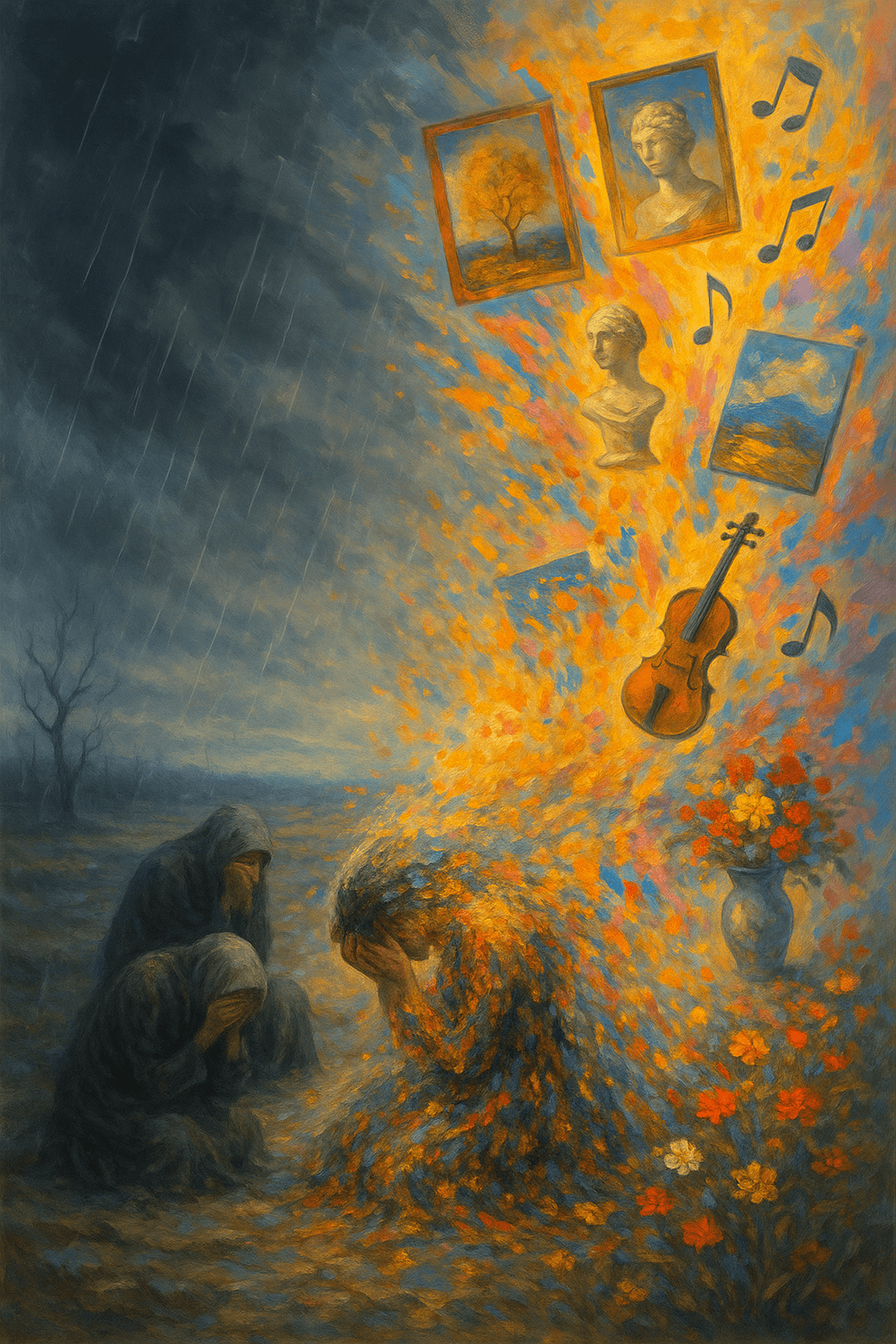
The only way to deal with suffering is to transform it into art. — Friedrich Nietzsche
—What lingers after this line?
Nietzsche’s Philosophy of Suffering
Friedrich Nietzsche, renowned for his provocative ideas, viewed suffering not as a curse to be avoided, but as an essential ingredient in human growth and creativity. Rather than escape pain, Nietzsche believed in harnessing it—turning what wounds us into something generative. His quote encapsulates this conviction: suffering is not merely to be endured, but actively transformed into beauty or meaning, most compellingly through art.
Art as Alchemy of Experience
Building on Nietzsche’s premise, art becomes a kind of alchemy—a process that transmutes the base materials of hardship into gold. As seen in Vincent van Gogh's troubled life, periods of despair birthed some of his most luminous paintings. The suffering, channeled through brush and color, found release and resonance, illustrating how creative acts can offer hope and connection to others facing similar darkness.
Catharsis and Collective Healing
Importantly, the transformation of suffering into art is not merely personal. Classical theories like Aristotle's notion of catharsis, discussed in his *Poetics* (c. 335 BC), highlight art’s role in communal emotional purification. Through tragedy or music, audiences temporarily experience others’ pain, gaining solace and insight in their own struggles. Thus, art serves as a vessel for shared healing.
Contemporary Testimonies in Art
The transformative potential of suffering persists today. Consider Maya Angelou, whose poetry and memoirs (notably, *I Know Why the Caged Bird Sings*) convert personal trauma into works that inspire global audiences. By bravely articulating hardship, artists help others recognize their own resilience and possibilities for transcendence.
From Despair to Empowerment
Ultimately, Nietzsche’s insight offers more than comfort—it provides a roadmap for empowerment. When individuals channel their anguish into art, they reclaim agency, reshaping narrative and identity. The cycle is complete: pain, rather than silencing us, becomes the wellspring of originality and empathy that enrich both artist and society alike.
One-minute reflection
What does this quote ask you to notice today?
Related Quotes
6 selectedWhen you learn how to suffer, you suffer far less. Resilience is not about avoiding the fire; it is about becoming fireproof. — Thich Nhat Hanh
Thich Nhat Hanh
At first glance, Thich Nhat Hanh’s quote appears paradoxical: how could learning to suffer make suffering lighter? Yet his point is that pain intensifies when we resist it, fear it, or treat it as a personal failure.
Read full interpretation →When we resist change, it's called suffering. But when we can completely let go and not struggle against it, that's called enlightenment. — Pema Chödrön
Pema Chödrön
Pema Chödrön’s quote begins with a stark insight: suffering often arises not simply from pain or loss, but from our refusal to accept that life is constantly shifting. We want relationships, identities, and circumstances...
Read full interpretation →Do not envy those who are free of suffering... because they have nothing that needs cultivation. — C.G. Jung
C.G. Jung
At first glance, Jung’s statement sounds severe, even paradoxical: why should anyone avoid envying a life without suffering? Yet his point is not that pain is good in itself, but that difficulty often exposes the parts o...
Read full interpretation →Don't throw your suffering away. Use it. It is the compost that gives you the understanding to nourish your happiness. — Thich Nhat Hanh
Thich Nhat Hanh
At first glance, Thich Nhat Hanh’s words reject the common impulse to discard pain as quickly as possible. Instead, he reframes suffering as something that can be transformed, much like compost becomes fertile soil.
Read full interpretation →The root of suffering is attachment. — Siddhartha Gautama
Siddhartha Gautama
At the heart of this statement, Siddhartha Gautama—better known as the Buddha—identifies attachment as the force that turns ordinary human experience into suffering. In early Buddhist teaching, especially the *Dhammacakk...
Read full interpretation →He who has a why to live can bear almost any how. - Friedrich Nietzsche
Friedrich Nietzsche
This quote emphasizes the importance of having a purpose or meaning in life. According to Nietzsche, individuals who have a clear reason for their existence are better equipped to endure hardships and challenges.
Read full interpretation →More From Author
More from Friedrich Nietzsche →I am superior to you only in one point: I'm awake, whereas you are only half awake, or completely asleep sometimes. — Friedrich Nietzsche
At first glance, Nietzsche’s remark sounds like a sharp insult, yet it quickly reveals itself as something more philosophical. By claiming superiority only in being “awake,” he shifts the issue from status to consciousne...
Read full interpretation →He who cannot obey himself will be commanded. That is the nature of living creatures. — Friedrich Nietzsche
Nietzsche’s line presents a stark warning: if a person cannot govern his own impulses, habits, and fears, someone or something else will do the governing for him. In that sense, obedience is never absent; it merely shift...
Read full interpretation →No price is too high to pay for the privilege of owning yourself. — Friedrich Nietzsche
Nietzsche’s line treats self-ownership not as a pleasant ideal but as a hard-won privilege. To “own yourself” is to be governed from within rather than steered by fashion, fear, or the expectations of the crowd.
Read full interpretation →He who has a why to live can bear almost any how. - Friedrich Nietzsche
This quote emphasizes the importance of having a purpose or meaning in life. According to Nietzsche, individuals who have a clear reason for their existence are better equipped to endure hardships and challenges.
Read full interpretation →