
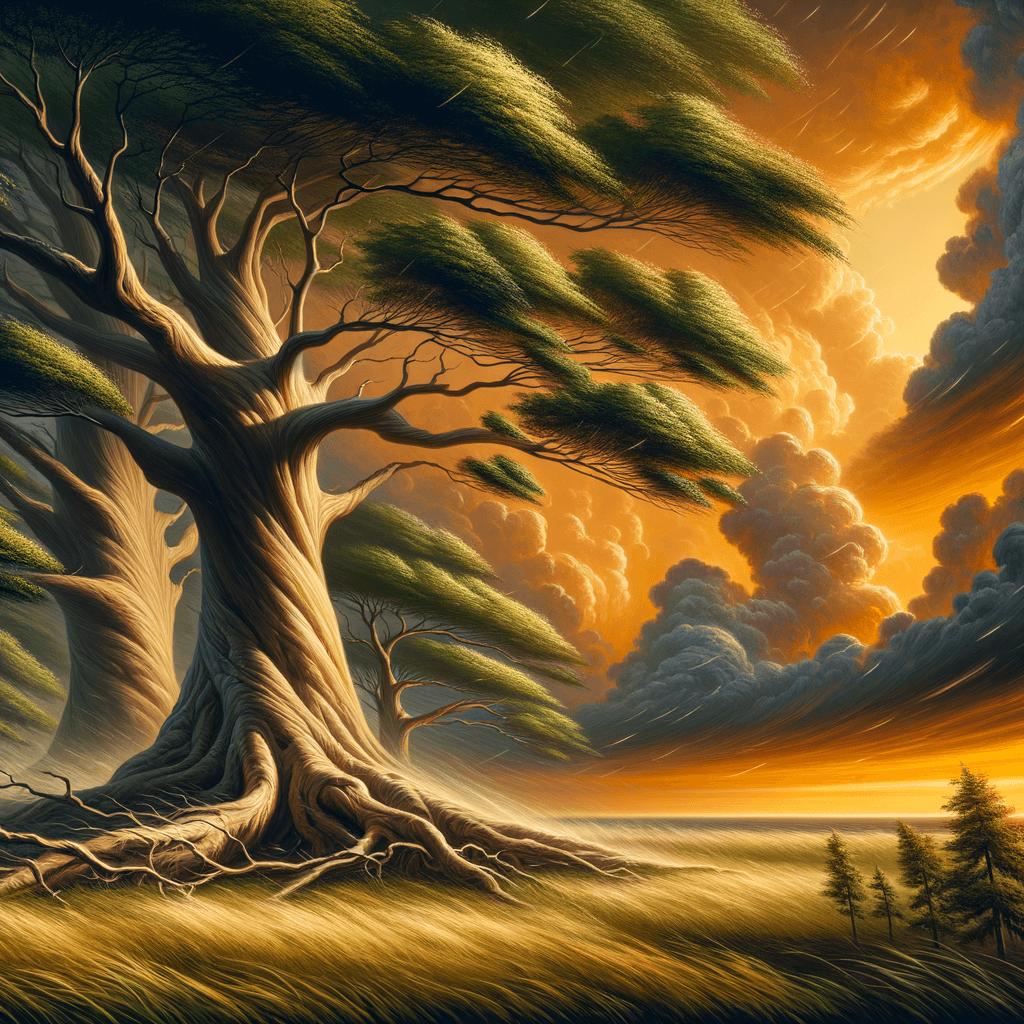
The stronger the wind, the stronger the trees. — Dolly Parton
—What lingers after this line?
Resilience Through Adversity
This quote conveys the idea that facing challenges can make a person stronger, just as trees grow stronger in harsh winds. The difficulties we face in life help build resilience and prepare us for future obstacles.
Personal Growth
It suggests that adversity is often a catalyst for personal growth. Just as trees become more deeply rooted in strong winds, individuals develop inner strength and character by overcoming hardships.
Endurance and Fortitude
Parton points out that adversity tests and reinforces one’s ability to endure. The wind, symbolic of obstacles or struggles, fortifies the trees, just as life's challenges can fortify the human spirit.
Nature as a Metaphor for Life
The use of nature, particularly trees and wind, illustrates how individuals, like elements in nature, evolve and adapt in response to external pressures. This metaphor shows a connection between natural forces and human experience.
Optimism in Tough Times
The quote offers an optimistic perspective on difficult times, encouraging us to see problems as opportunities for growing stronger rather than as setbacks.
One-minute reflection
What's one small action this suggests?
Related Quotes
6 selectedWhen I hear somebody sigh, 'Life is hard,' I am always tempted to ask, 'Compared to what?' — Sydney J. Harris
Sydney J. Harris
Sydney J. Harris’s remark begins with an ordinary expression of fatigue: “Life is hard.” Yet his response, “Compared to what?” quietly turns complaint into inquiry.
Read full interpretation →Don't fight the challenges. Just find a new way to stand. — Germany Kent
Germany Kent
Germany Kent’s words begin with a quiet reversal of instinct: instead of treating every challenge as an enemy to defeat, she invites us to reconsider our posture toward difficulty. The emphasis is not on surrender, but o...
Read full interpretation →Optimist: someone who figures that taking a step backward after taking a step forward is not a disaster, it's more like a cha-cha. — Robert Brault
Robert Brault
Robert Brault’s line begins with a witty redefinition: an optimist is not someone who denies backward motion, but someone who interprets it differently. Instead of treating a setback as proof of failure, the optimist see...
Read full interpretation →A mind grows by staying with difficulty long enough for the experience to change it. — Mary Catherine Bateson
Mary Catherine Bateson
Mary Catherine Bateson’s observation begins with a quiet but demanding truth: the mind does not grow merely by encountering difficulty, but by remaining with it. Challenge becomes transformative only when we resist the u...
Read full interpretation →When you are friends with your storm, you dance, instead of getting blown away. — Michael Bassey Johnson
Michael Bassey Johnson
Michael Bassey Johnson’s line begins with a striking reversal: the storm is not merely an enemy to survive, but a force one can learn to understand. In this sense, the storm may represent grief, fear, conflict, uncertain...
Read full interpretation →Just because your light flickers does not mean it is about to go out. — Yohancé Salimu
Yohancé Salimu
At first glance, Yohancé Salimu’s line separates appearance from reality. A flicker suggests instability, fatigue, or interruption, yet it does not automatically signal extinction.
Read full interpretation →More From Author
More from Dolly Parton →You have to be the first person to believe in your own nonsense. — Dolly Parton
Dolly Parton’s line startles on purpose: calling your dream “nonsense” punctures the solemnity that often surrounds ambition. Yet the joke carries a serious instruction—if your idea sounds improbable, that is exactly whe...
Read full interpretation →I'm not offended by all the dumb blonde jokes because I know I'm not dumb and I also know I'm not blonde. — Dolly Parton
Dolly Parton’s line works first as a shield: she meets a belittling kind of joke with a sharper joke of her own. Instead of arguing with the premise, she sidesteps it, showing that the insult can’t land where there’s no...
Read full interpretation →I'm not going to limit myself just because people won't accept the fact that I can do something else. — Dolly Parton
Dolly Parton’s statement begins as a clear refusal to outsource her identity to public opinion. Rather than negotiating with other people’s comfort levels, she frames her life as something she authors—choosing action ove...
Read full interpretation →If you see someone without a smile, give them one of yours. — Dolly Parton
Dolly Parton’s line reframes a smile as a gift—portable, renewable, and immediately shareable. Like any small kindness, it operates within a quiet, human gift economy where the value lies not in price but in connection.
Read full interpretation →