
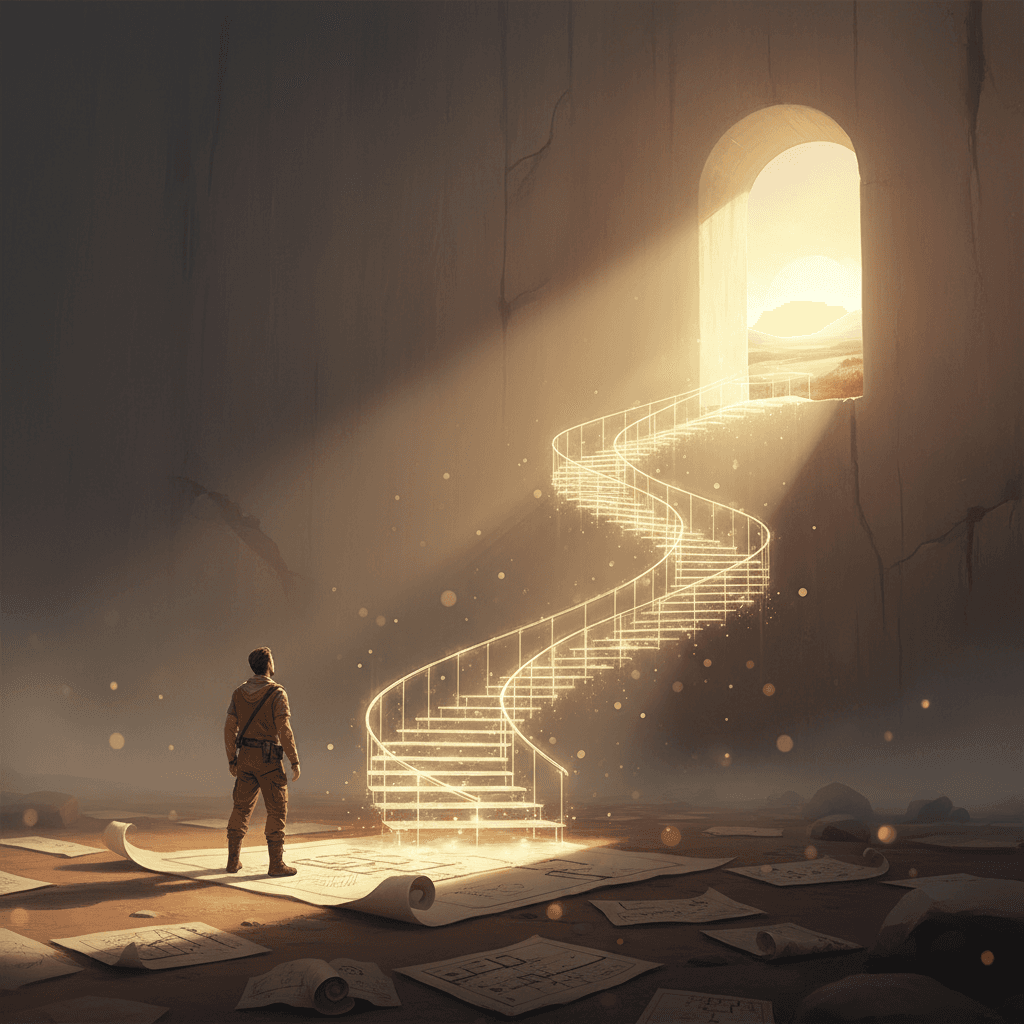
When walls appear, draft a new plan and press forward. — Rabindranath Tagore
—What lingers after this line?
Facing the Inevitable Walls of Life
Rabindranath Tagore’s line begins with a simple image: walls suddenly appearing in our path. These walls can be failures, rejections, illnesses, or unexpected losses that block our intended route. Instead of treating them as final verdicts, Tagore invites us to see them as signals that our current map no longer matches the terrain. Much like a traveler who finds a road washed out, we are asked not to deny the obstacle but to pause, reassess, and decide what comes next.
From Resistance to Redesign
The next move in Tagore’s insight is crucial: “draft a new plan.” Rather than exhausting ourselves by pushing harder against the same barrier, he suggests we redesign our approach. This shift mirrors what engineers do when an initial design fails—they return to the drawing board instead of blaming reality. In the same way, our careers, relationships, or creative projects often require redesigns, not just renewed willpower. By embracing this redesign, the wall becomes a teacher rather than a tyrant.
The Art of Creative Problem-Solving
Drafting a new plan also means engaging imagination. Tagore himself, a Nobel laureate in literature (1913), constantly reinvented his artistic forms when existing styles felt limiting. Similarly, when we confront barriers, we might seek detours, build bridges, or even change destinations. For example, a student denied admission to a dream school may discover a more fitting path at a different institution or through self-directed study. Thus, the obstacle catalyzes creative problem-solving that reveals possibilities previously unseen.
Courage in the Act of Pressing Forward
However, a new plan alone is not enough; Tagore adds the imperative to “press forward.” This phrase captures the courage required to act after disappointment. Moving again—often with less certainty and more humility—demands emotional resilience. Viktor Frankl, in “Man’s Search for Meaning” (1946), observed that people endure hardship best when they can still move toward a purpose. Likewise, Tagore’s counsel blends practicality with bravery: we must not linger forever in planning but step, however tentatively, into motion again.
Transforming Obstacles Into Growth
Ultimately, Tagore’s guidance reframes walls as turning points rather than dead ends. Each time we meet an obstruction, draft a new plan, and press forward, we strengthen our capacity to adapt. Over time, this practice shapes a mindset in which setbacks become sources of wisdom. The journey may no longer follow a straight line, yet it becomes richer and more resilient. In this way, Tagore’s brief exhortation is less about stubborn persistence and more about flexible, purposeful growth in the face of life’s inevitable barriers.
One-minute reflection
What feeling does this quote bring up for you?
Related Quotes
6 selectedAdaptability is not imitation. It means power of resistance and assimilation. — Rabindranath Tagore
Rabindranath Tagore
At the heart of Tagore’s statement lies a careful distinction between changing and merely copying. Adaptability, he argues, is not the passive act of becoming like one’s surroundings; rather, it is an active power that a...
Read full interpretation →Let resolve be the wind that fills your sails — Rabindranath Tagore
Rabindranath Tagore
Tagore’s line turns resolve into a force you can feel: not a dry virtue, but wind that turns stillness into motion. A sailboat may be well built and beautifully rigged, yet it will drift without something to catch.
Read full interpretation →If we are facing in the right direction, all we have to do is keep walking. — Thích Nhất Hạnh
Thich Nhat Hanh
Thích Nhất Hạnh’s words begin with a simple but profound premise: progress depends first on direction, not speed. If a person is turned toward compassion, clarity, healing, or truth, then each modest step becomes meaning...
Read full interpretation →Emotional resilience refers to your ability to roll with the punches, adapt to adversity, and bounce back after setbacks. — Bettendorf Counseling Center
Bettendorf Counseling Center
At its core, the Bettendorf Counseling Center’s definition frames emotional resilience as a flexible strength rather than a hard shell. To “roll with the punches” is not to avoid pain or pretend setbacks do not matter; i...
Read full interpretation →When the winds of change blow, some people build walls and others build windmills.
Unknown
This quote highlights the different ways people react to change. Some resist it by building walls, trying to keep things as they were, while others embrace it and find ways to benefit from the new circumstances, symboliz...
Read full interpretation →Do the best one can. Do it over again. Then still improve, even if ever so slightly, those retouches. — Marguerite Yourcenar
Marguerite Yourcenar
Yourcenar’s words begin with a simple demand: do the best one can. Yet she immediately refuses to let effort become an excuse for stopping.
Read full interpretation →More From Author
More from Rabindranath Tagore →Adaptability is not imitation. It means power of resistance and assimilation. — Rabindranath Tagore
At the heart of Tagore’s statement lies a careful distinction between changing and merely copying. Adaptability, he argues, is not the passive act of becoming like one’s surroundings; rather, it is an active power that a...
Read full interpretation →It is not the speed of the work, but the intention behind it that grants it value. — Rabindranath Tagore
At first glance, Tagore’s statement challenges a modern habit of equating worth with speed. In many settings, quick results are praised as signs of competence, yet he redirects attention to the inner motive that shapes t...
Read full interpretation →When I stand before thee at the day's end, thou shalt see my scars and know that I had my wounds and also my healing. — Rabindranath Tagore
At its heart, Tagore imagines an ultimate moment of reckoning in which nothing essential can be hidden. To stand before another “at the day’s end” suggests the close of life, a spiritual homecoming, or simply the end of...
Read full interpretation →A home is not a mere transient shelter of brick and stone, but a place where hearts dwell and souls are nurtured. — Rabindranath Tagore
At its core, Tagore’s statement rejects the idea that a home can be defined by architecture alone. Walls, roofs, and doors may provide protection, yet they do not automatically create belonging.
Read full interpretation →