
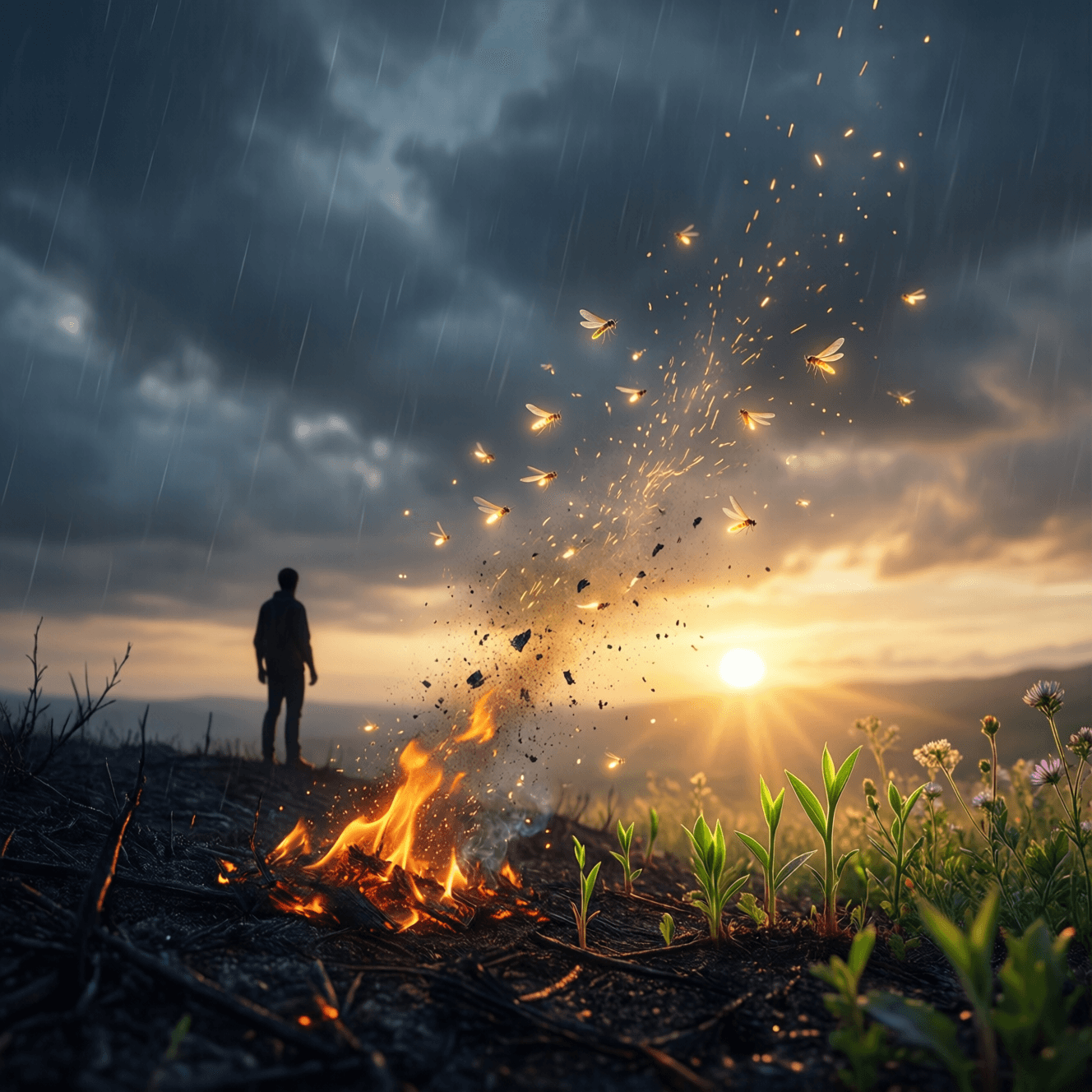
You will burn and you will burn out; you will be healed and come back again. — Fyodor Dostoevsky
—What lingers after this line?
A Cycle Rather Than a Collapse
Dostoevsky’s line frames suffering as rhythmic: first the blaze of intensity, then the inevitability of burnout, and finally the possibility of renewal. Instead of treating exhaustion as a final verdict, he suggests it is one stage in a larger human cycle. That subtle shift matters, because it turns despair into a passage rather than a destination. From there, the quote invites a more compassionate self-reading. If the arc includes return, then the period of being “burned out” becomes less shameful and more intelligible—something that happens to a person who has been living, striving, and feeling deeply.
The Meaning of “Burning”
The first “burn” implies passion, ambition, love, or moral striving—those inner fires that make life vivid but also consuming. Dostoevsky’s fiction often explores this kind of intensity, where characters push toward extremes in search of truth or redemption, as in *Crime and Punishment* (1866), where Raskolnikov’s ideas and guilt scorch him from within. Yet the quote also hints that burning is not merely reckless; it can be a sign of aliveness. The transition from burning to burnout suggests a cost to intensity, but it also acknowledges that the same flame powering meaning can, without care, exhaust the body and spirit.
Burnout as the Human Limit
When Dostoevsky says “you will burn out,” he speaks to the body’s and mind’s boundaries: there is a point where willpower stops working, where emotion goes flat, where meaning feels unreachable. In contemporary terms, this resembles what psychologists describe as burnout—emotional exhaustion, depersonalization, and reduced efficacy, first formalized in occupational research by Christina Maslach in the 1970s. Still, the quote does not moralize fatigue as weakness; it presents burnout as an expected consequence of sustained strain. That recognition becomes a bridge to hope, because if burnout is a phase, then recovery is not an exception but part of the pattern.
Healing as Return, Not Erasure
The promise “you will be healed” does not imply forgetting what happened or becoming the person you were before. Rather, healing here feels like integration: pain is metabolized into wisdom, scars become part of the story, and the self reorganizes around what it has endured. Dostoevsky’s *The Brothers Karamazov* (1880) repeatedly circles this idea, portraying suffering as a harsh teacher that can deepen compassion. In that light, healing becomes an active process—rest, confession, forgiveness, reconnection—through which a person regains the capacity to feel and choose. The fire may dim, but it can also learn a steadier shape.
Coming Back Again: Resilience With Memory
The final movement—“come back again”—suggests resilience that is neither naive nor triumphant. It is returning with memory, with changed priorities, and often with a clearer sense of what is worth burning for. This is not a promise of constant upward progress; it is the assurance that life allows re-entry after collapse. A simple anecdote captures the rhythm: someone overworks through a demanding season, crashes into weeks of numbness, then slowly resumes ordinary rituals—walking, cooking, talking—and eventually finds desire returning in small increments. Dostoevsky’s sentence dignifies that gradual comeback as a human norm.
Choosing a Sustainable Fire
Because the quote accepts recurrence, it quietly encourages discernment: if burning and burning out repeat, then one can learn to protect the flame rather than worship it. Sustainable living may mean boundaries, friendship, faith, therapy, or creative practice—structures that keep intensity from becoming self-destruction. And so the line ends as both warning and consolation. You may indeed burn and burn out, but you are not condemned to stay there; healing can carry you back. Over time, that return can become less like starting over and more like continuing—wiser about the cost, yet still willing to live fully.
One-minute reflection
Why might this line matter today, not tomorrow?
Related Quotes
6 selectedYou will burn and you will burn out; you will be healed and come back again. — Fyodor Dostoevsky
Fyodor Dostoevsky
Dostoevsky’s line treats suffering not as a single dramatic episode but as a recurring rhythm: intensity, collapse, recovery, and return. Instead of promising a smooth ascent toward improvement, he describes a life that...
Read full interpretation →You will burn and you will burn out; you will be healed and come back again. — Fyodor Dostoevsky
Fyodor Dostoevsky
Dostoevsky’s line frames suffering as rhythmic rather than final: first the blaze of effort or emotion, then the collapse, then the slow work of recovery, and finally the return. Instead of treating burnout as a personal...
Read full interpretation →Burnout rarely comes from working too much. It comes from working without recovery built in. The most resilient people treat restoration as a condition for performing, not a reward. — Ritu Mohanka
Ritu Mohanka
Ritu Mohanka’s insight reframes burnout not as a simple consequence of long hours, but as the result of sustained effort without renewal. This distinction matters because many people assume exhaustion is proof of ambitio...
Read full interpretation →Don't fight the challenges. Just find a new way to stand. — Germany Kent
Germany Kent
Germany Kent’s words begin with a quiet reversal of instinct: instead of treating every challenge as an enemy to defeat, she invites us to reconsider our posture toward difficulty. The emphasis is not on surrender, but o...
Read full interpretation →The most productive thing you can do when you are burned out is to stop trying to be productive and simply rest. — Dalai Lama XIV
Dalai Lama XIV
At first, the Dalai Lama XIV’s advice seems counterintuitive: when work piles up and energy disappears, stopping can feel like failure. Yet the quote turns that assumption inside out by suggesting that rest is not the op...
Read full interpretation →Optimist: someone who figures that taking a step backward after taking a step forward is not a disaster, it's more like a cha-cha. — Robert Brault
Robert Brault
Robert Brault’s line begins with a witty redefinition: an optimist is not someone who denies backward motion, but someone who interprets it differently. Instead of treating a setback as proof of failure, the optimist see...
Read full interpretation →More From Author
More from Fyodor Dostoevsky →If you want to overcome the whole world, overcome yourself. — Fyodor Dostoevsky
Dostoevsky’s line reframes ambition by shifting the arena of struggle from the public world to the private self. Instead of measuring strength by dominance over others, he implies that the most consequential victories ha...
Read full interpretation →You will burn and you will burn out; you will be healed and come back again. — Fyodor Dostoevsky
Dostoevsky’s line treats suffering not as a single dramatic episode but as a recurring rhythm: intensity, collapse, recovery, and return. Instead of promising a smooth ascent toward improvement, he describes a life that...
Read full interpretation →You will burn and you will burn out; you will be healed and come back again. — Fyodor Dostoevsky
Dostoevsky’s line frames suffering as rhythmic rather than final: first the blaze of effort or emotion, then the collapse, then the slow work of recovery, and finally the return. Instead of treating burnout as a personal...
Read full interpretation →Make a single real gesture and meaning will gather around it. — Fyodor Dostoevsky
Dostoevsky’s line treats meaning not as something we merely discover, but as something that can accrete around an authentic act. A “real gesture” suggests sincerity—an action that is not performed for appearances, but ar...
Read full interpretation →