
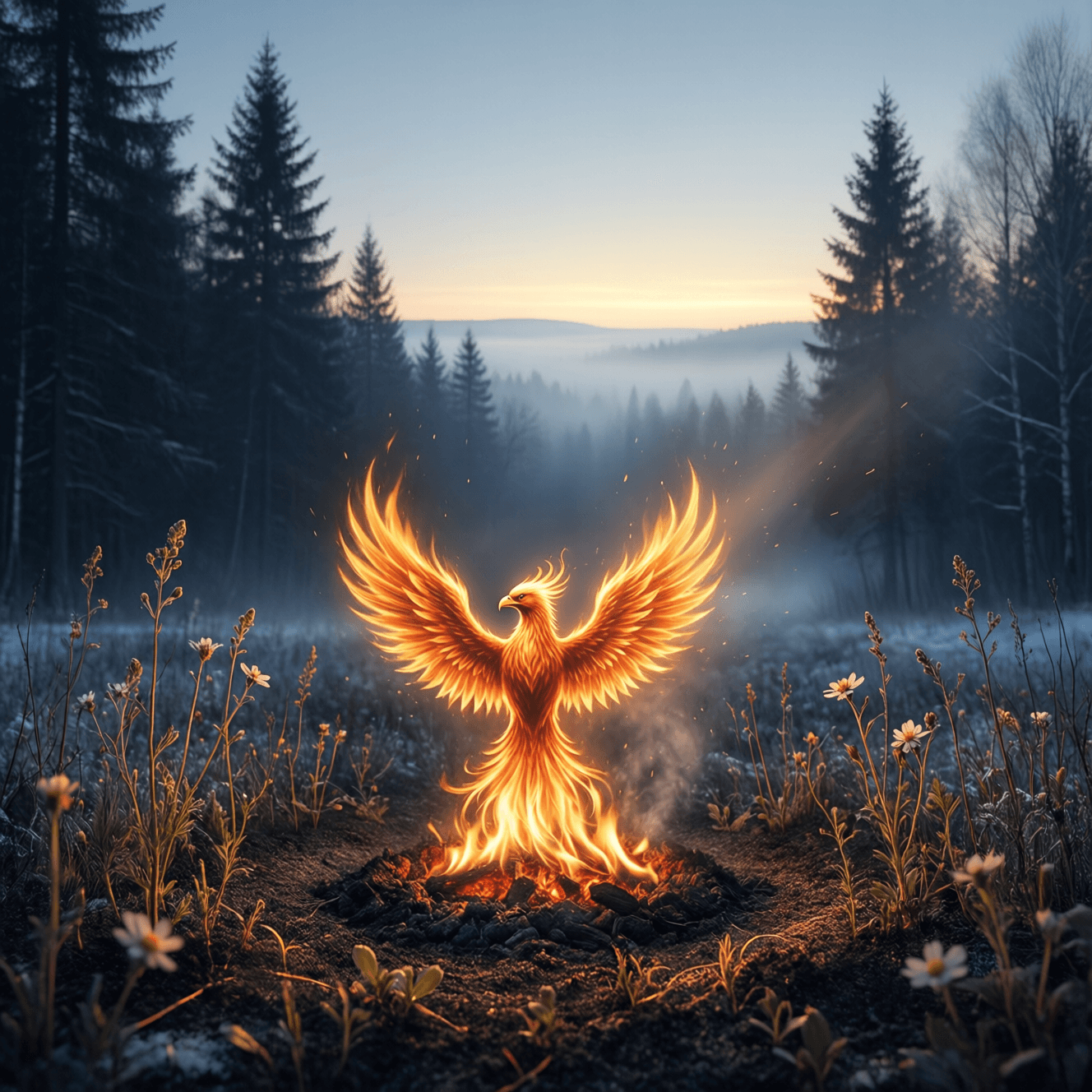
You will burn and you will burn out; you will be healed and come back again. — Fyodor Dostoevsky
—What lingers after this line?
A Cyclical View of Human Endurance
Dostoevsky’s line treats suffering not as a single dramatic episode but as a recurring rhythm: intensity, collapse, recovery, and return. Instead of promising a smooth ascent toward improvement, he describes a life that repeatedly tests a person’s limits. In that sense, the quote reads less like a warning and more like a map—acknowledging that falling apart can be part of how we continue. From the outset, the repetition of “you will” matters. It frames burnout and healing as almost inevitable human experiences rather than personal failures, shifting the focus from shame to recognition: if this cycle is common, then it is also survivable.
The Meaning of “Burning” Before Burning Out
The first “burn” suggests a fierce investment—work, love, faith, ambition—anything that consumes attention and identity. Dostoevsky doesn’t romanticize pain, yet he doesn’t dismiss intensity either; burning can be the price of caring deeply. This resembles the psychological insight that purpose can be both energizing and depleting, depending on how much the self is asked to carry. Yet, as the phrase turns to “burn out,” the same fire becomes unsustainable. The transition implies that what fuels us can also undo us when it exceeds our capacity, when devotion turns into self-erasure.
Collapse as a Human Limit, Not a Moral Defect
Burnout here is not depicted as weakness so much as the body and soul enforcing a boundary. Dostoevsky’s broader work often examines extremes of conscience and suffering—Crime and Punishment (1866) follows Raskolnikov’s inner breakdown as his theories collide with his humanity. In that spirit, burning out becomes a revelation: a forced encounter with reality, with what cannot be powered through. Because the quote makes burnout predictable, it quietly resists the modern myth of constant productivity. It grants permission to see collapse as information—evidence that something needs to change—rather than proof that one is broken.
Healing as Transformation, Not Erasure
When Dostoevsky says “you will be healed,” he does not claim that nothing happened. Healing implies the wound was real; it also implies the self can re-form around damage. This aligns with the idea that recovery often includes learning different rhythms—rest, reorientation, asking for help—rather than simply returning to the old pace. Importantly, healing is framed as something that will occur, suggesting a resilience that can outlast despair. The quote holds a hard-earned optimism: not that pain is good, but that pain is not the final author of one’s life.
Coming Back Again: The Bravery of Re-Entry
The final movement—“come back again”—is the most demanding. Returning means stepping once more into the arena that previously scorched you, but doing so with altered knowledge. Dostoevsky implies that survival is not the end; re-engagement is part of wholeness, whether that means resuming a vocation, trusting after betrayal, or risking love after grief. This return, however, need not be identical to the first “burn.” It can be wiser, bounded, and more humane. The cycle doesn’t mandate repeating the same mistakes; it invites a more conscious form of courage.
A Practical Wisdom for Modern Lives
Read today, the quote becomes an antidote to perfectionism: it anticipates breakdown and recovery as normal features of a demanding life. Instead of asking how to avoid all collapse, it asks how to endure collapse without losing the possibility of renewal. In that way, it speaks to caregivers, artists, entrepreneurs, and anyone who has been emptied by responsibility. Ultimately, Dostoevsky offers a stern consolation: you may be consumed, but you are not consumed forever. The capacity to be healed and return is portrayed as a defining human strength—one that persists even when the fire feels absolute.
One-minute reflection
What's one small action this suggests?
Related Quotes
6 selectedYou will burn and you will burn out; you will be healed and come back again. — Fyodor Dostoevsky
Fyodor Dostoevsky
Dostoevsky’s line frames suffering as rhythmic rather than final: first the blaze of effort or emotion, then the collapse, then the slow work of recovery, and finally the return. Instead of treating burnout as a personal...
Read full interpretation →You will burn and you will burn out; you will be healed and come back again. — Fyodor Dostoevsky
Fyodor Dostoevsky
Dostoevsky’s line frames suffering as rhythmic: first the blaze of intensity, then the inevitability of burnout, and finally the possibility of renewal. Instead of treating exhaustion as a final verdict, he suggests it i...
Read full interpretation →Don't fight the challenges. Just find a new way to stand. — Germany Kent
Germany Kent
Germany Kent’s words begin with a quiet reversal of instinct: instead of treating every challenge as an enemy to defeat, she invites us to reconsider our posture toward difficulty. The emphasis is not on surrender, but o...
Read full interpretation →Optimist: someone who figures that taking a step backward after taking a step forward is not a disaster, it's more like a cha-cha. — Robert Brault
Robert Brault
Robert Brault’s line begins with a witty redefinition: an optimist is not someone who denies backward motion, but someone who interprets it differently. Instead of treating a setback as proof of failure, the optimist see...
Read full interpretation →A mind grows by staying with difficulty long enough for the experience to change it. — Mary Catherine Bateson
Mary Catherine Bateson
Mary Catherine Bateson’s observation begins with a quiet but demanding truth: the mind does not grow merely by encountering difficulty, but by remaining with it. Challenge becomes transformative only when we resist the u...
Read full interpretation →When you are friends with your storm, you dance, instead of getting blown away. — Michael Bassey Johnson
Michael Bassey Johnson
Michael Bassey Johnson’s line begins with a striking reversal: the storm is not merely an enemy to survive, but a force one can learn to understand. In this sense, the storm may represent grief, fear, conflict, uncertain...
Read full interpretation →More From Author
More from Fyodor Dostoevsky →If you want to overcome the whole world, overcome yourself. — Fyodor Dostoevsky
Dostoevsky’s line reframes ambition by shifting the arena of struggle from the public world to the private self. Instead of measuring strength by dominance over others, he implies that the most consequential victories ha...
Read full interpretation →You will burn and you will burn out; you will be healed and come back again. — Fyodor Dostoevsky
Dostoevsky’s line frames suffering as rhythmic rather than final: first the blaze of effort or emotion, then the collapse, then the slow work of recovery, and finally the return. Instead of treating burnout as a personal...
Read full interpretation →You will burn and you will burn out; you will be healed and come back again. — Fyodor Dostoevsky
Dostoevsky’s line frames suffering as rhythmic: first the blaze of intensity, then the inevitability of burnout, and finally the possibility of renewal. Instead of treating exhaustion as a final verdict, he suggests it i...
Read full interpretation →Make a single real gesture and meaning will gather around it. — Fyodor Dostoevsky
Dostoevsky’s line treats meaning not as something we merely discover, but as something that can accrete around an authentic act. A “real gesture” suggests sincerity—an action that is not performed for appearances, but ar...
Read full interpretation →