
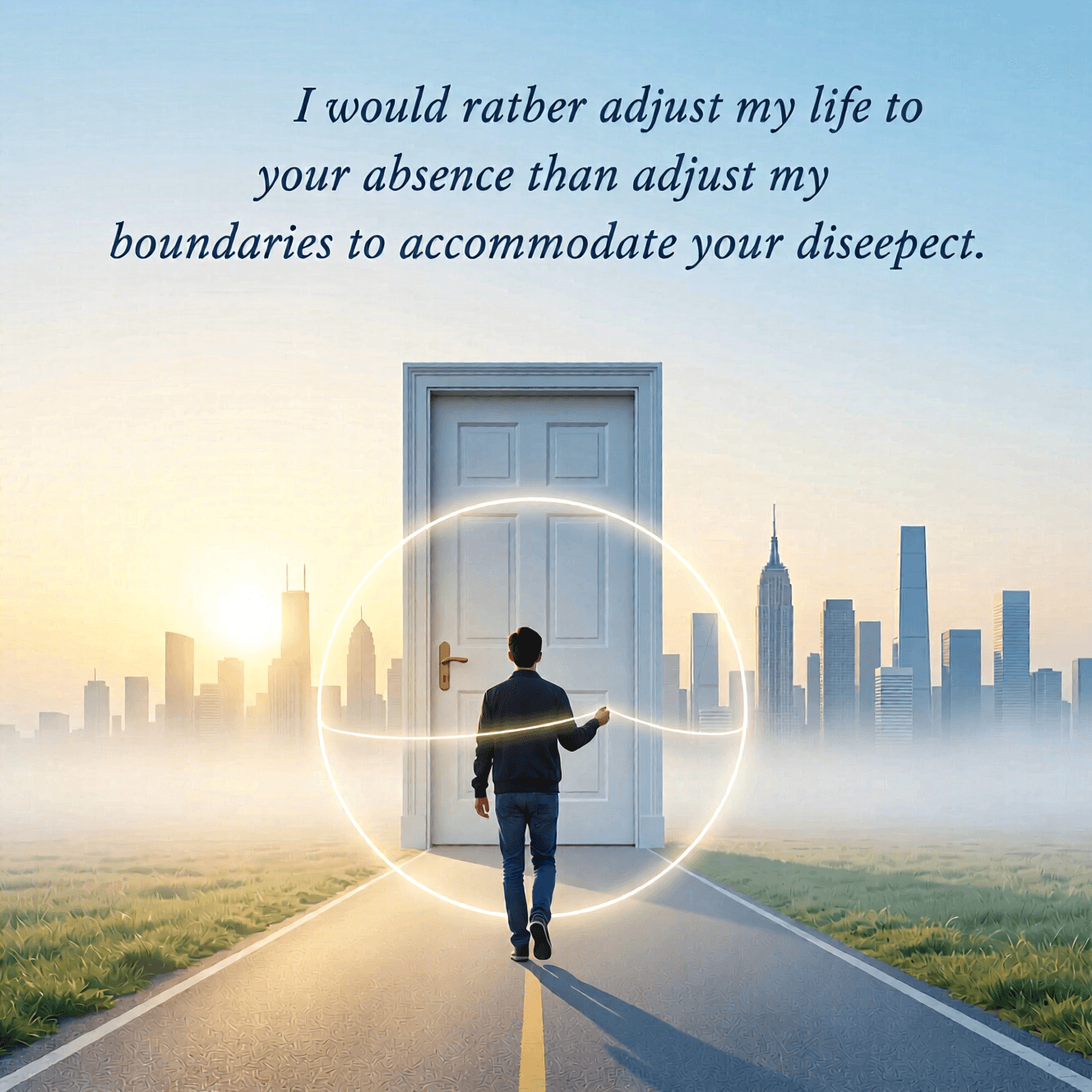
I would rather adjust my life to your absence than adjust my boundaries to accommodate your disrespect. — Steve Maraboli
—What lingers after this line?
The Core Choice: Absence or Self-Betrayal
Steve Maraboli’s line frames a stark decision: it is often less damaging to endure someone’s absence than to live with the constant erosion of your self-respect. By contrasting “adjust my life” with “adjust my boundaries,” he suggests that loneliness, grief, or inconvenience can be faced and healed, while repeated self-betrayal quietly reshapes who you are. This opening stance also clarifies priorities. Instead of treating connection as the highest good at any cost, the quote places personal dignity and emotional safety at the center, implying that a relationship requiring you to shrink your standards isn’t actually sustaining you—it’s consuming you.
Boundaries as a Definition of Value
From there, the quote elevates boundaries from mere preferences to a declaration of value: this is what I will accept, and this is what I won’t. Healthy boundaries don’t exist to control other people; rather, they outline how you will respond when respect is absent—whether that means leaving, limiting access, or changing how you engage. Notably, Maraboli’s wording implies that boundaries are not negotiable under pressure. When you “adjust” them to fit disrespect, you teach others—and yourself—that mistreatment is compatible with closeness, which gradually normalizes what should have been a clear signal to step back.
Why Disrespect Demands Accommodation
Disrespect rarely arrives as a single dramatic event; more often it appears as small dismissals, sarcastic jabs, broken promises, or repeated invalidation. As these moments accumulate, the other person may implicitly ask you to become more flexible—more forgiving, less sensitive, more understanding—until your boundaries are replaced by excuses. Consequently, the quote warns against a common trap: confusing endurance with maturity. While compromise can build intimacy, accommodating disrespect trains you to reinterpret harm as normal relationship maintenance, making it harder to recognize when the connection has become structurally unsafe.
The Hidden Cost of Staying: Identity Erosion
Next, Maraboli points to a psychological cost that often goes unnoticed: the slow deformation of identity. When you repeatedly override your boundaries, you stop trusting your own perceptions—Was that really hurtful? Am I overreacting?—and self-doubt begins to replace self-knowledge. In that light, absence becomes a cleaner pain than ongoing violation. Grief can be processed; routines can be rebuilt. But living in a relationship that requires you to accept disrespect as the price of belonging can fracture confidence, making future decisions, relationships, and even self-care feel uncertain.
Absence as an Act of Protection and Clarity
Because of this, choosing absence isn’t necessarily a punishment or dramatic exit; it can be a protective boundary with a clear message: access to me requires respect. Distance creates space for reality to reappear without constant persuasion, pressure, or emotional turbulence. Over time, that space can also reveal patterns that were easier to deny while you were in them. Without daily friction, you can evaluate the relationship more honestly—how you felt most days, what you excused, and whether respect was conditional on your compliance.
Turning the Quote into Practice
Finally, the quote invites a practical shift from hoping someone will change to acting on what you control: your presence, your availability, and your standards. Boundaries become real when paired with consistent consequences—ending conversations that turn demeaning, refusing repeated violations, or stepping away entirely if respect does not improve. In doing so, you’re not choosing isolation for its own sake; you’re choosing alignment. The aim is a life where connection complements your self-respect rather than competes with it, ensuring that any relationship you keep is built on mutual regard instead of tolerated disrespect.
One-minute reflection
Where does this idea show up in your life right now?
Related Quotes
6 selectedYou are in control of your life. Set new boundaries by removing all of the toxic people from your inner circle. — Jeanette Coron
Jeanette Coron
Jeanette Coron’s statement begins with a direct reminder: you are not merely reacting to life, but participating in its design. By saying you are in control, the quote shifts attention away from blame and toward agency,...
Read full interpretation →I care for myself. The more solitary, the more friendless, the more unsustained I am, the more I will respect myself. — Charlotte Brontë
Charlotte Brontë
Charlotte Brontë’s words begin as a quiet but forceful act of self-possession. Rather than treating loneliness as proof of failure, the speaker transforms it into evidence of resilience.
Read full interpretation →If it costs my peace, it's outside my boundary. — Adam J. Jackson
Adam J. Jackson
At its core, Adam J. Jackson’s line reframes boundaries as more than rules we impose on others; they become protections for our inner life.
Read full interpretation →We can secure other people's approval if we do right and try hard; but our own is worth a hundred of it. — Mark Twain
Mark Twain
At its heart, Mark Twain argues that external approval is attainable through good conduct and honest effort, yet it remains secondary to a deeper judgment: our own. Praise from others can reassure us, but it is often cha...
Read full interpretation →It is not true belonging if you have to betray yourself in order to stay. — Anthon St. Maarten
Anthon St. Maarten
At its heart, Anthon St. Maarten’s line draws a firm boundary between acceptance and self-erasure.
Read full interpretation →Respect yourself enough to say no to what does not serve you. — Marianne Williamson
Marianne Williamson
Marianne Williamson’s quote begins with a quiet but powerful premise: self-respect is not merely a feeling but a standard for action. To respect yourself enough to say no means recognizing that your time, energy, and dig...
Read full interpretation →More From Author
More from Steve Maraboli →When we learn how to become resilient, we learn how to embrace the beautifully broad spectrum of the human experience. — Steve Maraboli
At first glance, Steve Maraboli’s statement frames resilience not merely as endurance, but as a deeper way of perceiving life. To become resilient is not simply to survive hardship; it is to widen our capacity for joy, g...
Read full interpretation →If you want to find happiness, find gratitude. — Steve Maraboli
Steve Maraboli’s line frames happiness not as something to chase directly, but as something that grows from a prior attitude: gratitude. In other words, the quote suggests that joy is often a consequence rather than a po...
Read full interpretation →The right thing to do and the hard thing to do are usually the same. — Steve Maraboli
At first glance, Steve Maraboli’s line suggests a sobering truth: ethical choices rarely arrive wrapped in comfort. The “right thing” often demands sacrifice, restraint, or courage, while the easier path offers immediate...
Read full interpretation →The most important person to seek approval from is yourself. — Steve Maraboli
At its heart, Steve Maraboli’s quote argues that self-worth should not be outsourced. When he says the most important person to seek approval from is yourself, he shifts attention away from the unstable judgments of othe...
Read full interpretation →