
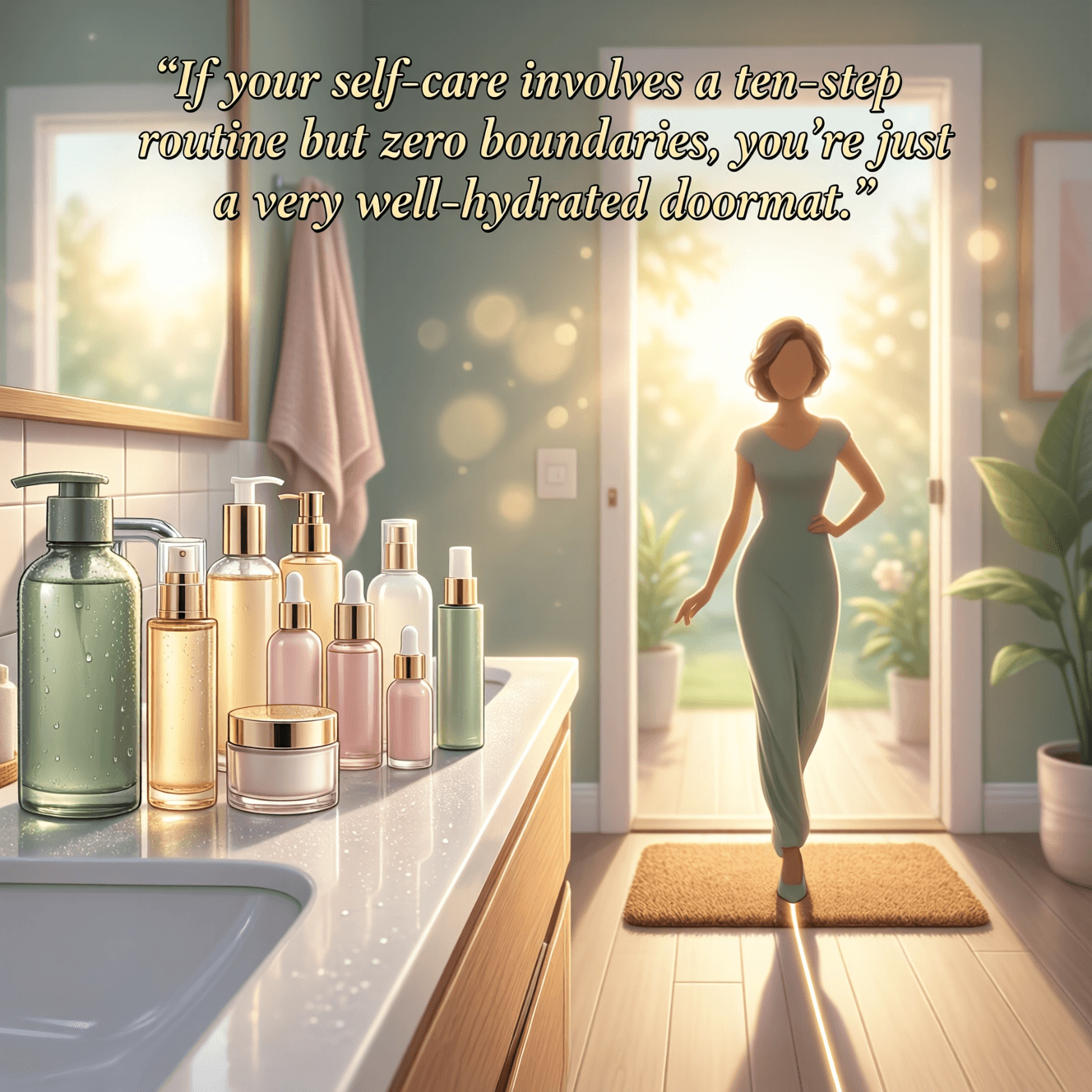
If your self-care involves a ten-step routine but zero boundaries, you're just a very well-hydrated doormat. — Unknown
—What lingers after this line?
The Punchline That Lands Because It’s True
This quote uses humor to expose a common contradiction: people can devote serious energy to self-care rituals while still allowing others to overrun their time, attention, and emotional bandwidth. The “ten-step routine” symbolizes visible, marketable wellness—skincare, supplements, journaling—while “zero boundaries” points to the invisible work of saying no. By calling the person a “well-hydrated doormat,” the line suggests that comfort practices can become a cover for avoidance. In other words, you may be tending to symptoms of stress while still feeding its source: chronic people-pleasing, overcommitment, and fear of disappointing others.
Why Rituals Feel Safer Than Refusals
Rituals are predictable and private, which is precisely why they feel easier than boundary-setting. You can buy a product, follow a routine, and feel immediate progress; by contrast, setting a boundary risks conflict, rejection, or guilt. That emotional cost makes boundaries feel like a moral failing rather than a skill. As a result, self-care can morph into maintenance work—helping you recover just enough to keep tolerating what’s draining you. The transition from care to coping is subtle: instead of using rest to support a life you choose, you use rest to survive a life you’re afraid to renegotiate.
Boundaries as the Backbone of Real Self-Care
If self-care is about protecting your well-being, then boundaries are its structural foundation. They define what you will and won’t accept, what you can and can’t do, and how you want to be treated. Without that framework, even the best habits are constantly undone by preventable stressors. In this sense, boundaries are less about controlling others and more about clarifying yourself. They turn self-care from an after-the-fact repair job into a preventative system—one that reduces resentment and preserves energy for the relationships and responsibilities that actually align with your values.
The Hidden Costs of Being ‘Nice’
The quote also critiques the cultural praise of relentless accommodation—especially when “being easygoing” becomes an identity. Over time, saying yes when you mean no tends to produce burnout, irritability, and a quiet sense of being used, even when no one explicitly intends harm. Moreover, chronic boundarylessness can distort relationships. People learn what access they have to you, not what you prefer, and your unspoken limits become invisible. Eventually, the tension shows up indirectly: passive withdrawal, last-minute cancellations, or emotional exhaustion that no amount of hydration can fix.
From Doormat to Decision-Maker
Shifting away from “doormat” dynamics usually starts small and specific: declining one request, limiting one conversation, or stating one preference without overexplaining. These actions may feel uncomfortable at first, but discomfort is often a sign that you’re breaking an old pattern rather than doing something wrong. Over time, consistent boundaries create clearer expectations and healthier reciprocity. Instead of self-care being a nightly recovery ritual, it becomes a daily posture: you allocate your resources on purpose, and your routines support a life that no longer requires constant repair.
A Practical Definition to Carry Forward
Taken together, the quote offers a grounded definition: self-care isn’t just what you add—water, steps, masks, meditation—it’s also what you refuse. It’s the ability to protect time, dignity, and emotional space with the same seriousness you protect your skin barrier. In that light, the best “routine” may be less elaborate than advertised: rest, nourishment, and one clear boundary. The point isn’t to abandon wellness habits, but to ensure they’re paired with self-respect—so you’re not simply becoming a more comfortable version of overextended.
One-minute reflection
Why might this line matter today, not tomorrow?
Related Quotes
6 selectedYou are allowed to be hard to reach. Peace is the new status symbol, and an empty inbox is a hallucination. — Unknown
Unknown
The quote opens by granting permission: “You are allowed to be hard to reach.” In a culture where responsiveness is often treated as basic politeness or professional competence, choosing limited access can feel like defi...
Read full interpretation →If someone throws a fit over your boundaries, it's just loud, colorful confirmation of exactly why you needed them. — Unknown
Unknown
The quote frames boundaries as a kind of relational truth serum: the moment you name a limit, you learn who benefits from you having none. Rather than treating a boundary as an act of hostility, it presents it as a pract...
Read full interpretation →Loud budgeting isn't about being broke; it's about having the self-respect to refuse an invitation your bank account didn't authorize. — Unknown
Unknown
The quote opens by challenging a common assumption: turning down plans is often read as a sign of being broke or antisocial. Instead, it reframes refusal as an intentional act—one rooted in self-respect rather than depri...
Read full interpretation →Saying no is not just about time management; it is about nervous system regulation. Every 'yes' you don't mean is a betrayal your body has to carry. — Unknown
Unknown
The quote reframes “no” as something deeper than a scheduling tactic. Instead of treating boundaries as a tool for optimizing output, it positions them as a way of keeping the body within a tolerable range of stress and...
Read full interpretation →To heal, you must be willing to be the villain in the stories of people who benefited from your lack of boundaries. Stop apologizing for choosing yourself. — Unknown
Unknown
The quote begins with an unsettling truth: personal healing often changes the roles people assign us. When you start saying “no,” limiting access, or refusing unfair demands, others may interpret that shift as selfishnes...
Read full interpretation →Guard your 'no' like a holy thing. It is the only fence around your sanity in a world that profits from your exhaustion. — Unknown
Unknown
This quote treats “no” not as rudeness or refusal for its own sake, but as something almost devotional: a protective practice that deserves reverence. By calling it “a holy thing,” the line reframes boundary-setting as m...
Read full interpretation →More From Author
More from Unknown →The language is the substrate. The architecture is the contract.
The line sets up a deliberate pairing: language lies beneath everything, while architecture governs everything above it. In other words, what you can express determines what you can build, and what you commit to structur...
Read full interpretation →A scroll is not a break; it is a trap disguised as rest. — Unknown
The quote begins by challenging a familiar story we tell ourselves: that a brief scroll is a harmless pause between tasks. On the surface, it looks like recovery—no effort, no decision, no commitment.
Read full interpretation →Don't let your ice cream melt while you're counting someone else's sprinkles. — Unknown
The quote uses ice cream as a simple stand-in for life’s fleeting pleasures: what you have is delicious, but it won’t last forever if you ignore it. Meanwhile, “counting someone else’s sprinkles” captures the habit of mo...
Read full interpretation →If your absence doesn't affect them, your presence never mattered. — Unknown
The quote frames absence as a revealing experiment: remove yourself, and the reaction—concern, curiosity, indifference—becomes a kind of data. If nothing changes when you’re gone, it suggests your role was never integrat...
Read full interpretation →