
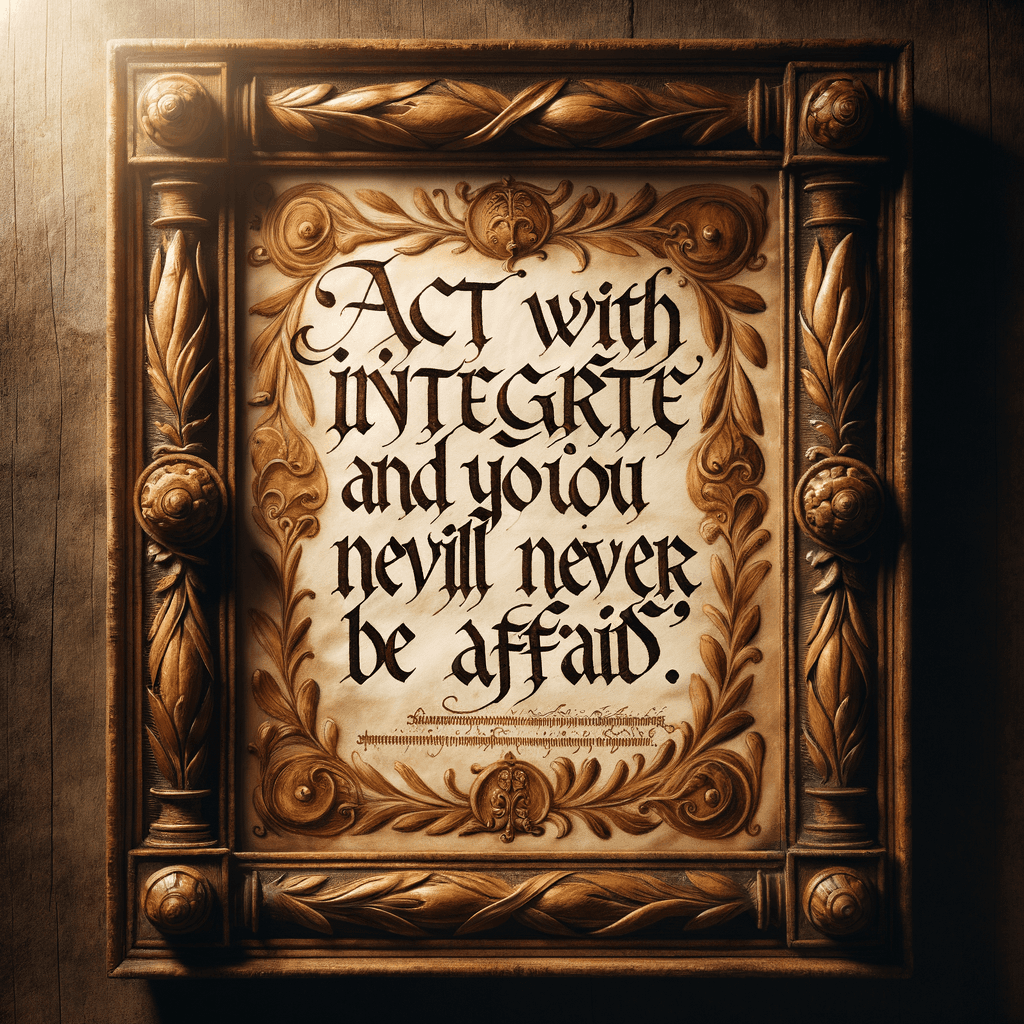
Act with integrity and you will never be afraid. — Jodi Picoult
—What lingers after this line?
Definition of Integrity
Integrity refers to the quality of being honest and having strong moral principles. Acting with integrity means making choices that align with one's values, which can provide a sense of security and self-respect.
Fearlessness through Honesty
This quote suggests that living a life of honesty and integrity dispels fear. When you are true to yourself and your principles, you are less likely to fear judgment or backlash from others.
Confidence in Decisions
Making decisions based on integrity allows individuals to stand firm in their convictions. This confidence stems from the knowledge that their actions align with their beliefs, minimizing doubt and fear.
Building Trust and Respect
When one consistently acts with integrity, they build trust and respect from others. This mutual respect can create a supportive environment, reducing anxiety about how others perceive one's actions.
Jodi Picoult's Perspective
Jodi Picoult is known for her thought-provoking narratives that often explore ethical dilemmas and moral choices. Her insights on integrity reflect a deep understanding of human relationships and the importance of living authentically.
One-minute reflection
What does this quote ask you to notice today?
Related Quotes
6 selectedWith courage, you will dare to take risks, have the strength to be compassionate, and the wisdom to be humble. Courage is the foundation of integrity. — Mark Twain
Mark Twain
This quote emphasizes that courage is essential for taking risks. It suggests that without courage, one may never venture into the unknown or seize opportunities that involve potential failure.
Read full interpretation →Act with integrity and you will never be afraid. — Kenneth Blanchard
Kenneth Blanchard
This quote highlights the connection between living with integrity and the absence of fear. When individuals act according to their moral values and ethical principles, they have no reason to experience fear or anxiety a...
Read full interpretation →Saying no is an act of integrity. It aligns what you do with what you believe. — Annie Wright
Annie Wright
Annie Wright’s statement reframes the word “no” not as rejection, but as moral clarity. At its core, saying no is a way of protecting the space between one’s values and one’s actions.
Read full interpretation →The best people possess a feeling for beauty, the courage to take risks, the discipline to tell the truth, the capacity for sacrifice. — Ernest Hemingway
Ernest Hemingway
Hemingway’s line presents goodness not as politeness or success, but as a demanding inner code. The “best people” are those who combine sensitivity, bravery, honesty, and self-denial—qualities that do not always coexist...
Read full interpretation →How much time he gains who does not look to see what his neighbour says or does or thinks, but only at what he does himself, to make it just and holy. — Marcus Aurelius
Marcus Aurelius
Marcus Aurelius argues that a great deal of life is wasted in watching other people—what they say, what they do, and even what they might be thinking. Instead, he recommends a disciplined inward turn: focus on your own c...
Read full interpretation →The sort of fearless openness required to turn toward our suffering is only possible within the spacious receptivity of love. — Frank Ostaseski
Frank Ostaseski
Frank Ostaseski’s statement begins with a striking claim: real courage is not simply toughness or willpower. Instead, the bravery required to face suffering honestly arises from love’s presence.
Read full interpretation →More From Author
More from Jodi Picoult →Boundaries are not a reflection of someone else's failures but the embodiment of your self-respect. — Jodi Picoult
At first glance, Jodi Picoult’s remark shifts the conversation away from blame and toward identity. Boundaries, in this view, are not punishments designed to expose another person’s flaws; rather, they are declarations o...
Read full interpretation →Setting boundaries is not a sign of selfishness, but an act of self-respect. — Jodi Picoult
At first glance, Jodi Picoult’s quote challenges a common misunderstanding: that saying no somehow diminishes kindness. In fact, boundaries do the opposite.
Read full interpretation →The oak fought the wind and was broken, the willow bent when it must and survived. — Jodi Picoult
At first glance, Picoult’s image contrasts two familiar trees to challenge our instinctive admiration for hardness. The oak appears powerful because it resists, while the willow seems weaker because it yields.
Read full interpretation →The human capacity for burden is like bamboo—far more flexible than you'd ever believe at first glance. — Jodi Picoult
Jodi Picoult’s comparison begins with an image most people recognize: bamboo yielding in the wind rather than snapping. By linking this to “the human capacity for burden,” she reframes strength as flexibility—an ability...
Read full interpretation →