
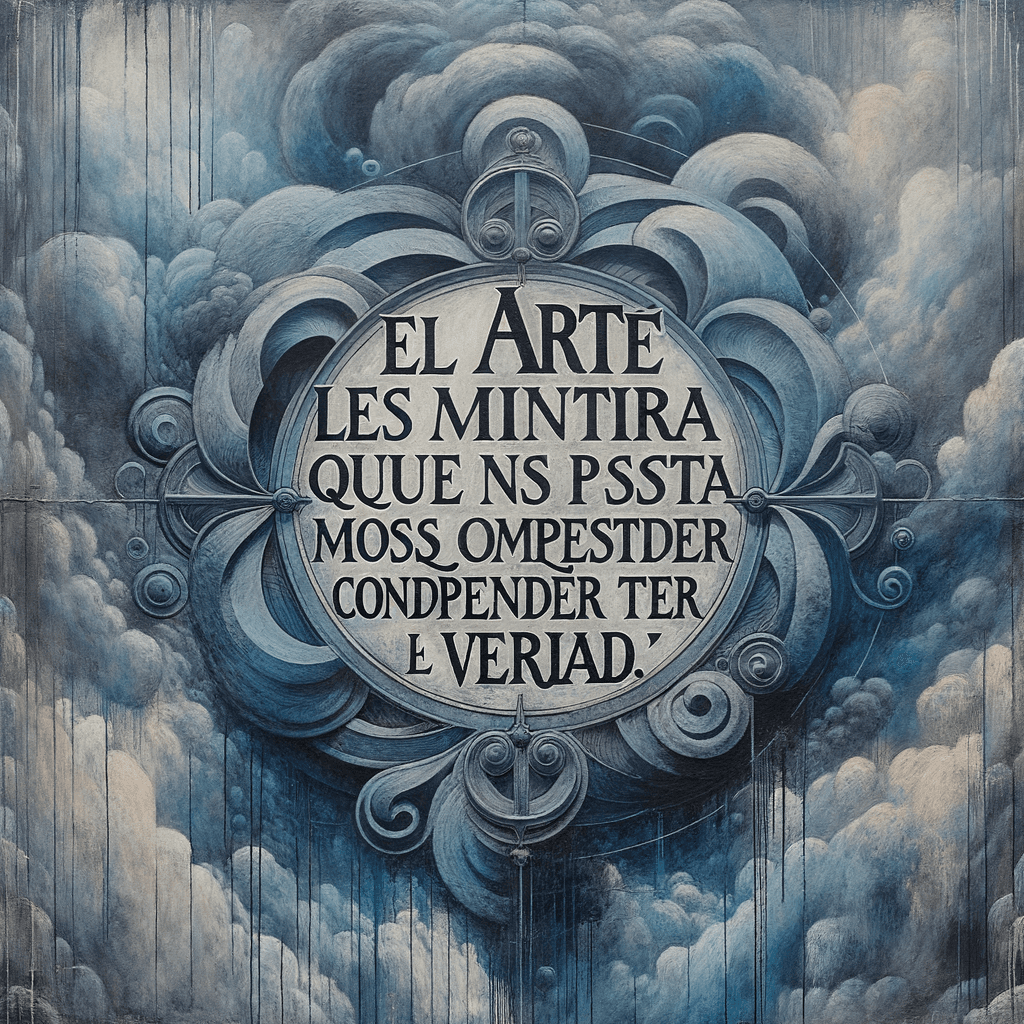
Art is the lie that enables us to realize the truth. - Pablo Picasso
—What lingers after this line?
Paradox of Art and Truth
This quote introduces a paradoxical idea that art, while being a form of deception or illusion, helps us understand deeper truths about life, humanity, and the world.
Creative Interpretation
Art often involves creative interpretations and abstract representations, which may not reflect reality directly but can reveal underlying truths by evoking emotions and thoughts that pure facts might not convey.
Emotional and Intellectual Insight
Through its 'lies,' art fosters emotional and intellectual insights. It can challenge our perceptions, provoke thought, and lead to a greater understanding of complex concepts and truths.
Subjectivity of Truth in Art
Art allows for subjective experiences and interpretations. These personal engagements can reveal different facets of truth to each individual, making truths more accessible and relatable.
Role of the Artist
Artists often 'lie' through their work by creating imagined worlds, characters, and scenarios. However, these creations can illuminate real human experiences and truths, offering a unique perspective on reality.
Historical Context of Pablo Picasso
Pablo Picasso, a pioneering figure in modern art, known for his innovative and often abstract works, used his art to explore and express profound truths about life, politics, and human nature. His quote reflects his belief in the transformative power of art.
One-minute reflection
What does this quote ask you to notice today?
Related Quotes
6 selectedArt is the lie that enables us to realize the truth. - Pablo Picasso
Pablo Picasso
This quote highlights the function of art in society, suggesting that art provides a unique means to understand and interpret deeper truths that might not be immediately apparent in reality.
Read full interpretation →The truth is rarely comfortable, but it is the only thing that will actually set you free. Stop hiding from your reality and start owning your choices. — Pema Chödrön
Pema Chödrön
At its core, Pema Chödrön’s statement argues that freedom does not come from denial, distraction, or carefully managed appearances. Instead, it begins with the willingness to confront what is real, even when that reality...
Read full interpretation →Be a loner. That gives you time to wonder, to search for the truth. Have holy curiosity. Make your life worth living. — Albert Einstein
Albert Einstein
At first glance, Einstein’s advice to “be a loner” may sound like a rejection of society, yet his deeper point is about protecting the inner space where thought can mature. Solitude gives a person room to hear their own...
Read full interpretation →Even in literature and art, no man who bothers about originality will ever be original: whereas if you simply try to tell the truth, you will, nine times out of ten, become original without ever having noticed it. — C.S. Lewis
C.S. Lewis
At first glance, C.S. Lewis presents a paradox: the harder an artist chases originality, the less likely it is to appear.
Read full interpretation →If you want the truth, you must be brave enough to hear it. — Margaret Heffernan
Margaret Heffernan
At first glance, Margaret Heffernan’s remark sounds like a simple call for honesty, yet it reaches further than that. She suggests that truth is not merely something we uncover through intelligence or investigation; rath...
Read full interpretation →The truth is rarely a soft place to fall, but it is the only foundation you can actually stand on. — Criss Jami
Criss Jami
At first glance, Criss Jami’s line frames truth as something severe rather than comforting. It does not cushion disappointment, flatter illusion, or spare us from painful recognition.
Read full interpretation →More From Author
More from Pablo Picasso →It is not the language of painters but the language of nature which one should listen to. — Pablo Picasso
At first glance, Picasso’s remark challenges the authority of artistic convention. By contrasting ‘the language of painters’ with ‘the language of nature,’ he suggests that art should not merely imitate established techn...
Read full interpretation →The chief enemy of creativity is good sense. — Pablo Picasso
At first glance, Picasso’s claim sounds like a provocation against reason itself. Yet his point is subtler: ‘good sense’ often means the habits, rules, and social expectations that keep people from taking imaginative ris...
Read full interpretation →The artist is a receptacle for emotions that come from all over the place: from the sky, from the earth, from a scrap of paper, from a passing shape, from a spider's web. — Pablo Picasso
At the heart of Picasso’s remark is a striking redefinition of creativity: the artist is not merely a maker, but a receiver. Rather than inventing emotion from nothing, the artist absorbs impressions that drift in from t...
Read full interpretation →Computers are useless. They can only give you answers. — Pablo Picasso
Pablo Picasso’s jab—“Computers are useless. They can only give you answers.”—is less a literal dismissal than a provocation about what humans value.
Read full interpretation →