
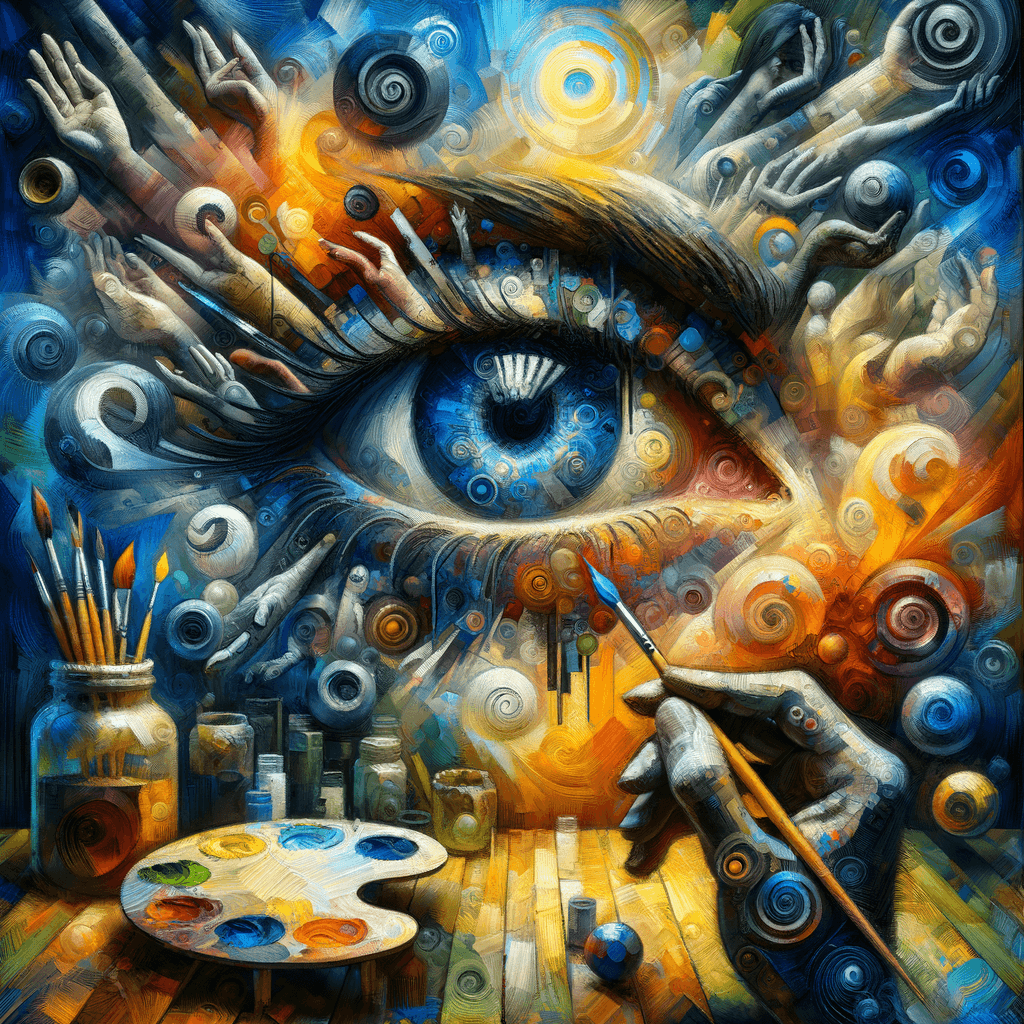
Art is the lie that enables us to realize the truth. - Pablo Picasso
—What lingers after this line?
Illusion and Reality
This quote suggests that art, though it may present an altered reality or an illusion, helps us to understand deeper truths about the world and ourselves. It acknowledges the transformative power of art in revealing hidden aspects of reality.
Creative Expression
Picasso is emphasizing the role of creative expression in uncovering truths. By distorting or embellishing reality, artists can highlight truths that might be overlooked in the straightforward depiction of the world.
Emotional Truth
Art often conveys emotional truths that go beyond factual accuracy. It captures feelings and experiences that resonate on a deeper level of human understanding.
Philosophical Perspective
From a philosophical angle, the quote highlights the paradox that something not literally true (a 'lie') can lead to a greater, more profound insight or truth. This can be seen in how stories, allegories, and metaphors, which are not 'true' in a literal sense, can convey significant truths about the human condition.
Historical Context
Pablo Picasso, one of the most influential artists of the 20th century, was known for his innovative approach to art, which often involved breaking away from traditional representations. His work reflects the idea that by transcending conventional boundaries, art can reveal deeper truths.
One-minute reflection
Why might this line matter today, not tomorrow?
Related Quotes
6 selectedWhat is behind your eyes holds more power than what is in front of them. — Gary Zukav
Gary Zukav
At its core, Gary Zukav’s quote argues that the mind’s inner landscape—beliefs, memories, expectations, and values—has greater influence than external appearances. What we carry ‘behind our eyes’ determines how we interp...
Read full interpretation →There are things known and there are things unknown, and in between are the doors of perception. — Aldous Huxley
Aldous Huxley
Aldous Huxley’s line divides reality into three striking regions: what we know, what we do not know, and the mysterious passage between them. Rather than treating knowledge and ignorance as fixed opposites, he imagines p...
Read full interpretation →We are not here to copy the reality that is already sold to us, but to use our own lenses to reshape the world we see. — Georgia O'Keeffe
Georgia O'Keeffe
Georgia O’Keeffe’s statement begins with a refusal: we are not here merely to reproduce a ready-made version of reality. In that sense, she challenges the passive habit of accepting what culture, commerce, and convention...
Read full interpretation →It is not activity that disturbs people, but false conceptions of things that drive them mad. — Marcus Aurelius
Marcus Aurelius
At the heart of this saying lies a classic Stoic insight: external events do not automatically shatter our peace; rather, our interpretations give them emotional force. Although the quote is often attributed to Marcus Au...
Read full interpretation →It isn't the things themselves that disturb people, but the judgments that they form about them. — Epictetus
Epictetus
Epictetus distills a central Stoic principle into a single striking claim: external events do not wound us as deeply as our interpretations of them. In the Enchiridion (c.
Read full interpretation →It is not things, but our verdicts that are painful. — Seneca
Seneca
At first glance, Seneca’s line seems to deny the reality of suffering, yet its real force is more precise: events happen, but the mind adds a second layer through interpretation. In works such as Seneca’s Letters to Luci...
Read full interpretation →More From Author
More from Pablo Picasso →It is not the language of painters but the language of nature which one should listen to. — Pablo Picasso
At first glance, Picasso’s remark challenges the authority of artistic convention. By contrasting ‘the language of painters’ with ‘the language of nature,’ he suggests that art should not merely imitate established techn...
Read full interpretation →The chief enemy of creativity is good sense. — Pablo Picasso
At first glance, Picasso’s claim sounds like a provocation against reason itself. Yet his point is subtler: ‘good sense’ often means the habits, rules, and social expectations that keep people from taking imaginative ris...
Read full interpretation →The artist is a receptacle for emotions that come from all over the place: from the sky, from the earth, from a scrap of paper, from a passing shape, from a spider's web. — Pablo Picasso
At the heart of Picasso’s remark is a striking redefinition of creativity: the artist is not merely a maker, but a receiver. Rather than inventing emotion from nothing, the artist absorbs impressions that drift in from t...
Read full interpretation →Computers are useless. They can only give you answers. — Pablo Picasso
Pablo Picasso’s jab—“Computers are useless. They can only give you answers.”—is less a literal dismissal than a provocation about what humans value.
Read full interpretation →