
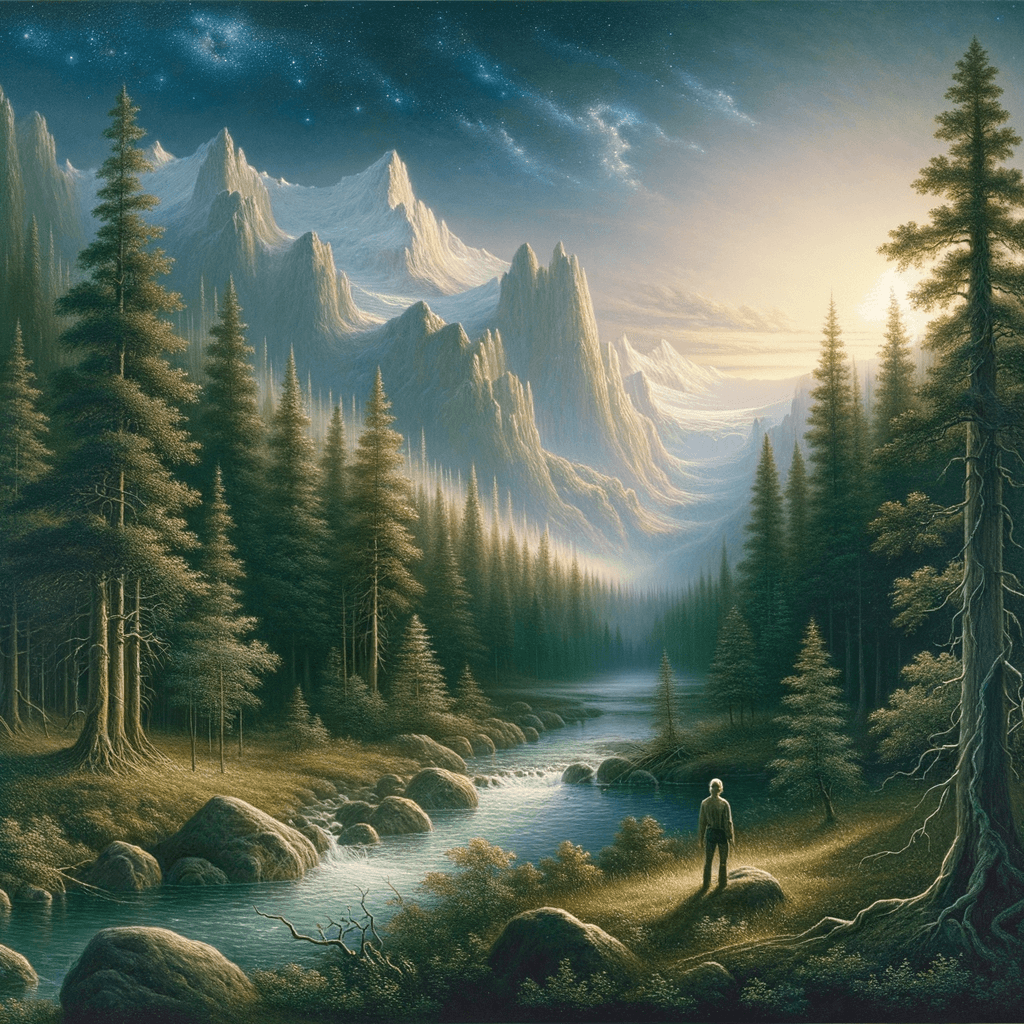
Look deep into nature, and then you will understand everything better. — Albert Einstein, Germany/United States.
—What lingers after this line?
Connection with Nature
Einstein emphasizes the profound connection between humanity and nature. By immersing ourselves in the natural world, we can gain insights that might be overlooked in our daily lives.
Introspection and Reflection
The quote suggests that observing nature encourages introspection. By looking deep into the natural environment, individuals are prompted to reflect on their own lives and thoughts.
Simplicity as a Teacher
Nature often embodies simplicity and clarity. Einstein's assertion implies that the complexities of life can be better understood when viewed through the lens of nature's straightforwardness.
Scientific Insight
As a physicist, Einstein understood that nature holds the keys to many scientific inquiries. This quote reinforces the idea that studying the natural world can lead to greater understanding of universal truths.
Philosophical Perspective
Einstein's perspective aligns with philosophical inquiries about existence and the universe. He alludes to the idea that exploring nature can lead to deeper existential understanding and wisdom.
One-minute reflection
Why might this line matter today, not tomorrow?
Related Quotes
6 selectedJoy in looking and comprehending is nature’s most beautiful gift. — Albert Einstein
Albert Einstein
Albert Einstein’s observation draws attention to the deep emotional rewards embedded in the act of exploration and comprehension. Unlike fleeting pleasures, the satisfaction derived from gazing at nature and striving to...
Read full interpretation →There is nothing pleasanter than spading when the ground is soft and damp. — John Steinbeck
John Steinbeck
At first glance, Steinbeck’s line seems almost modest, yet its pleasure is precise and deeply felt. Spading soft, damp ground turns labor into something nearly sensual: the tool enters easily, the earth yields without re...
Read full interpretation →Nature is not only all that is visible to the eye, it also includes the inner pictures of the soul. — Edvard Munch
Edvard Munch
At first glance, Munch’s statement expands the ordinary idea of nature beyond forests, skies, and seas. He argues that nature is not limited to what the eye can measure; it also includes the emotional and imaginative ima...
Read full interpretation →It is a luxury to be understood. — Ralph Waldo Emerson
Ralph Waldo Emerson
At first glance, Emerson’s line seems simple, yet it captures a quietly profound truth: to be understood is not an everyday guarantee but a rare gift. People are often heard only in fragments, filtered through assumption...
Read full interpretation →The glory of gardening: hands in the dirt, head in the sun, heart with nature. — Alfred Austin
Alfred Austin
Alfred Austin’s line condenses the appeal of gardening into one vivid scene: the body grounded in soil, the mind lifted by sunlight, and the emotions attuned to the natural world. At once physical and poetic, the quote s...
Read full interpretation →It is not the language of painters but the language of nature which one should listen to. — Pablo Picasso
Pablo Picasso
At first glance, Picasso’s remark challenges the authority of artistic convention. By contrasting ‘the language of painters’ with ‘the language of nature,’ he suggests that art should not merely imitate established techn...
Read full interpretation →More From Author
More from Albert Einstein, Germany/United States. →