
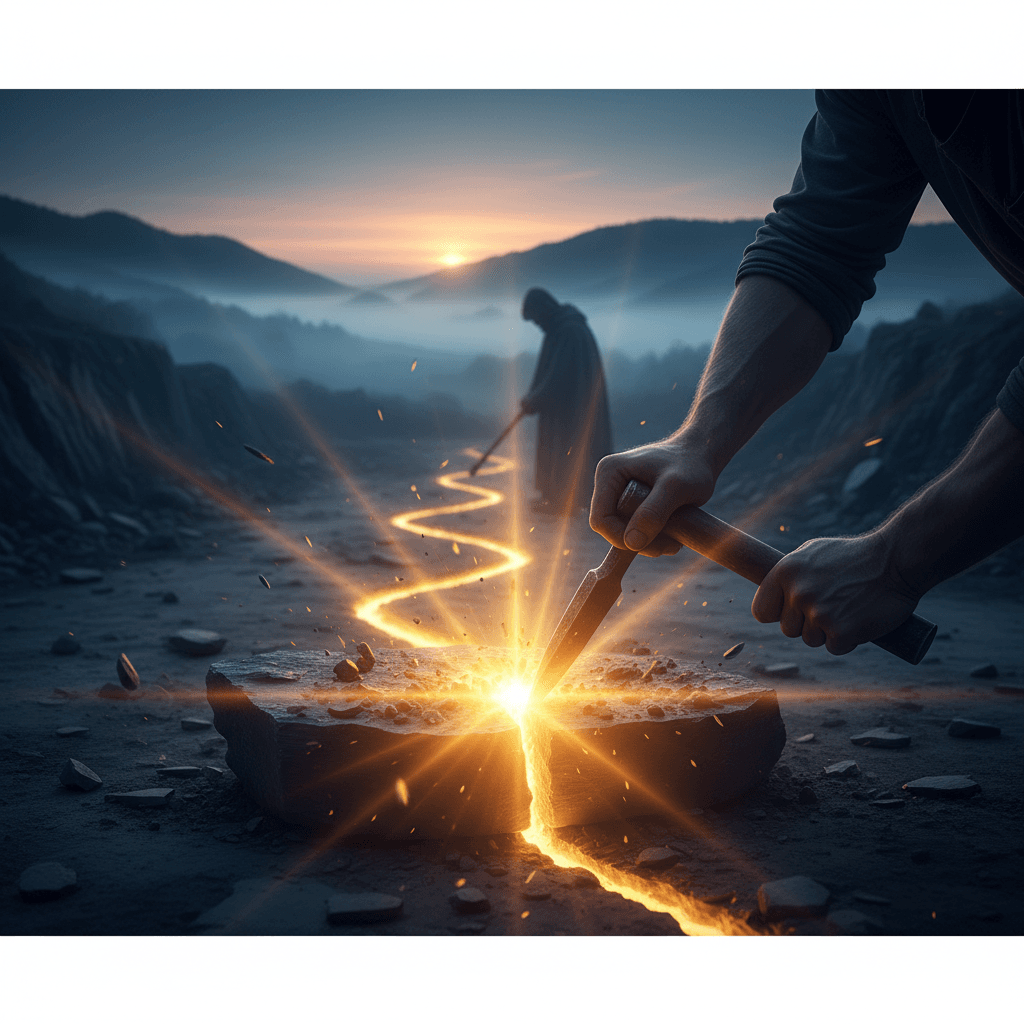
A hopeful mind carves possibilities from doubt like light from stone. — Pablo Picasso
—What lingers after this line?
The Metaphor of Light from Stone
Picasso’s image begins with an apparent contradiction: stone is opaque, yet he imagines light emerging from it. By pairing “doubt” with “stone,” he frames uncertainty as heavy, resistant material—something that does not yield easily. And yet the hopeful mind, rather than denying that hardness, treats it as raw substance. From there, the verb “carves” matters. Hope isn’t mere optimism; it’s an active force that shapes what seems immovable. In this view, possibility is not discovered like a hidden treasure but created through persistent, intentional effort applied to the most stubborn moments of indecision.
Hope as a Craft, Not a Mood
If carving is the central action, then hope resembles a practiced craft more than a fleeting feeling. The hopeful mind returns to the same block—revising, refining, and working around fractures—until form appears. That suggests disciplined attention: choosing the next small cut even when the final outcome is unclear. This shift is important because doubt often paralyzes. Yet, by treating doubt as workable material, hope reframes the situation: uncertainty becomes the very thing that gives effort direction. In other words, the obstacle supplies the contours that guide creation.
Creative Vision Under Constraint
The quote also implies that creativity thrives under constraint. Stone limits what can be made, just as doubt limits what feels immediately believable. Paradoxically, those limits can sharpen vision: when not everything is possible, the mind must choose what matters most and pursue it with clarity. This is where Picasso’s own artistic context feels relevant. Modern art repeatedly shows that innovation often comes from resisting easy answers—testing forms, breaking habits, and tolerating ambiguity. In that sense, doubt isn’t the enemy of imagination; it can be the pressure that gives imagination shape.
The Psychology of Possibility
Moving from art to inner life, the metaphor fits how people navigate uncertainty: a hopeful stance makes room for multiple future paths instead of collapsing into a single feared outcome. Rather than insisting on guaranteed success, hope keeps the mind flexible enough to search for alternatives. This flexibility is practical. When you can hold doubt without surrendering to it, you’re more likely to experiment, learn, and revise. Over time, those iterations produce real options—new skills, new relationships, new plans—so “possibilities” become less like fantasies and more like results of sustained engagement.
Resilience as Repeated Carving
Carving is slow, and that slowness hints at resilience. Hopeful thinking doesn’t erase setbacks; it absorbs them into the work. A chip in the stone becomes a feature to accommodate, and a wrong turn becomes information for the next attempt. This is how hope can coexist with realism. The hopeful mind acknowledges the weight of the material—failure, fear, doubt—yet continues shaping it. The light, then, isn’t naïve brightness; it’s the steady glow that emerges when persistence meets meaning.
Turning Doubt Into Direction
Finally, Picasso’s line suggests a subtle but powerful conclusion: doubt can be converted into direction. When you ask, “What if I can’t?” you can also ask, “What would make this possible?” That reframing doesn’t promise certainty; it offers a next step. In everyday terms, a hopeful mind looks at the same situation others call a dead end and begins sketching exits—small actions, incremental improvements, tentative experiments. Over time, those cuts accumulate, and what once felt like solid stone starts to show seams where light can enter.
One-minute reflection
What feeling does this quote bring up for you?
Related Quotes
6 selectedWhen hope feels small, fashion a tangible act of faith and watch it widen. — Pablo Picasso
Pablo Picasso
Picasso’s line begins with an honest admission: hope can feel small, not because we lack character, but because uncertainty compresses our imagination. When outcomes are unclear, the mind narrows to what seems immediatel...
Read full interpretation →Don't fight the challenges. Just find a new way to stand. — Germany Kent
Germany Kent
Germany Kent’s words begin with a quiet reversal of instinct: instead of treating every challenge as an enemy to defeat, she invites us to reconsider our posture toward difficulty. The emphasis is not on surrender, but o...
Read full interpretation →Optimist: someone who figures that taking a step backward after taking a step forward is not a disaster, it's more like a cha-cha. — Robert Brault
Robert Brault
Robert Brault’s line begins with a witty redefinition: an optimist is not someone who denies backward motion, but someone who interprets it differently. Instead of treating a setback as proof of failure, the optimist see...
Read full interpretation →A mind grows by staying with difficulty long enough for the experience to change it. — Mary Catherine Bateson
Mary Catherine Bateson
Mary Catherine Bateson’s observation begins with a quiet but demanding truth: the mind does not grow merely by encountering difficulty, but by remaining with it. Challenge becomes transformative only when we resist the u...
Read full interpretation →When you are friends with your storm, you dance, instead of getting blown away. — Michael Bassey Johnson
Michael Bassey Johnson
Michael Bassey Johnson’s line begins with a striking reversal: the storm is not merely an enemy to survive, but a force one can learn to understand. In this sense, the storm may represent grief, fear, conflict, uncertain...
Read full interpretation →Just because your light flickers does not mean it is about to go out. — Yohancé Salimu
Yohancé Salimu
At first glance, Yohancé Salimu’s line separates appearance from reality. A flicker suggests instability, fatigue, or interruption, yet it does not automatically signal extinction.
Read full interpretation →More From Author
More from Pablo Picasso →It is not the language of painters but the language of nature which one should listen to. — Pablo Picasso
At first glance, Picasso’s remark challenges the authority of artistic convention. By contrasting ‘the language of painters’ with ‘the language of nature,’ he suggests that art should not merely imitate established techn...
Read full interpretation →The chief enemy of creativity is good sense. — Pablo Picasso
At first glance, Picasso’s claim sounds like a provocation against reason itself. Yet his point is subtler: ‘good sense’ often means the habits, rules, and social expectations that keep people from taking imaginative ris...
Read full interpretation →The artist is a receptacle for emotions that come from all over the place: from the sky, from the earth, from a scrap of paper, from a passing shape, from a spider's web. — Pablo Picasso
At the heart of Picasso’s remark is a striking redefinition of creativity: the artist is not merely a maker, but a receiver. Rather than inventing emotion from nothing, the artist absorbs impressions that drift in from t...
Read full interpretation →Computers are useless. They can only give you answers. — Pablo Picasso
Pablo Picasso’s jab—“Computers are useless. They can only give you answers.”—is less a literal dismissal than a provocation about what humans value.
Read full interpretation →