
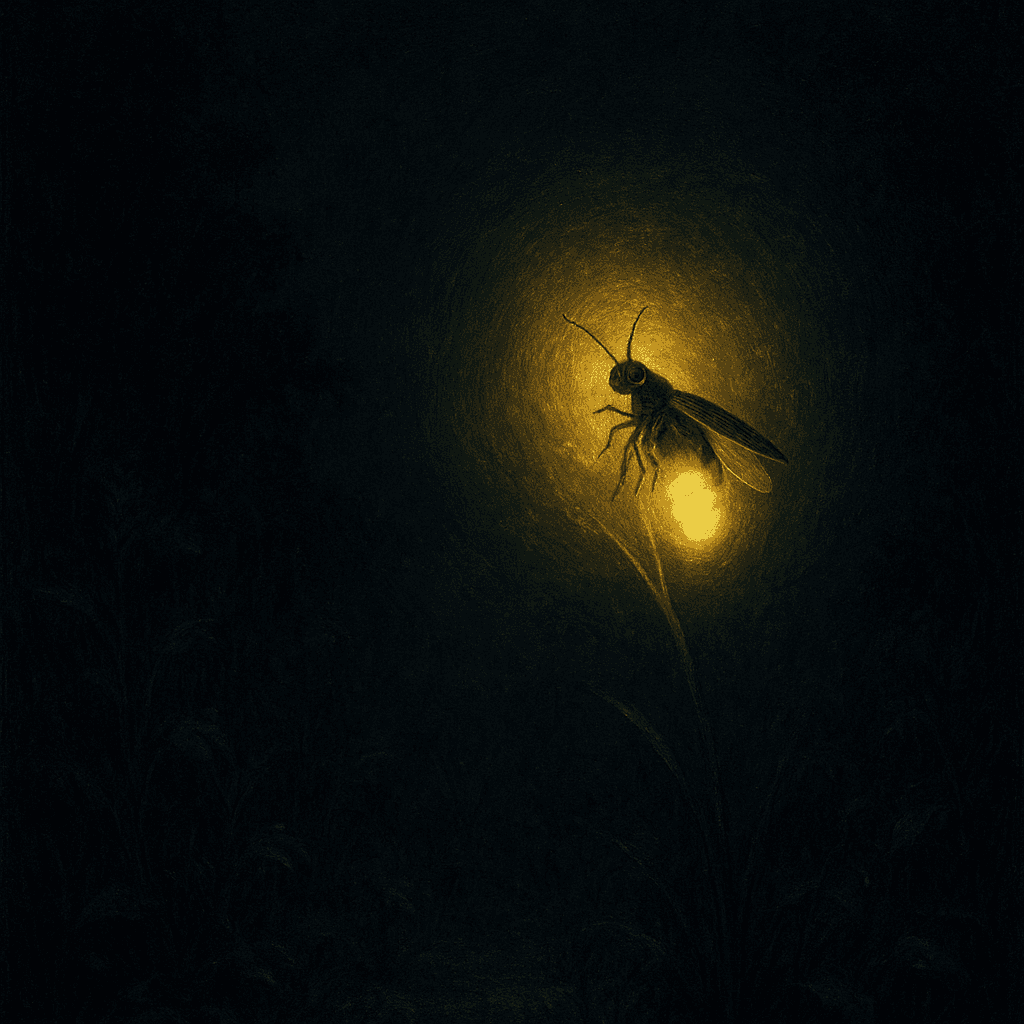
Glow fiercely like a firefly in the darkest night. — John Green
—What lingers after this line?
Symbolism of the Firefly's Glow
John Green’s evocative imagery encourages us to radiate our inner light even in the bleakest times, much like a firefly’s glow in the dark. A single firefly’s bioluminescence can pierce through the night, symbolizing hope and resilience. This metaphor suggests that even small acts of courage or kindness can have outsized impacts, illuminating spaces overwhelmed by gloom.
Courage in the Face of Adversity
Building upon this image, the ‘darkest night’ represents periods of hardship and uncertainty. History is replete with figures who, like the firefly, shone brightest when the world was shadowed. For instance, Anne Frank’s diary, written during the Holocaust, serves as a testament to human spirit persisting amid desolation. Just as fireflies need the night to reveal their brilliance, our moments of struggle can bring out our truest strengths.
Choosing to Stand Out
Transitioning from adversity to agency, Green’s quote invites us not merely to endure darkness but to actively ‘glow fiercely.’ This fierceness implies intentionality: choosing authenticity and optimism over fear or conformity. Like artists or activists who speak out for justice in repressive environments—think Maya Angelou’s poetic defiance—such choices light the way for others.
Inspiration for Community
Moreover, a firefly's glow is not just for itself; in nature, collective illumination can guide or attract entire communities. Similarly, when individuals bravely share their light, they inspire unity and hope in others. Martin Luther King Jr.’s leadership during the civil rights movement exemplifies how one person’s unwavering brightness can rally many, sparking lasting social change.
Embracing Your Unique Spark
Ultimately, Green’s metaphor celebrates personal uniqueness—the singular spark each of us carries. In a world that sometimes prefers shadows, daring to glow fiercely becomes a radical act of selfhood. As Ralph Waldo Emerson urged in his essays on self-reliance, “Do not go where the path may lead, go instead where there is no path and leave a trail.” Our individual radiance, no matter how modest, can help brighten the darkness for all.
Recommended Reading
As an Amazon Associate, we earn from qualifying purchases.
One-minute reflection
Why might this line matter today, not tomorrow?
Related Quotes
6 selectedThe light in me sees the light in you. — Marianne Williamson
Marianne Williamson
At its heart, Marianne Williamson’s line suggests that human connection begins with recognition rather than judgment. To say “the light in me sees the light in you” is to describe a meeting beneath personality, status, o...
Read full interpretation →It does not matter what you bear, but how you bear it. — Seneca
Seneca
At its heart, Seneca’s remark shifts attention away from suffering itself and toward character. Misfortune, pain, and limitation are often beyond human control, yet our response remains a moral choice.
Read full interpretation →Peace is not freedom from the storm, but peace amid the storm. — Martin Luther King Jr.
Martin Luther King Jr.
Martin Luther King Jr.’s words redefine peace as something deeper than comfort or calm surroundings. Rather than imagining peace as the total absence of conflict, pain, or uncertainty, he presents it as an inner steadine...
Read full interpretation →Yield and overcome, bend and be straight. — Lao Tzu
Lao Tzu
At first glance, Lao Tzu’s line seems contradictory: how can yielding lead to overcoming, or bending result in straightness? Yet this paradox lies at the heart of Taoist thought.
Read full interpretation →A blazing fire makes flame and brightness out of everything that is thrown into it. — Marcus Aurelius
Marcus Aurelius
Marcus Aurelius compresses a central Stoic lesson into a vivid image: a strong fire does not merely endure what is cast into it, but transforms it into more flame and light. In that sense, adversity is not just something...
Read full interpretation →Glow fiercely like a firefly in the darkest night. — John Green
John Green
John Green’s evocative metaphor places the firefly—a creature best known for lighting up the darkness—at the heart of his message. The tiny insect, whose bioluminescence cuts through the night, becomes a symbol of hope,...
Read full interpretation →More From Author
More from John Green →There is hope, even when your brain tells you there isn't. — John Green
John Green’s line begins by acknowledging a familiar conflict: the mind can deliver convincing arguments for despair, yet hope can still exist alongside them. Rather than treating hope as a naïve feeling, he frames it as...
Read full interpretation →What's the point of being alive if you don't at least try to do something remarkable? — John Green
This quote questions the significance of life and urges individuals to seek a meaningful existence. It suggests that simply living is not enough; one must strive to achieve something noteworthy.
Read full interpretation →Those who do not understand true pain can never understand true joy. — John Green
This quote conveys that pain and joy are deeply connected experiences. Without going through significant sorrow or hardship, it may be impossible to fully appreciate moments of profound happiness.
Read full interpretation →In the face of impossible odds, people who love adventure will always find a way. — John Green
This quote highlights the power of resilience and determination. Those who have a passion for adventure are not easily discouraged by challenges; instead, they use obstacles as motivation to push forward.
Read full interpretation →