
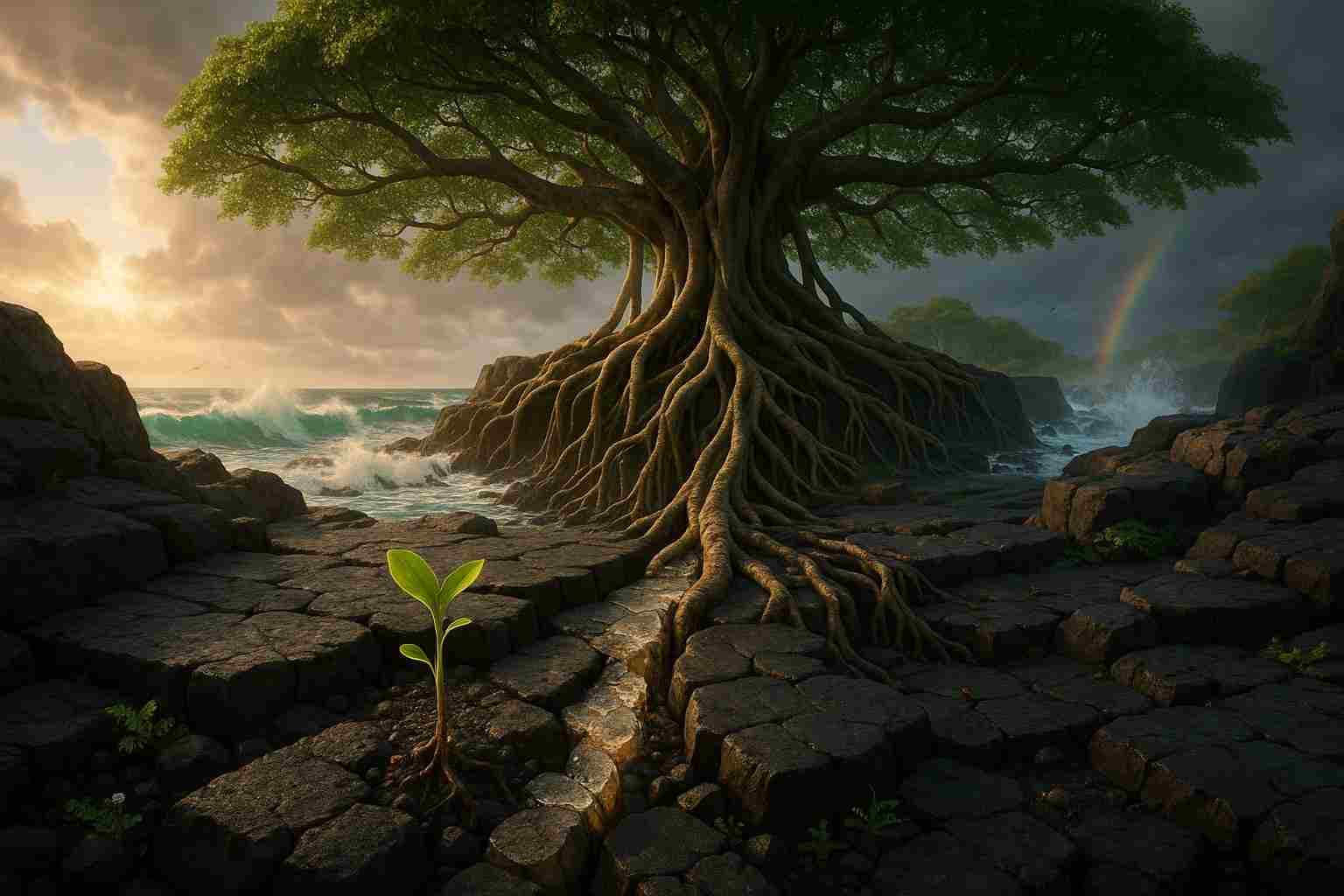
It is in the acts of facing what is hard that we discover how wide we can grow. — Toni Morrison
—What lingers after this line?
Understanding Morrison's "wide" growth
At the outset, Morrison's line insists that growth is not a vertical ladder but a widening—an enlargement of empathy, skill, and imagination. By saying "acts," she foregrounds repetition: courage is a practice, not a one-off epiphany. Facing what is hard might be grief, accountability, craft, or a new language; in doing so, we gain breadth. This redefinition resists narrow metrics of success—titles, ranks—and relocates worth in the capacity to hold more of life without breaking. With that frame in place, we can see how older traditions anticipated her insight.
Philosophical threads of confronting difficulty
Historically, philosophers argued that difficulty discloses character. Epictetus's Enchiridion (c. 125 CE) notes that trials reveal who we are; Nietzsche's Twilight of the Idols (1888) compresses it to "what does not kill me..." Meanwhile, James Baldwin warned, "Not everything that is faced can be changed, but nothing can be changed until it is faced" (1962). These claims converge on Morrison's "acts": confrontation is a creative force. Yet intuition benefits from evidence, so we turn to psychology's account of why facing hardship can widen us.
Psychological mechanisms behind courage
Psychologically, two lines of research illuminate Morrison's point. Carol Dweck's growth mindset work (2006) shows that viewing ability as developable increases persistence when tasks are hard. Complementing this, post-traumatic growth research by Tedeschi and Calhoun (1996) documents how grappling with adversity can enlarge appreciation, relationships, and life philosophy. Even in therapy, exposure protocols (Foa & Kozak, 1986) help patients gently face feared stimuli, shrinking anxiety's radius. Taken together, they suggest that calibrated encounters with difficulty remodel our nervous systems and narratives. This science invites a practical question: How, day to day, do we stage such encounters without collapsing?
Everyday practices that expand capacity
From theory to practice, width grows through small, repeatable challenges. Deliberate practice research (Ericsson, Krampe, & Tesch-Romer, 1993; Ericsson & Pool, 2016) shows that targeted struggle at the edge of competence builds capacity. Micro-acts—speaking up once in a meeting, running one hill repeat, attempting a difficult passage on an instrument—teach the body that strain is survivable. Crucially, reflection converts pain into progress: brief journals, mentoring conversations, or after-action reviews translate effort into learning. This personal craft prepares us to recognize Morrison's vision in her own art.
Morrison's fiction as a living laboratory
In Morrison's Beloved (1987), Sethe's decision to name and confront her "rememory" initiates a risky, widening reckoning; as stories surface, the community's capacity to witness expands. Likewise, Milkman in Song of Solomon (1977) grows only when he faces his family's history, traveling into difficult truths that enlarge his sense of self and kinship. By contrast, The Bluest Eye (1970) shows the cost of avoidance: unfaced pain narrows perception until it crushes Pecola. Through these narratives, Morrison dramatizes how acts of facing—however imperfect—create room for more life. That room is not merely private; it has civic contours.
Communities that grow by facing truths
Collectively, societies grow wide when they face hard histories. South Africa's Truth and Reconciliation Commission (1996) staged public testimony to widen the nation's moral imagination beyond denial. Germany's ongoing Vergangenheitsbewaeltigung—working through the past—illustrates how institutions and curricula can confront atrocity to cultivate democratic guardrails. Even local truth projects about redlining or school segregation expand communal empathy and policy options. Such examples echo Morrison's insistence that width is built through enacted courage, not slogans. This returns us to the ethical habits that sustain the work.
Making width a daily discipline
Finally, making width a daily discipline means designing for courageous contact with difficulty. Rituals of reflection, structured discomfort (stretch assignments, feedback circles), community support, and real rest form a sustainable cycle: face, feel, make meaning, recover. Over time, the horizon moves; what once felt unthinkable becomes Tuesday. In that steady expansion, Morrison's sentence proves descriptive rather than aspirational: it is in the acts of facing what is hard that we discover how wide we can grow—and how wide a community we can welcome.
One-minute reflection
What's one small action this suggests?
Related Quotes
6 selectedThe ability to endure is the discipline of the soul. — Toni Morrison
Toni Morrison
Toni Morrison’s line shifts endurance from a mere survival trait into a deliberate inner practice: a discipline cultivated in the soul. Rather than glorifying pain for its own sake, she suggests that the capacity to cont...
Read full interpretation →Consistency is a superpower. — Ryan Holiday
Ryan Holiday’s line begins with a deceptively simple idea: greatness is rarely built through dramatic gestures. More often, it emerges from repeated actions that seem ordinary in isolation but become extraordinary over t...
Read full interpretation →Just because your light flickers does not mean it is about to go out. — Yohancé Salimu
Yohancé Salimu
At first glance, Yohancé Salimu’s line separates appearance from reality. A flicker suggests instability, fatigue, or interruption, yet it does not automatically signal extinction.
Read full interpretation →Confidence is silent. Insecurities are loud. — Unknown (Wait—skip/replace with: True nobility is being superior to your former self. — Ernest Hemingway)
Ernest Hemingway
At its core, Hemingway’s line redefines nobility as an inward achievement rather than a social rank. Instead of measuring worth by wealth, pedigree, or dominance over others, it points to a quieter standard: becoming bet...
Read full interpretation →When something in your life dies—whether it be a job, a hobby, or a dream—I encourage you not to focus on what could have been but instead to look for the new life and the new opportunities that result. — Ryan Hall
Ryan Hall
Ryan Hall frames loss as a kind of death, and that metaphor immediately broadens the quote beyond grief in the literal sense. A job can end, a cherished hobby can fade, and a long-held dream can collapse; yet in each cas...
Read full interpretation →Dreams are made of sturdy stuff. — William Carlos Williams
William Carlos Williams
At first glance, William Carlos Williams’s line reverses a familiar assumption: dreams are often treated as airy, fleeting, and insubstantial, yet he insists they are made of “sturdy stuff.” In that compact phrase, he gi...
Read full interpretation →More From Author
More from Toni Morrison →The building of the architecture of a novel - the craft of it - is something I never tire of. — Toni Morrison
At its core, Toni Morrison’s remark celebrates not merely storytelling, but the deliberate construction behind it. By speaking of the “architecture of a novel,” she shifts attention from inspiration alone to design, sugg...
Read full interpretation →The role of art has never been to escape reality, but to help us understand it. — Toni Morrison
At first glance, art is often treated as a refuge from hardship, a private world where pain can be softened or forgotten. Toni Morrison overturns that expectation by arguing that art’s deeper purpose is not avoidance but...
Read full interpretation →The ability to endure is the discipline of the soul. — Toni Morrison
Toni Morrison’s line shifts endurance from a mere survival trait into a deliberate inner practice: a discipline cultivated in the soul. Rather than glorifying pain for its own sake, she suggests that the capacity to cont...
Read full interpretation →You are your best thing. — Toni Morrison
Toni Morrison’s line, “You are your best thing,” quietly overturns a common habit: looking outward for proof of worth. Instead of treating love, status, or achievement as the final measure, the quote plants value inside...
Read full interpretation →