
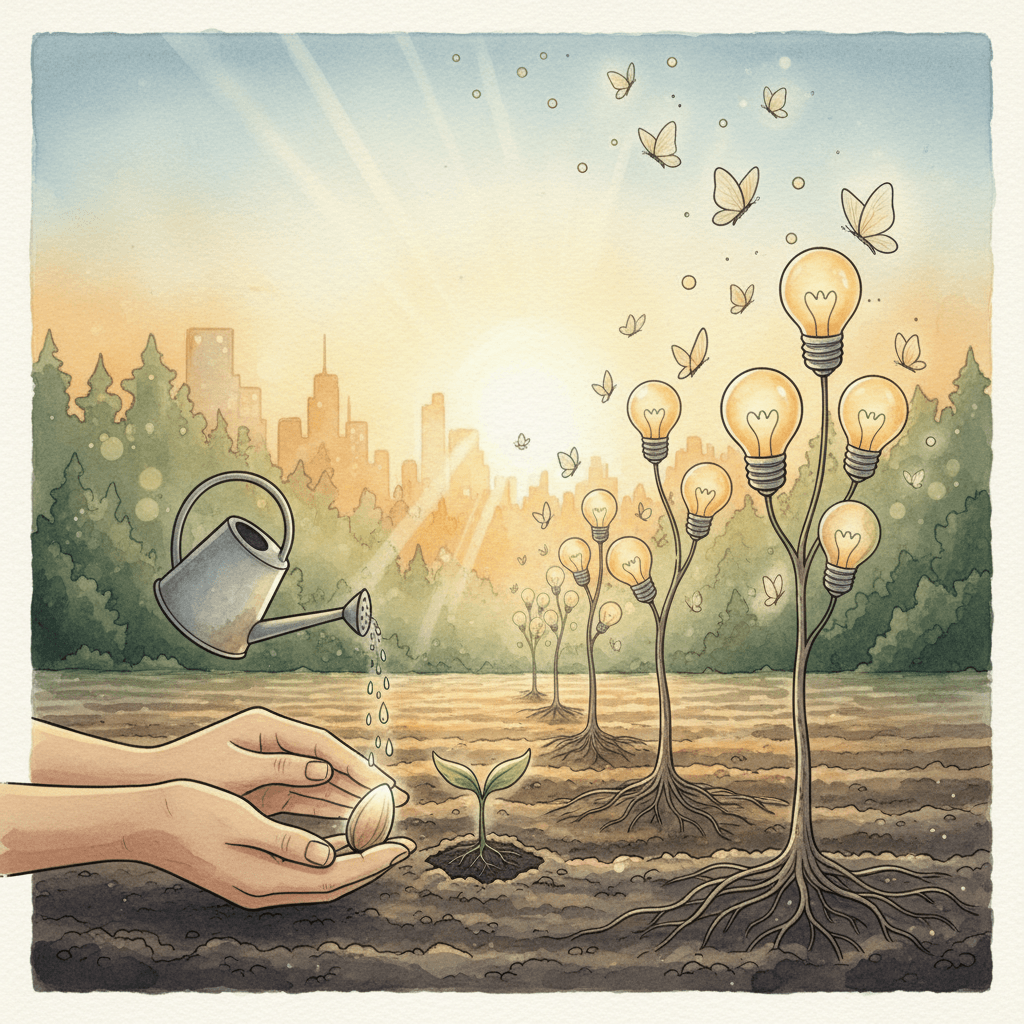
When you plant an idea in honest soil and nurture it, change becomes inevitable — Malala Yousafzai
—What lingers after this line?
A Seed, a Soil, a Promise
Malala Yousafzai’s image invites us to picture an idea as a seed, small yet potent. Planted in honest soil, it draws strength from truth the way roots draw nutrients, and with care it grows beyond its first fragile shoot. The metaphor is agricultural, but its implications are civic and personal: integrity in the ground, patience in the gardener, and transformation in the harvest. Because seeds do not sprout overnight, the promise is gradual rather than explosive. Still, if the soil is right and the tending is steady, growth proceeds from unseen germination to visible change, reminding us that inevitability is not haste but persistence.
Honesty as the Fertile Ground
Honest soil suggests conditions where facts, trust, and accountability prevail. Such environments help ideas anchor deeply, avoiding the shallow roots that fail under scrutiny. Gandhi’s ethic of satyagraha—truth-force—demonstrated how ideas grounded in reality can outlast coercion, while Martin Luther King Jr.’s Letter from Birmingham Jail (1963) appealed to moral clarity to reframe public conscience. When communities value verification over rumor and candor over expedience, they provide the nutrients that keep ideas from withering in cynicism. In this way, truth serves not only as a moral principle but as a growth medium.
Nurture Through Education and Dialogue
Nurture, in Yousafzai’s world, means education, conversation, and courage. Her memoir, I Am Malala (2013), recounts how classrooms can be greenhouses for possibility, especially for girls denied learning. Dialogue—between teachers and students, families and institutions—acts like careful watering, preventing both drought (silence) and flood (noise). Paulo Freire’s Pedagogy of the Oppressed (1970) echoes this: education is not the mere transfer of facts but the cultivation of critical thought. As learners question, connect, and create, an idea thickens its stem, readying itself to withstand storms.
From Sprout to Movement: How Ideas Spread
Once rooted, ideas propagate along social networks. Everett Rogers’s Diffusion of Innovations (1962) describes how early adopters, then the early majority, normalize the new until a tipping point is reached. Mark Granovetter’s threshold models (1978) show how individual decisions cascade into collective shifts when enough neighbors change. Storytelling accelerates this journey, turning abstract notions into lived narratives. Thus a sprout becomes a hedge, and then a forest—incremental growth that suddenly looks like overnight change.
Resilience Against Resistance
Honest ideas often face pruning—censorship, discrediting, or fatigue. Yet integrity confers resilience. Rachel Carson’s Silent Spring (1962) endured fierce pushback but seeded modern environmentalism by resting on meticulous evidence. Likewise, samizdat writings in the Soviet era circulated truths quietly, showing how roots can spread even under concrete. Resistance may slow the canopy, but it also compels deeper rooting. The more carefully an idea is examined and vindicated, the harder it becomes to uproot.
Creating Conditions Where Growth Is Likely
To make change predictable rather than accidental, gardeners of ideas build ecosystems: transparent data, plural voices, and feedback loops. Small wins—pilot projects, prototypes, local proofs—act like trellises, guiding growth upward and inviting wider participation. Over time, institutions adopt what communities have already tested in practice. Thus, cultivation is collective. Mentors, allies, and critics each provide different nutrients, ensuring robustness rather than fragility.
Time, Patience, and the Harvest of Change
Finally, inevitability operates on the clock of seasons, not seconds. Farmers know to watch the weather, prune at the right moment, and trust the slow chemistry of soil and sun. Likewise, meaningful transformation matures through cycles of learning and correction. By planting in honesty and tending with care, we set in motion a process that, given time, bears fruit. What begins as an idea ends as a landscape—changed not by force, but by growth.
One-minute reflection
What's one small action this suggests?
Related Quotes
6 selectedReal integrity is doing the right thing, knowing that nobody's going to know whether you did it or not. — Oprah Winfrey
Oprah Winfrey
At its core, Oprah Winfrey’s remark defines integrity as an inner standard rather than a public performance. Doing the right thing when no recognition is possible strips away applause, reputation, and reward, leaving onl...
Read full interpretation →Plant ideas like seeds and tend them with action until forests of change grow — Marie Curie
Marie Curie
Marie Curie’s metaphor treats ideas not as static thoughts but as living seeds—small, vulnerable, and full of latent potential. A seed contains an entire future, yet it remains invisible until it meets the right conditio...
Read full interpretation →Stop expecting honesty from people who lie to themselves. — Steven Bartlett
Steven Bartlett
Steven Bartlett’s line draws a boundary around what “honesty” can realistically mean. If someone cannot face the truth about their own motives, behavior, or feelings, then any promise of transparency to others is unstabl...
Read full interpretation →Honest effort blooms into a reputation; tend both with care. — Confucius
Confucius
Confucius frames honest effort as something organic: it “blooms,” as if diligence were a seed that can become visible, recognizable growth. The word “honest” matters here, because he is not praising mere busyness or ambi...
Read full interpretation →Start with one honest gesture and the world will learn to answer. — Langston Hughes
Langston Hughes
Langston Hughes frames honesty not as a grand manifesto but as a single, deliberate gesture—something concrete enough to attempt today. The line implies that integrity is contagious: once it appears in the open, it chang...
Read full interpretation →Begin with a single honest gesture and watch the horizon change its shape. — Octavio Paz
Octavio Paz
Octavio Paz’s line invites us to linger on the word “begin.” Rather than demanding a grand transformation, he calls for a single, honest gesture—a small, concrete act that nonetheless carries immense weight. This framing...
Read full interpretation →More From Author
More from Malala Yousafzai →Stand firm in tenderness; strength without compassion narrows the soul. — Malala Yousafzai
Malala Yousafzai’s line reframes tenderness not as softness, but as a disciplined stance—something you “stand firm” in. In other words, compassion is not a mood that comes and goes; it is a choice that can hold steady un...
Read full interpretation →Let your questions be louder than your fears. — Malala Yousafzai
Malala Yousafzai’s line hinges on a simple but powerful metaphor: fears and questions both speak inside us, yet we can choose which one gets the microphone. Rather than pretending fear doesn’t exist, she implies it will...
Read full interpretation →Let your voice be the river that nourishes the valleys of doubt — Malala Yousafzai
Malala Yousafzai’s line turns “voice” into something living and vital: a river that continuously moves, carries, and gives. Rather than portraying speech as a single act—one speech, one post, one declaration—she frames i...
Read full interpretation →Stand where your heart points, even if the road is less traveled. — Malala Yousafzai
Malala Yousafzai’s line treats the heart not as a fickle impulse but as a moral compass—an inner pointer toward what feels true and necessary. To “stand” where it points suggests steadiness: not merely choosing once, but...
Read full interpretation →