
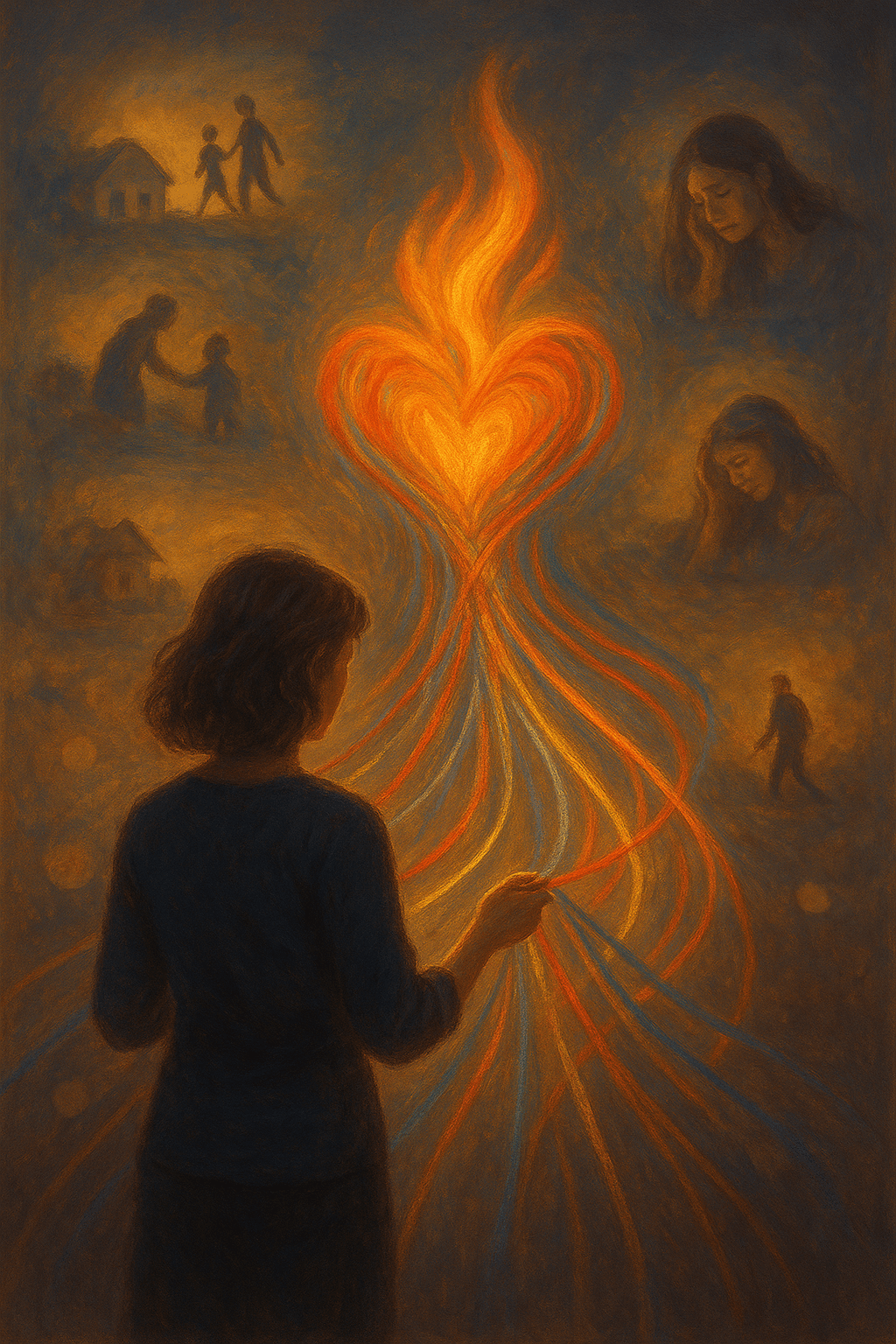
Gather the threads of your days and weave them into something fierce and kind. — Alice Walker
—What lingers after this line?
Seeing Each Day as a Thread
Alice Walker’s image invites us to imagine every day as a single strand of fiber—fragile on its own, yet full of potential when joined with others. Moments of joy, boredom, conflict, and rest all become threads in this metaphorical basket. Rather than dismissing the ordinary, the quote urges us to notice it: conversations over breakfast, late-night worries, acts of care, and even our mistakes are material. In this way, nothing is wasted; everything can be gathered and used. The simple act of “gathering” suggests paying attention, as if we are bending down to pick up dropped strands so that our lives are not scattered but held in our hands with intention.
The Art and Labor of Weaving
From gathering, Walker moves to “weave,” evoking an ancient, often overlooked craft associated with patience, repetition, and skill. Weaving is slow work; it requires returning to the same loom, the same threads, again and again. This parallels how we shape character: not with one grand gesture, but with repeated choices over time. Like a weaver adjusting tension to keep cloth from tearing or sagging, we continually recalibrate our responses to the world. The metaphor also honors domestic and communal labor, recalling how many cultures used weaving circles as spaces of storytelling and resistance, where ordinary work became a site of quiet power.
Understanding Fierceness as Moral Courage
Crucially, Walker does not ask us to weave something merely pretty or comfortable; she calls for something “fierce.” Here, fierceness is not cruelty but moral courage: the willingness to stand up, speak out, and protect what matters. In her novel *The Color Purple* (1982), characters discover a fierce inner voice that had long been silenced, transforming their sense of worth and agency. In the quote, that same fierceness is envisioned as a woven garment or banner we can wear into the world. It represents resolve—born from every hard lesson we’ve lived through—to no longer be passive in the face of injustice or self-betrayal.
Kindness as the Essential Counterweight
Yet fierceness alone can become sharp and wounding, so Walker pairs it deliberately with “kind.” This pairing suggests that true strength must be softened and guided by compassion. To weave a life that is both fierce and kind is to hold boundaries while still seeing the humanity in others, including those who harm us. Writers from the Buddha to Martin Luther King Jr. have echoed this dual demand: oppose oppression, but refuse to dehumanize. In practice, this might mean confronting a harmful comment without humiliating the speaker, or advocating for yourself without abandoning empathy. Kindness, then, is not weakness but precision—it directs our fierceness toward healing rather than domination.
Transforming Experience Into Intentional Living
When we put these elements together, the quote becomes a blueprint for intentional living. Instead of letting days fray and drift, we gather them; instead of piling them up unshaped, we weave; instead of defaulting to numbness or aggression, we aim for a combination of courage and care. Over time, this practice turns random experiences into a coherent pattern—a life that tells a story we can stand behind. Moreover, it suggests that even painful or chaotic strands need not be hidden. Like master weavers who integrate darker threads to deepen the beauty of a tapestry, we can incorporate our struggles into a design that is both resilient and gentle, fierce and kind.
Everyday Practices of Fierce, Kind Weaving
Finally, Walker’s metaphor becomes concrete in daily habits. Reflective journaling, for instance, gathers the threads of a day, making feelings and choices visible. Setting small, values-driven intentions—such as “speak honestly,” “listen fully,” or “show mercy”—guides how we weave those threads together. Acts of solidarity, whether defending a colleague or volunteering locally, express fierceness, while checking in on a struggling friend or forgiving a minor slight cultivates kindness. Over weeks and years, these small gestures interlace into a pattern recognizable as our character. The quote thus offers both invitation and reassurance: we do not need perfect days, only the willingness to keep gathering and weaving, strand by strand.
One-minute reflection
Where does this idea show up in your life right now?
Related Quotes
6 selectedFamily is not just a place we come from, but a sanctuary we build every day through the small, intentional acts of kindness we offer one another. — Daisaku Ikeda
Daisaku Ikeda
At first glance, Ikeda’s quote gently shifts the meaning of family away from mere ancestry or birthplace. He suggests that family is not defined only by bloodlines or shared history, but by what people actively create to...
Read full interpretation →Boundaries do not make you less kind; they make you more capable of being kind without resentment. — Brené Brown
Brené Brown
At first glance, Brené Brown’s quote challenges a common assumption that kindness means endless availability. Instead, she reframes boundaries as the structure that allows generosity to remain sincere rather than forced.
Read full interpretation →You don't have to be a billionaire to believe you can make a difference. Give your time, give your love, or simply give a smile. — Steve Goodier
Steve Goodier
At its core, Steve Goodier’s quote challenges the idea that influence belongs only to the wealthy or powerful. By placing time, love, and even a smile alongside money, he broadens generosity into something almost anyone...
Read full interpretation →We must all do what we can to help one another. — Jane Austen
Jane Austen
At first glance, Jane Austen’s line sounds modest, yet its moral force is striking: each person carries some responsibility for the well-being of others. The phrase “what we can” is especially important, because it does...
Read full interpretation →You can be a good person with a kind heart and still say no to people. — Tracy A. Malone
Tracy A. Malone
At its core, Tracy A. Malone’s quote challenges the mistaken belief that kindness requires constant availability.
Read full interpretation →To be kind to all, to like many and love a few, to be needed and wanted by those we love, is certainly the nearest we can come to happiness. — Mary Stuart
Mary Stuart
Mary Stuart frames happiness not as wealth, fame, or private achievement, but as a pattern of human connection. At the center of her thought is a layered vision: kindness extended broadly, affection shared generously, lo...
Read full interpretation →More From Author
More from Alice Walker →The most beautiful things are those that take time to grow, requiring a commitment to the process rather than a hunger for the end. — Alice Walker
Alice Walker’s reflection shifts beauty away from instant results and toward slow formation. At its heart, the quote suggests that what becomes truly beautiful does so through time, care, and endurance rather than speed...
Read full interpretation →Hard times require furious dancing. Each of us is the proof. — Alice Walker
Alice Walker’s line treats “hard times” not as a cue for silence, but as a summons to movement. The phrase “furious dancing” reads like an intentional contradiction—how can joy or art survive suffering?
Read full interpretation →The most common way people give up their power is by thinking they don't have any. — Alice Walker
Alice Walker’s line points to a paradox: people often lose power not through force, but through a belief that power was never theirs to begin with. That assumption quietly reshapes behavior—choices narrow, risks feel poi...
Read full interpretation →In an age of speed, I began to think nothing is as precious as slowness. — Alice Walker
Alice Walker’s line begins with a modern assumption—life is accelerating—and then performs a quiet reversal: the rarer something becomes, the more it is worth. In an age that prizes quick replies, rapid production, and c...
Read full interpretation →