
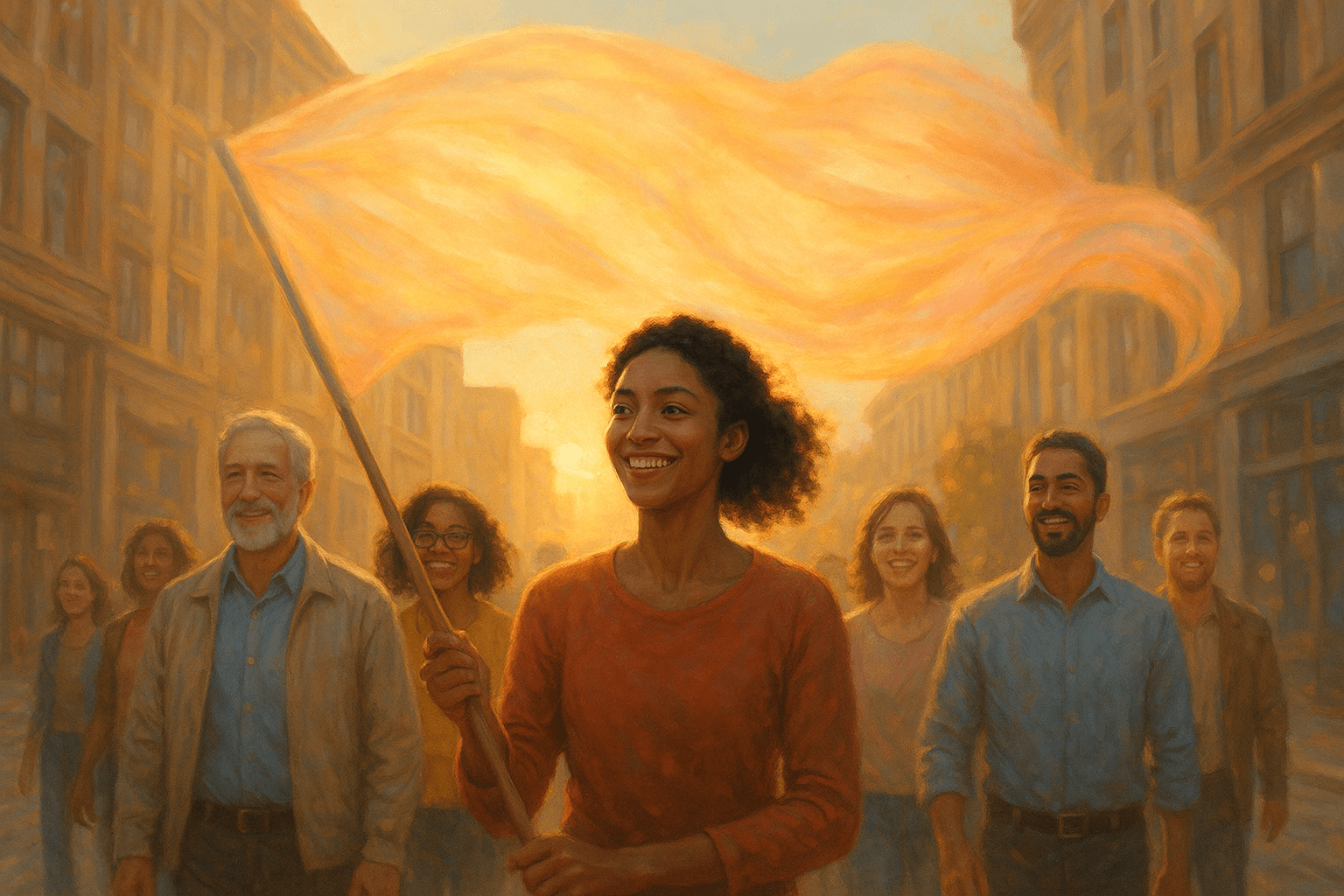
Carry your kindness like a banner into the streets. — Kahlil Gibran
—What lingers after this line?
The Image of a Banner
Gibran’s metaphor of carrying kindness like a banner immediately evokes visibility, courage, and declaration. A banner is not tucked away; it is raised high, meant to be seen from afar. By pairing kindness with this image, he suggests that compassion should not remain a private sentiment or a quiet thought but something we are willing to display openly. In this sense, kindness becomes less an occasional act and more a defining emblem of identity. Thus, the quote nudges us to consider what we are known for in public: is it our ambition, our opinions, or, as Gibran urges, our consistent gentleness toward others?
From Private Virtue to Public Practice
Moving from imagery to action, the streets in Gibran’s line symbolize the shared spaces where diverse lives intersect: markets, workplaces, buses, and digital forums. It is relatively easy to be kind in intimate circles or in the privacy of our thoughts, yet far more challenging to extend that same spirit to strangers or adversaries. By specifying “into the streets,” Gibran redirects kindness from the realm of intention into the arena of lived practice. Like the Good Samaritan parable in the Gospel of Luke (c. 1st century CE), the quote insists that genuine care is proven not in theory but in concrete encounters with those beyond our familiar circles.
Courage and Vulnerability in Visible Kindness
However, raising any banner also exposes the bearer. Public kindness can be misunderstood as naivety, weakness, or even hypocrisy, making some people hesitant to display it. Gibran’s wording subtly acknowledges this risk: to carry kindness openly demands courage, because it rejects cynicism as a shield. Psychologist Brené Brown’s work on vulnerability (2012) shows that choosing openness in a skeptical world is an act of strength, not fragility. In this light, the quote calls for a bravery that refuses to let fear of mockery or exploitation silence compassionate action. Kindness becomes a deliberate stance rather than a convenient mood.
Kindness as a Contagious Social Signal
Once raised, a banner acts as a signal to others, gathering people and setting a tone. In the same way, visible acts of kindness influence social norms. Studies on prosocial behavior, such as those by Nicholas Christakis and James Fowler (2010), show that generosity and cooperation tend to ripple through social networks, inspiring similar behavior in observers. Therefore, when kindness is carried “into the streets,” it not only benefits its immediate recipient but also reshapes the moral climate around it. Over time, these small, public gestures can normalize empathy in places where indifference or hostility once prevailed.
Transforming Everyday Encounters
Ultimately, Gibran’s exhortation is less about grand heroic deeds and more about transforming the mundane. Streets are ordinary spaces: we pass people we may never see again. Yet it is precisely here that choosing a kind word, a patient response, or a helping hand can alter the trajectory of someone’s day. Literature from Victor Hugo’s *Les Misérables* (1862) to contemporary urban narratives shows how brief encounters can bear surprising moral weight. By imagining kindness as a banner we always carry, the quote encourages us to treat every crossing of paths as an opportunity to embody the values we claim to cherish, thereby stitching small threads of goodness into the fabric of daily life.
One-minute reflection
What's one small action this suggests?
Related Quotes
6 selectedSpeak with kindness, act with conviction, and the world listens back. — Kahlil Gibran
Kahlil Gibran
Gibran’s line links three elements—kindness, conviction, and response—into a quiet theory of influence. He implies that people don’t listen merely because someone is loud or clever; they listen when the speaker’s tone lo...
Read full interpretation →Measure your worth by the kindness you return, not by the applause you gather. — Kahlil Gibran
Kahlil Gibran
Kahlil Gibran’s insight invites a quiet but radical shift: from living for the world’s reaction to living for the good we do within it. Instead of tallying praise, followers, or public recognition, he suggests we look in...
Read full interpretation →Plant words of kindness; harvest a field of courage. — Kahlil Gibran
Kahlil Gibran
Kahlil Gibran’s image of planting words of kindness treats language as a living seed rather than a fleeting sound. Every remark, encouragement, or gentle reply enters the hidden soil of another person’s inner life, where...
Read full interpretation →Plant your truth in the soil of kindness and it will feed the world. — Kahlil Gibran
Kahlil Gibran
At the outset, Gibran’s image turns truth into a seed: potent, yet dependent on the soil that receives it. He suggests that facts or convictions, when rooted in kindness, gain the conditions to germinate rather than boun...
Read full interpretation →In a world where you can be anything, be kind.
Unknown
The message highlights the vast array of possibilities available in today's world. With numerous paths and opportunities, kindness is suggested as a fundamental and powerful choice.
Read full interpretation →Throw kindness around like confetti. — Unknown
Unknown
This quote encourages individuals to be generous with their acts of kindness, distributing them freely and abundantly just as one would scatter confetti at a celebration.
Read full interpretation →More From Author
More from Kahlil Gibran →Your home is your larger body. It grows in the sun and sleeps in the stillness of the night. — Kahlil Gibran
At first glance, Gibran transforms the idea of home from a mere structure into something intimate and organic: “your larger body.” In this image, a dwelling is not separate from the person who inhabits it, but an outward...
Read full interpretation →March on. Do not tarry. To go forward is to move toward perfection. — Kahlil Gibran
Gibran’s opening imperative—“March on. Do not tarry.”—sets a tone of disciplined urgency.
Read full interpretation →There must be spaces in your togetherness, and let the winds of the heavens dance between you. — Kahlil Gibran
Gibran’s line opens with a gentle paradox: he speaks to people who are already “together,” yet insists that togetherness is healthiest when it includes room. Rather than portraying love as fusion, he frames it as a relat...
Read full interpretation →Our anxiety does not come from thinking about the future, but from wanting to control it. — Kahlil Gibran
Kahlil Gibran reframes anxiety as something more specific than mere anticipation. The future itself—uncertain, unfolding, and not yet real—doesn’t automatically distress us; rather, distress appears when we demand certai...
Read full interpretation →